








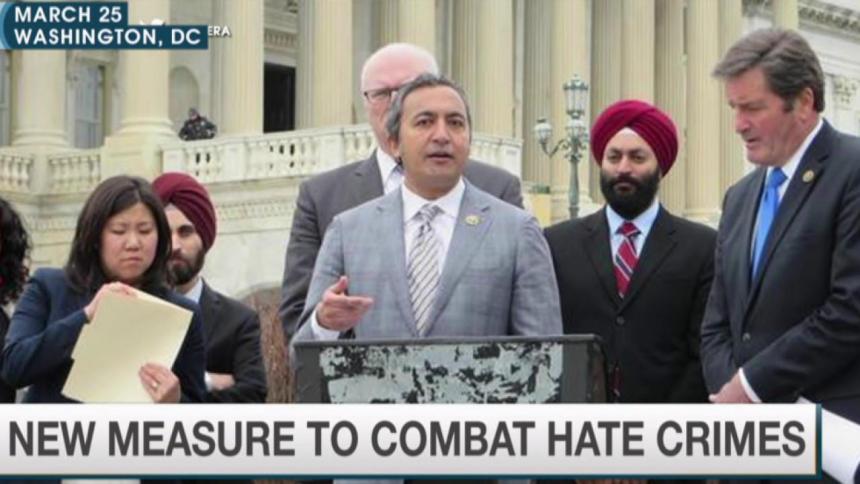
For the first time since announcing in 2013 it would begin tracking hate crimes against Sikh, Hindu, and Arab American communities, the Department of Justice has updated its hate crimes training manual to include sections dedicated to identifying crimes against South Asian and Arab victims and witnesses.
The FBI Hate Crime Data Collection Guidelines and Training Manual “is designed to assist law enforcement with collecting and submitting data on bias-motivated offenses to the FBI’s Uniform Crime Reporting (UCR) Program” across the country, and was recently updated with the help of Sikh advocacy and civil rights groups. The manual now also includes guidelines on distinguishing between anti-Arab, anti-Hindu, anti-Muslim, and anti-Sikh hate crimes.
In a statement released Thursday, Jasjit Singh, executive director of the Sikh American Legal Defense and Education Fund (SALDEF), praised the DOJ’s efforts to accurately and effectively document hate crimes as “an important step that will ultimately aid the Sikh community as we continue to address the roots of anti-Sikh bias.”
Proud to join w/ my colleagues & advocates to applaud new system to combat hate crimes → http://t.co/KggeYRzcFP pic.twitter.com/gw854XuKVi
— Congressman Ami Bera (@RepBera) March 26, 2015Singh added, “Sikh, Muslim, Hindu, South Asian, and Arab Americans have disproportionately faced senseless violence motivated by hate in recent years. We look forward to continuing our work with the FBI to ensure law enforcement is addressing the Sikh community’s needs.”
Singh joined six lawmakers in Washington, D.C., on Wednesday to celebrate the progress and call for nationwide support of the DOJ’s efforts. “Religious tolerance is a fundamental value of our nation and we must do everything we can to prevent these crimes motivated by bias against a victim’s religious beliefs,” California Rep. Ami Bera, the House’s only Indian-American congressman, said. “I’ve been calling for these steps since I got to Congress because they’re important to confronting hatred and increasing public awareness about the crimes committed against often-targeted people. This is a big win for these communities, and a huge win for justice.”
The push for the DOJ to track hate crimes more accurately gained momentum in 2012 after a mass shooting at a Sikh temple in Oak Creek, Wisconsin, that killed six people. Until the recent release of the updated FBI manual, violence against Sikhs were classified as “anti-Islamic.” RELATED: Sikh professor survives hate attack, ‘This is not the Harlem I know’ But in a New York Times op-ed, Simran Jeet Singh, senior religion fellow for The Sikh Coalition, argued that the mis-classification of anti-Sikh violence made the assumption that all violence targeted at Sikhs were simply a case of “mistaken identity.” As a result, there has been little recognition of the history of discrimination against Sikhs in America, and therefore little effort to find ways to address the problem. With the news of the updated manual this week, Singh says he and members of The Sikh Coalition are hopeful. “Overall, we are pleased that the FBI will begin tracking hate crimes against religious minorities, but we also hope the agency will work with us to correct some residual flaws in its hate crime training and tracking programs,” Singh said in an email to msnbc. “Better data quality on hate crimes will lead to better hate crime prevention programs.”
Traci Lee Recommended


