








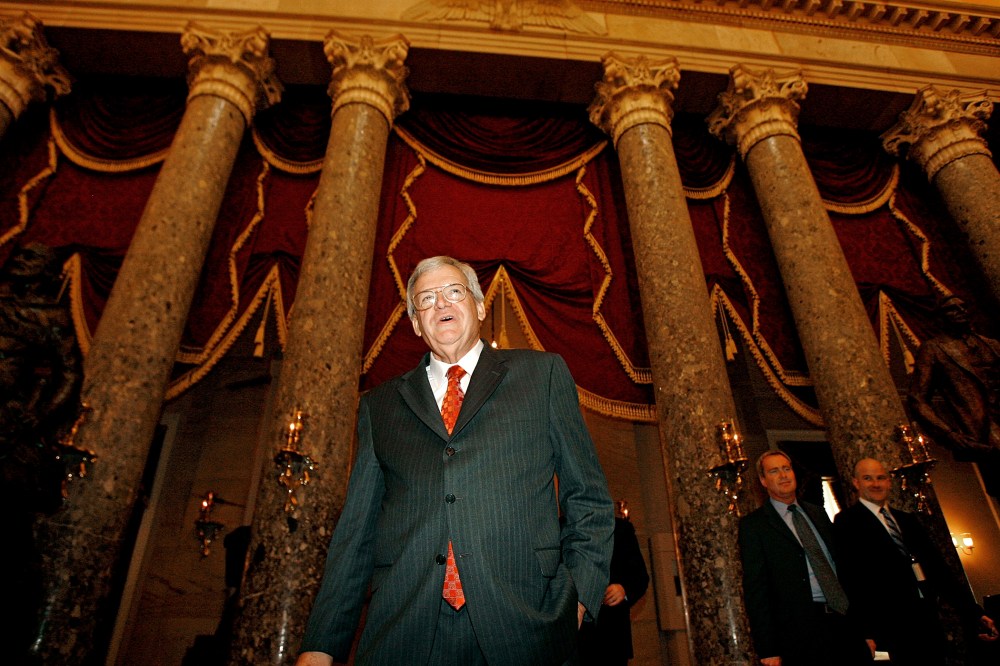
Former House Speaker Dennis Hastert has hired a high-powered Washington attorney who is a veteran of political scandals to represent him against federal charges that he lied to the FBI about bank withdrawals — money he allegedly used as payoffs to keep sexual misconduct accusations under wraps.
Thomas Green of the white-shoe firm Sidley Austin — where President and Michelle Obama worked as young lawyers — will represent Hastert at his arraignment on Tuesday, which will mark the pol’s first public appearance since his indictment nearly two weeks earlier.

Hastert, a Republican who retired from Congress in 2007 and became a lobbyist, is accused of structuring bank transactions to avoid triggering red flags. Court papers say he agreed to pay a person — identified only as Individual A — $3.5 million in hush money to conceal “prior misconduct.”
Federal sources have said “Individual A” was a student at Yorkville High School in Illinois, where Hastert was a teacher, wrestling coach and football coach between 1965 and 1981, before he took public office. They say the misconduct was sexual in nature.
Court documents initially listed an attorney at Dickstein Shapiro, where Hastert was a lobbyist until the indictment as his counsel, but it was always expected he would hire a different defense lawyer.
Green’s bio notes that he has represented members of Congress and other public officials in a range of scandals — including Watergate, the Whitewater investigation and the Iran-Contra affair.
Tuesday’s arraignment in Chicago Federal Court is expected to be a fairly routine affair in which Hastert will be presented with the charges, enter a plea and — most likely — be released on a recognizance bond, legal experts said.
The identity of Individual A does not have to be disclosed at the arraignment — and could remain secret for months.
“It does not have to come out,” said Sergio Acosta, a former federal prosecutor who is now a white-collar attorney.
He predicted that prosecutors will ask for a protective order to keep the name out of the public arena as the case moves toward trial.
Even if the case does go to trial, prosecutors could seek to keep the witness anonymous, although that would be very unusual.
“There is an effort to protect anonymity of victims, particularly if the alleged victim is someone who has suffered sexual abuse,” said Dan Collins, another former federal prosecutor turned defense lawyer.
While the man referred to in court papers remains a mystery, the name of another alleged victim has been made public. Jolene Burdge said her brother, Steven Reinboldt, who died of AIDS-related complications in 1995, told her Hastert abused him. “I just hope more people will come forward,” Burdge said over the weekend. But many of Hastert’s ex-wrestlers say they can’t imagine their former coach doing anything inappropriate. “He was always fair, never showed any favoritism,” said Mike Pfingston, who grappled on the 1981 team. “We went to wrestling camp with him, six to eight or us, he took us to Colorado, and there were no problems there.” Pfingston said he doesn’t understand how the allegations, if true, could have remained secret for so many years in a town that was filled with cornfields back in the ’70s and ’80s. And he is concerned that Hastert is being shamed — his name was taken off a program at his alma mater, Wheaton College, and an abuse group wants his portrait removed from the walls of Congrees — before he’s had his day in court. “Nothing has even been proven,” Pfingston said.
Tracy Connor Recommended


