








Democrats found a winning strategy in 2012, then quickly forgot it. Republicans were happy to pick it up.
The Democratic 2012 playbook included aggressive use of opposition research to attack opponents, superior field organization and tight coordination among outside groups and wealthy donors. Republicans’ mistakes during that election included candidates who made lots of gaffes. This year, both scripts were flipped.
RELATED: Why the Democrats lost, according to everyone
“They don’t want to admit we beat them at their own game,” Republican National Committee Chairman Reince Priebus said Friday at a breakfast with reporters hosted by The Christian Science Monitor in Washington.
The 2012 cycle, more than anything else, was defined by GOP gaffes. From Mitt Romney’s terminal case of foot-in-mouth to the more shocking comments about rape from Senate candidates Todd Akin and Richard Mourdock, Republicans inflicted more damage on themselves than Democrats ever could have hoped. But in 2014, Democrats took the lead in verbal flubs, even as they waited in vain for Republicans to slip up.
The marquee Senate race in Iowa proved to be especially fertile ground. Republicans and Democrats in the state said that everything in the race changed after video surfaced of Democrat Bruce Braley apparently deriding farmers. He also complained about the towel service in the congressional gym, contributing to the notion that he was arrogant. And in the final days of the campaign came Sen. Tom Harkin’s comments about Braley’s female Republican opponent that put his campaign off balance in the home stretch. In Arkansas, Democratic Sen. Mark Pryor accused his opponent — an Iraq war veteran — of harboring a sense of “entitlement” over his military record.
RELATED: The curse of the Obama coalition
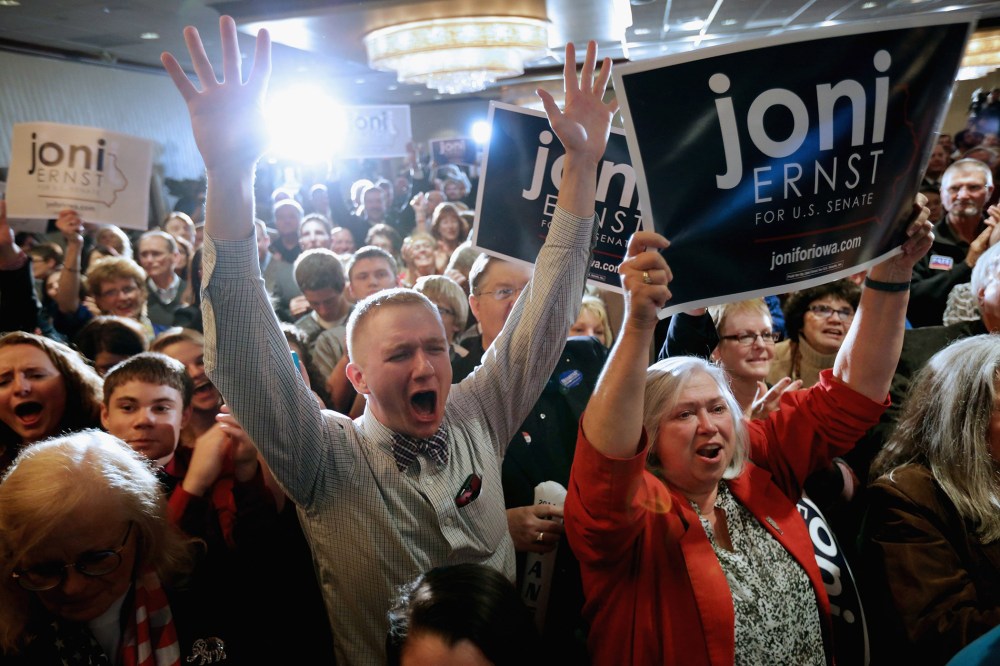
Republicans, meanwhile, went to great lengths to “gaffe-proof” their candidates ahead of the midterms. But gaffes aren’t worth much unless they can be effectively inserted into the political bloodstream. Democrats were very good at this in 2012, pouncing on Akin’s “legitimate rape” comment and escalating it into a major scandal within hours of its utterance. In 2014, Republicans replicated that Democratic infrastructure. They created the new opposition research and rapid response group American Rising, a direct answer to Democrats’ American Bridge, which claimed plenty of scalps in 2012.
“As they said themselves, American Bridge outmaneuvered the Republicans in the 2012 cycle, and they set out to copy our model this cycle to some effect, for example in the Iowa Senate race,” said David Brock, who founded the Democratic American Bridge.
This year, Republicans had their own big wins on opposition research. Montana Democratic Senate candidate John Walsh dropped out of the race after it was revealed that he plagiarized his college thesis, and Republicans dug up damaging dirt on plenty of other candidates.
“As we do after every election we are assessing whether we need to add some new components to our model to continue to stay ahead of the competition,” Brock told msnbc. “That’s all I’ll say without revealing trade secrets.”
RELATED: Left fails to match GOP’s roster of stars
It’s not that Republicans didn’t do opposition research before, but they stepped up their game in the midterms. “It really started with Chairman Priebus’ Growth and Opportunity Project and recognizing that the party needed to change some things mechanically in field, data and research. We were outspent last cycle in these areas, and it showed,” said Tim Miller, co-founder of America Rising, one of the groups that arose from the project.
When Romney ran for president, Republicans had an archipelago of billionaires and deep-pocketed outside groups pushing their own pet causes, with little concern for how their money fit into the party’s larger effort. That lack of strategy led to a lot of wasted money, and proved counterproductive in some cases.
In 2014, the single biggest spender of the entire election was billionaire environmentalist Tom Steyer, who won only three races out of seven he was involved in, despite spending $57 million. As Politico reported, Democrat donors complained that Steyer “didn’t collaborate enough with the party committees in a race where conservative groups worked in lock-step with the GOP establishment.” Meanwhile, former New York City Mayor MIchael Bloomberg angered some Democrats — including former president Bill Clinton — by using some of his billions to attack Democrats in red states for supporting gun rights. Another major donor that mostly supported Democrats this year was MayDay PAC. Founded this election cycle by Harvard professor Lawrence Lessig, the super PAC wanted to end super PACs, but it was plagued by mismanagement and ill-conceived strategy. In 2012, Democrats blew Republicans out of the water when it came to party infrastructure, like field operations and data gathering. Democrats’ operation was bigger and more sophisticated, while Mitt Romney’s high-tech answer to the Obama advantage, an app called Orca, crashed on Election Day. In 2014, Republicans invested heavily in those areas. While they may not have surpassed Democrats, they at least started to close the gap. They mobilized 30,000 volunteers and made 35 million voter contacts, focusing on so-called “low propensity voters” — people who likely wouldn’t vote unless nudged. RELATED: What changed in the battleground states “They did their job. Republicans did our job better. Without a superior Republican ground game, Republican candidates would not have won the victories they did,” the GOP election committees said in a memo released Friday. And in the waning days of the 2014 campaign, as polls showed their candidates trailing, Democrats resorted to the same desperate tactics that Republicans employed in 2012: They tried to “unskew” the polls. On the Thursday before Election Day, they passed around a New York Times piece titled “Why polls tend to undercount Democrats.” Democrats clung to the sliver of hope offered by a Nate Silver analysis showing that only a tiny change in polls could dramatically alter the outcome. On the stump, Democrats insisted the polls were wrong. “I just don’t buy the poll,” said Harkin while campaigning with Braley, whom a new poll showed down 7 points. He ended up losing by 8 points. But in the 2016 presidential race, Brock said he thinks the landscape will tilt back toward Democrats. “I expect the oppo arms race to continue,” Brock said, using a term for opposition research. “Oppo will be more important on our side than theirs because our potential nominee has been fully vetted and their crowded field has not been. The Republican presidential primary will be like Disneyland for us.”
Alex Seitz-Wald Recommended


