








Barbara Ehrenreich, one of our shrewdest popular critics of American politics and culture from the left, had a characteristically impish response to the Supreme Court’s decision in U.S. v. Windsor to overturn a key part of the Defense of Marriage Act. “DOMA down!” she wrote on Facebook. “Does this mean it’s safe to attack marriage again?”
One of the ironies of the marriage equality movement is the conservative movement’s stubborn refusal to recognize its fundamentally conservative nature. There are two strains in conservatism, and gay marriage is good for both of them. The libertarian strain calls for limits on government’s power to interfere with our pursuit of happiness—for instance, by marrying persons of any gender we please. The social-conservative strain calls for limits on sexual license and promotion of stable families. What better way to achieve this than by removing a meddlesome legal obstacle to gay monogamy?
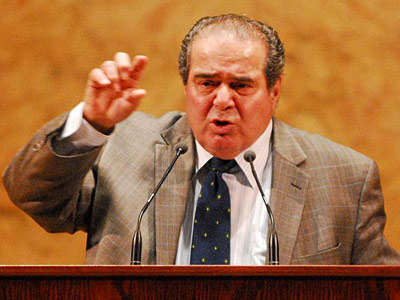
The Supreme Court’s majority ruling serves both conservative strains, but you’d never know that from Justice Antonin Scalia’s almost pathologically uncollegial dissent. Scalia called the majority ruling “high-handed” and said it “demeans” the Court. He alluded only in passing to “traditional moral disapproval of same-sex marriage (or, indeed, of same-sex sex),” but his previous dissent in 2003’s Lawrence v. Texas (in which the Court struck down Texas’s anti-sodomy statute) left little doubt where Scalia stood on that score. Scalia famously compared homosexual practices to prostitution, bigamy, incest, and bestiality.
The facts of the case in Lawrence v. Texas, which only recently came fully to light in Dale Carpenter’s 2012 book Flagrant Conduct, provide an interesting cultural counterpoint to U.S. v. Windsor. From a legal standpoint, Lawrence was about due process and equal protection under the law, just as U.S. v. Windsor is. (Give Scalia credit for predicting that the Lawrence decision would result in legal sanction for gay marriage.) But the actual circumstances of the people involved in the two cases couldn’t be more different.
Lawrence was about two men having anal intercourse in an apartment decorated with pencil sketches of a naked James Dean. In other words, it was about sexual license in a culture entirely alien to most tradition-minded conservatives. The two gay men who were arrested did not, in fact, have sex with each other–a detail their attorneys successfully obscured in order to proceed with a legal challenge to the anti-sodomy law—but the events at the heart of the case did include heavy drinking, angry shouting, and an accusation by one person present (also false) that a gun had been brandished. The accused—John Geddes Lawrence and Tyron Garner—lived on society’s margins. Lawrence, in whose apartment the arrest took place, had a string of drunk-driving violations and lived in a skeevy East Houston neighborhood popular with strippers. Garner was homeless.
U.S. v. Windsor follows an entirely different plot line. It was about Edith Windsor, an 84 year-old one-time IBM consultant, being prevented by the Internal Revenue Service from claiming a widow’s exemption on a large sum she inherited from her deceased spouse Thea Spyer, a psychologist with whom she lived four decades. The IRS’s decision, which was compelled by DOMA, cost Windsor $363,000. In essence, Windsor is about being allowed to lead a respectable bourgeois existence married to and eventually widowed by the person you love, even if that person happens to be the same sex as you. The consequence of your not being allowed to lead that conventional existence is that the IRS will confiscate money that’s rightfully yours.
John Geddes Lawrence and Tyron Garner were not conservatives’ type of people. One was demonstrably irresponsible, the other was a rootless drifter, and their case was about a sexual act (albeit one never actually committed) that most conservatives really don’t like to think about. Edith Windsor and Thea Spyer, on the other hand, are precisely conservatives’ type of people (except for their sexual orientation and maybe their politics). They are (in Spryer’s case, were) affluent and mutually committed and responsible members of society. Their case is about not being bullied by the IRS into paying too much in taxes, which is something conservatives fret about all the time. When the history books are written, one likely conclusion will be that the swift ascendancy of gay rights in the second decade of the 21st century was largely attributable to gay people’s relentless pursuit of a boring lifestyle. That wouldn’t have been possible if gay people hadn’t already established the legal right to pursue a much more lurid and unconventional one. Scalia got that part of the story right. But what he and other conservatives now crying bloody murder about Windsor can’t appreciate is that extending basic human rights to people whose lives they don’t approve of makes it possible for many more people to live lives they do approve of—or would approve of if they weren’t so stubbornly committed to preserving old, exclusionary definitions of what it means to love someone, provide for someone, raise a family with someone. The writer Andrew Sullivan, who wrote a pioneering New Republic essay advocating gay marriage back in 1989, is one of the very few conservatives who grasps this (perhaps because he isn’t a “movement conservative”). The institution of marriage is without question less robust than it once was. Conservatives aren’t wrong about that. But that isn’t because gay people want to get married. It’s because many heterosexual people don’t want to get married, or stay married, often in reaction to patriarchal and other social and economic constrictions that critics like Ehrenreich have written trenchantly about. Endorsing gay marriage doesn’t compromise conservatives’ disagreement with such critiques. The right should be shouting hallelujah that Windsor makes the “gay lifestyle” about wedding ceremonies, not bathhouse orgies. Of course, gay people should be free to be monogamous or promiscuous, just as heterosexuals are. But that’s not what gay marriage is about. It’s about behaving more conservatively. Why can’t conservatives appreciate that?
Timothy Noah Recommended


