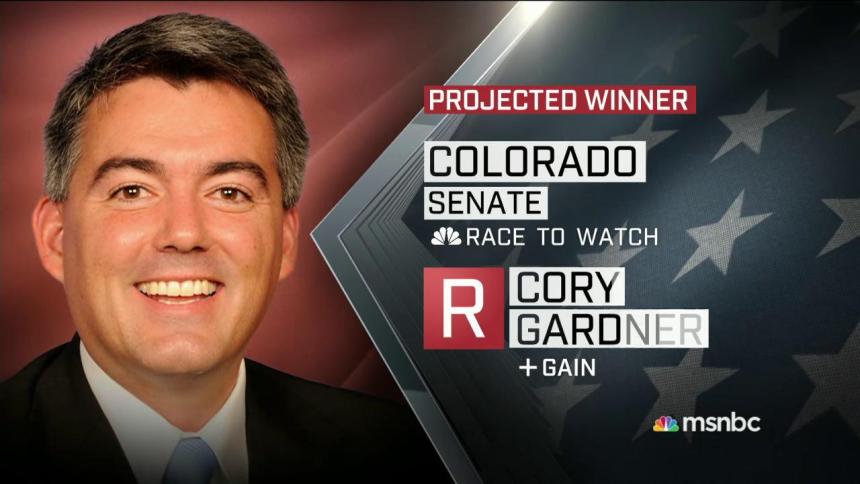
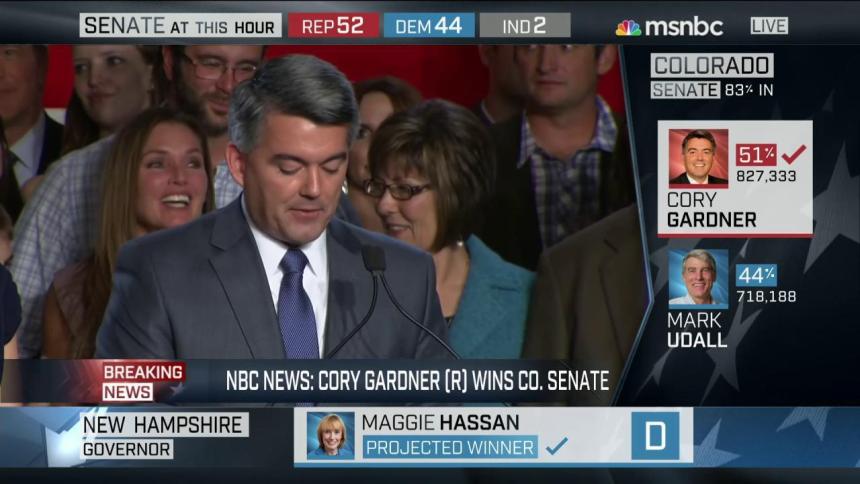
DENVER — Republican Cory Gardner has defeated Democratic Senator Mark Udall in Colorado, according to NBC News projections, riding discontent with President Obama and a sunny campaign style to victory. Democratic Governor John Hickenlooper’s race against Republican Bob Beauprez remains too close to call.
“I thought about Abe Lincoln,” Udall told supporters in his concession speech. “You know his famous story about the boy who stubbed his toe and he said it hurts too much to laugh, but he’s too old to cry?”
Gardner struck a bipartisan note in his own speech, telling supporters he hoped his win would “unite those voices who, while they may not have voted with the victor tonight, recognize the need to find common solutions, an altogether uncommon notion in Washington.”
Udall’s contest against Congressman Cory Gardner, who held a narrow average lead in the final round of polling, was one of the most closely watched in the country by national party leaders.
Unlike most of Senate states up for grabs in 2014, which tend to lean right, Democrats have dominated Colorado politics in recent years. The party won every major statewide race since 2004 thanks to strong performances with women and Latino voters, two groups critical to President Obama’s 2008 and 2012 victories. A Republican victory in a state whose diversity personifies the Obama coalition suggests that Democrats’ losses this year were about more than just a poor map.
Based on Democrats’ recent performances, the state was assumed to be a relative long shot for Republicans heading into 2014. The presumptive Republican nominee, Ken Buck, had already lost once to Democratic Senator Michael Bennett in 2010 despite historic gains for Republicans nationally. Gardner entered the race late after previously announcing he would stay in the House, prompting Buck to drop out and run for his now open seat.
Seeking to run up the score with women, Udall attacked Gardner relentlessly on reproductive rights issues. His campaign and Democratic allies spent millions targeting Gardner’s backing for a state personhood initiative, which would ban abortion and some forms of birth control.
Unlike Buck, however, Gardner refused to be easily caricatured as a hardcore conservative even as his voting record placed him clearly on his party’s right flank. He responded by disavowing his support for the state initiative, but refused to back away from his vote for a federal version, claiming – despite fact checkers’ insistence to the contrary – that it was merely a symbolic pro-life measure. He ran ads saying he wanted birth control pills available over-the-counter to further cover his left flank.
As Election Day grew near, Gardner’s strategy started to yield dividends. Polls showed him closing the gap with women against a candidate whose entire campaign was based on widening it. The Denver Post, not known for its conservative bent, lent him a surprising endorsement and decried Udall’s “obnoxious one-issue campaign.”
%22I%20did%20vote%20for%20him.%20%5BBut%5D%20I%20don%E2%80%99t%20think%20it%20was%20a%20positive%20campaign%20and%20that%20was%20upsetting.%22′
“I did vote for him,” Jody West, a Denver Udall supporter, told msnbc. “[But] I don’t think it was a positive campaign and that was upsetting,”
With Gardner holding a small lead in polls heading into Tuesday’s final vote, Democrats had already begun to publicly question whether Udall had erred by staking his campaign so strongly on one issue.
Udall took 52% of women’s vote but just 39% of men, according to the NBC News exit poll. Gardner’s victory Tuesday was built on strong support among traditionally more conservative groups, including 83% of white evangelicals, 59% of white men and 56% of voters age 65 and older. In this state with a strong independent streak, Gardner captured half – 50% — of those who consider themselves political independents. This is a significant shift from 2008, when Udall won 55% of independents. Another shift was among Latino voters — Udall won 63% of the Latino vote in 2008, but only about half of that group’s vote today per exit polls.
National issues were also on Coloradans’ minds tonight. A 81% majority of voters told the NBC exit poll that party control of the U.S. Senate was a very important consideration in their vote. And among this group, Gardner captured 51% to Udall’s 46%. Latino activists at a rally with Udall on Monday criticized the campaign for not running ads on immigration, an issue where Gardner was trying to present himself as a moderate as well. Bennett won 80% of the Latino vote in his 2010 victory over Buck, who had presided over a major immigration crackdown as Weld County District Attorney, and immigration reform advocates were eager for another strong performance to punish House Republicans for killing reform this year. RELATED: Udall rallies Latinos, but leaders fear it’s too little too late “We always thought this election would come down to how many Latino voters turned out,” Patty Kupfer, managing director of pro-reform group America’s Voice, told msnbc on Monday. “It doesn’t look like the Udall campaign was run [as if] that’s what the election is going to come down to.” Gardner opposed in-state tuition for DREAMers in the state legislature and rejected the bipartisan Senate immigration reform bill, but he hinted during the campaign he would support some form of earned path to legal status for undocumented immigrants while staying slippery on the details. The Udall campaign ran Spanish-language ads but none on immigration, arguing Latino voters already knew the difference between the candidates. Hickenlooper’s challenges were different. Republican challenger Bob Beauprez capitalized on a conservative backlash over the state’s rapid progressive turn in the state legislature since 2012, where Democrats passed new gun control legislation, a civil unions law, and a renewable energy standard that rural counties complained raised costs. The death penalty was also a prominent issue as Beauprez criticized Hickenlooper for delaying the execution of convicted murdered Nathan Dunlap. The Democratic incumbent pushed back by highlighting the state’s economic growth during his term. The unemployment rate had dropped from 9% to 4.7% in October, well below the national number. Whether Colorado’s results are a temporary blip or the start of a trend, expect both sides to weight them heavily as they plan their next moves. Republicans will almost certainly try to replicate Gardner’s combination of upbeat centrist messaging and solid conservative positions in future campaigns while Democrats may have to reconsider whether there may be limits to how hard they can ride social issues to victory.
Benjy Sarlin Recommended