








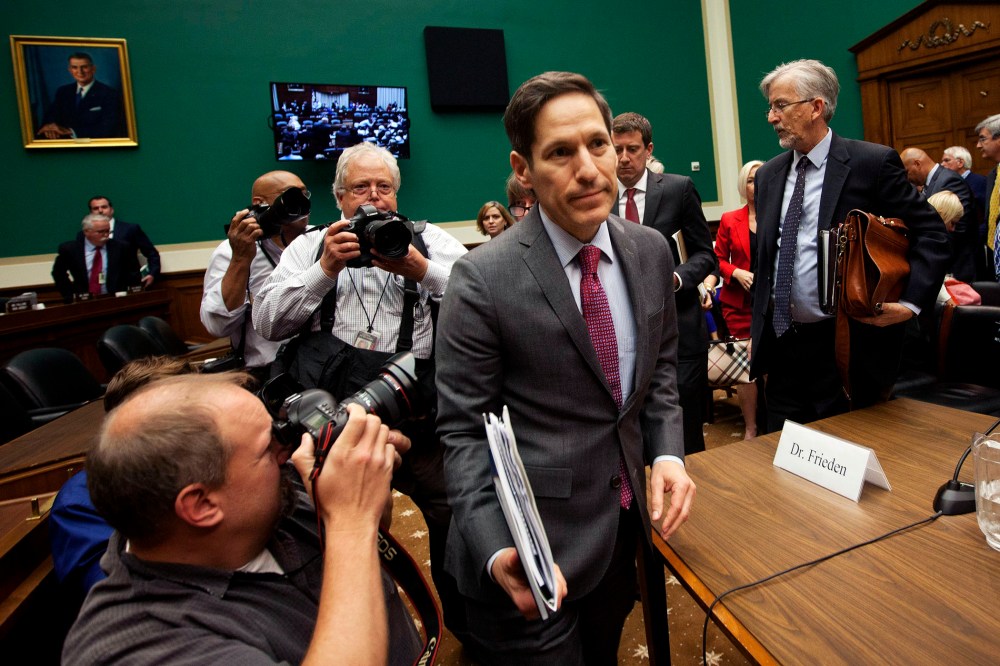
Some Republicans are calling for Dr. Thomas Frieden, the director of the Centers for Disease Control and Prevention, to resign over his controversial handling of the Ebola outbreak. Riding to Frieden’s defense, however, is an unlikely ally: George W. Bush’s former Health and Human Services Secretary, Tommy Thompson.
“There have been mistakes, there have been mishandlings, there’s no question about it. Tom Frieden has been the first one to acknowledge he’s made mistakes,” said Thompson, who served under Bush between 2001 and 2005, a stint that included the 2001 anthrax attacks in the United States, in which five people died, in addition to the Hong Kong SARS outbreak in 2003.
%22Instead%20of%20turning%20this%20into%20a%20gotcha%20mentality%2C%20let%E2%80%99s%20give%20%5BFrieden%5D%20the%20opportunity%20to%20fix%20it.%22′
Thompson, the former GOP governor of Wisconsin, added, “Instead of turning this into a gotcha mentality, let’s give [Frieden] the opportunity to fix it instead of terminating him now or calling for his resignation. You’d have to put someone else in and get them educated up to this point and we don’t have the time … Tom knows as much about Ebola and more so than probably anyone else in this country.”
On Wednesday, Republican Reps. Tom Marino of Pennsylvania and Pete Sessions of Texas separately called on Frieden to resign after news surfaced that a second healthcare worker in Dallas, Amber Vinson, contracted the deadly virus. That worker — who treated Thomas Duncan, the Liberian man who died of Ebola last week in Texas — flew from Dallas to Cleveland and back to prepare for her wedding even though she had a low-grade fever, generating concerns that the disease could spread. U.S. officials are now searching for the 132 passengers who were on board with the health worker. Consequently, two schools in the Cleveland area have been shut down as a precautionary measure.
The “Ebola situation is beginning to spiral beyond control,” said Marino in a statement, citing failures in hospital preparation, getting information out to the public and protecting public transportation facilities.
Frieden — who was appointed by Obama as the nation’s top health official beginning in 2009, after a stint as New York City health commissioner — has admitted that the CDC made a mistake in not sending a team of specialists to the Texas hospital where Duncan was being treated sooner, in addition to allowing the second nurse who was infected to board a commercial flight.
He was grilled by lawmakers during a hearing held by the House Energy and Commerce Subcomittee on Oversight and Investigations on Thursday. During his testimony, Frieden said, “We remain confident that Ebola is not a significant public health threat in the United States,” and described new recommendations the CDC has issued, including limiting the number of health workers who interact with patients who have Ebola.
%22Assignment%20of%20blame%20at%20this%20stage%20in%20the%20crisis%20is%20unproductive.%20We%20need%20to%20be%20about%20solving%20the%20problem.%22′
When former Republican governor of Utah, Michael Leavitt—who succeeded Thompson as HHS secretary under George W. Bush – was asked if Frieden should step down, Leavitt would not explicitly say one way or another but said “assignment of blame at this stage in the crisis is unproductive. We need to be about solving the problem.” An immediate step, he said, is emphasizing the role of state and local governments and providing them with more information they need to be prepared should Ebola hit their city or state.
Several Republicans — including Marino, House Speaker John Boehner and Sen. Ted Cruz of Texas — have also called on Obama to consider a travel ban on those coming into the U.S. from nations where the disease is thriving — something Frieden and the Obama administration have argued would do more harm than good.
While Thompson agreed that the Obama administration should at least consider the ban, Louis W. Sullivan, who served as HHS secretary under George H.W. Bush from 1989 to 1993, said such prohibitions would not be “rational or effective.” Leavitt also said he too was against such travel restrictions and instead said the United States should instead focus on dramatically enhancing security measures.
Such travel restrictions are intuitively an easy fix, “but when you get into the details of their execution, there are a lot of unintended consequences,” said Leavitt, giving several examples, including if a U.S. citizen goes abroad, becomes exposed to Ebola and wants to come home. “Do we keep a U.S. citizen out of the United States?” he asked rhetorically. Critics of the ban also argue it could result in civil unrest, or the virus spreading into other parts of Africa, and could create a barrier to aid workers trying to get supplies into the afflicted areas. Obama has since revved up airport security screening in both the U.S. and West Africa. Still, Thompson said the federal government’s response “has been jerky. It has not been consistent and that’s the problem.” He said officials need to do a better job of disseminating information to the public on a daily basis, and should set up a central office to deal directly with the CDC, the National Institutes of Health, and World Health Organization. Thompson also said the U.S. should immediately send CDC teams directly to the hospital when someone is detected with the virus and should establish a protocol that bans air travel for those patients — like the Dallas health worker — who may have been exposed to Ebola. Sullivan was far less critical of the CDC in comparison to Thompson, saying the government institute should be commended for establishing special isolation units. Sullivan, however, did take aim at Texas Health Presbyterian Hospital, where Duncan initially arrived with flu-like symptoms on Sept. 26 and reportedly told staff he traveled from West Africa. He was sent home, but came back to the hospital on Sept. 28 after his symptoms worsened. He was then tested for Ebola and isolated, but consequently died of the virus on Oct. 8. “This was a well-publicized epidemic that every health professional should have been aware of,” said Sullivan, who said he’s awaiting the results of a CDC investigation into how healthcare workers contracted Ebola before assigning specific blame. “But these mistakes are not acceptable. We really boast about having the worlds’ best trained health professionals and the strongest health care system. So seeing things like this happen really contradict that statement. That means we have to reevaluate our system.”Recommended


