








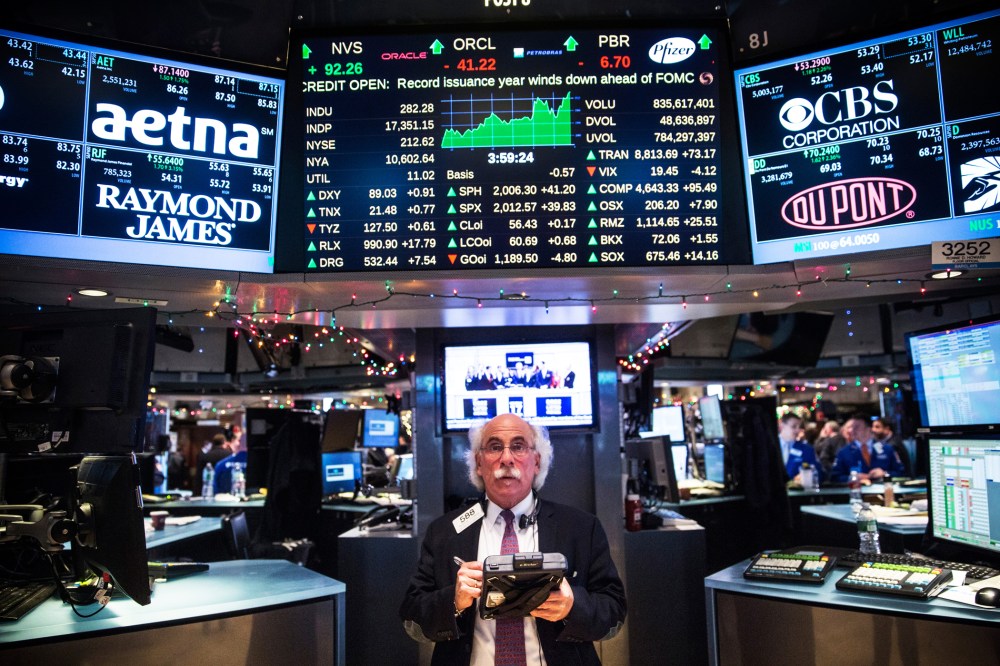
In the final weeks of 2014, critics of President Obama’s Wall Street reform scored their biggest victory to date, rolling back a new regulation on derivatives. But it’s just the first act of the GOP’s battle against the Dodd-Frank Wall Street Reform Act, as Republicans hope to make a bigger imprint as they take control of both houses of Congress.
“We have created a model,” GOP Rep. Kevin Yoder told Bloomberg, shortly after the spending bill passed. “This bipartisan success shows a pathway to solving other issues in the financial services area.”
Under a looming deadline, with almost no debate, Congress passed a bipartisan spending bill in December that gutted new regulations on complex financial instruments known as swaps. Days later, federal regulators announced that a central part of the Volcker Rule—which bans banks from speculative trading—would be delayed until 2017.
The one-two punch neatly illustrated Wall Street’s strategy to pushing back against the law: Fight for a delay of the rules, buying time to build bipartisan support for legislative rollbacks. “The attacks are nothing new, but they’ll come harder and faster,” says Lisa Donner, executive director of Americans for Financial Reform, a group that advocates for stricter financial regulation.
Related: Best GDP growth in more than a decade
Republicans have already laid out their potential targets through dozens of hearings and bills that the House has passed. Though they’re unlikely to push for full repeal, GOP lawmakers are expected to target new oversight for “systematically important” institutions that could threaten the health of the whole financial system if they were in trouble; attempt to repeal new rules for unwinding failing banks; and try to alter the funding, structure, and oversight of Obama’s new consumer watchdog.
In doing so, the GOP will also try to take the focus off Wall Street as much as possible. In recent months, they’ve gained more traction in pushing back against the law by allying themselves with smaller banks, Main Street companies, and others outside of Wall Street that believe that Dodd-Frank unfairly burdens them. That’s how House Republicans framed their fight against the Volcker Rule, which regulators have been struggling to finalize for years. The successful push to repeal the swaps pushout in December gained momentum in the final weeks when regional banks joined those vocally opposing the new regulation.
“The big guys are doing just fine under Dodd-Frank. The community bankers are struggling,” incoming Senate Majority Leader Mitch McConnell said shortly after the election. “I do think the Banking Committee will want to take a look at how much damage it’s done to the little guys who had nothing whatsoever to do with the meltdown in 2008.”
Obama has promised to hold firm on financial reform, particularly when it comes to his new consumer bureau. “If they try to water down consumer protections that we put in place in the aftermath of the financial crisis, I will say no,” he said at his year-end press conference.
But Republicans point out that their December victories came with Democratic support. As with the spending bill, Republicans could try to use must-pass legislation as vehicles for further regulatory change, forcing future dealmaking. And on certain issues, they will have allies among more moderate Democrats and others who consider themselves constructive critics of the law. “While wholesale changes are unlikely, there is a chance that some Dodd-Frank issues can pass both bodies with bipartisan support,” the American Bankers Association said shortly after the November election.
Aaron Klein of the Bipartisan Policy Center helped to craft Dodd-Frank as an aide to former Democratic Sen. Chris Dodd. But he believes that there are ways in which the law falls short—and that could be grounds for potential bipartisan compromise in the next Congress. He points to the new rules for designating certain banks as “systemically important” if they have $50 billion or more in assets, subject to additional federal oversight and stricter regulations.
Related: Forecast for the 2015 economy: Sunny
Klein believes that threshold needs to be higher and more flexible. “The fixed costs of Dodd-Frank have been a little higher than expected for crossing the threshold; the benefits are lower than expected for smaller institution,” he says. Even some Obama-appointed regulators agree, and large regional banks are lobbying hard against the “systematically important” designation. It’s already a prime target for House Republicans, who passed a bill giving non-banks a temporary exemption from the rule in July. Republicans also want to junk a new process that allows the FDIC to take over failing financial firms temporarily, arguing that it’s a backdoor bailout; instead they want to replace the new regulations with bankruptcy laws to allow failing banks to unwind themselves through the courts instead. Democrat are staunchly opposed to repealing such a major part of the law. But there’s interest from both left and right in revisiting bankruptcy laws for banks, which still contain major exemptions for derivatives and other complex financial products that Dodd-Frank didn’t address. Critics of Dodd-Frank will be particularly eager to alter the law in the next two years before the entire law goes into effect. Though financial reform was passed more than four years ago, Dodd-Frank only provides a blueprint for its biggest changes, requiring regulators to write the actual rules. “Things don’t always work as designed when you have this many new rules,” says Ken Bentsen, president and CEO of the Securities Industry and Financial Markets Association, a major financial lobbying group. Many of the reforms proved to be more complicated than its supporters had anticipated, and industry lobbyists have used the rule-writing process to challenge the law and slow down implementation. Donner, the pro-reform advocate, points out that’s all to Wall Street’s advantage. “It gives people more time for lobbying. It gives them more opportunity for the parade of horribles — they can tell a story about the disaster can occur,” she says. Congress’s repeal of the so-called “swaps pushout” was possible in part because it was never implemented. So while regulators have struggled to work out the details on the rule, Republicans drummed up Democratic support for repealing the swaps pushout, which passed in a 2013 bill with 70 House Democrats on board. Ultimately, 57 House Democrats voted for the spending bill that rolled back the regulation. Some supporters of Dodd-Frank insist it will prove to be a pyrrhic victory: They point out that the swaps pushout prompted a huge backlash led by Sen. Elizabeth Warren, suggesting there’s still deep public anger toward big banks. Regulators will also be better armed in 2015, as Democrats got more funding for two major financial agencies—the Securities and Exchange Commission and the Commodity Futures Trading Commission—in the spending bill as well. Former Rep. Barney Frank, who co-authored the law, believes the backlash will make it harder for Republicans to roll back the law in the future. “I was worried about this happening, but I have been encouraged by the angry reaction … I was afraid that they would do this, and nobody would fight back.” Frank told msnbc. “It’s now clear the president is going to be much tougher in resisting it.”
Suzy Khimm Recommended


