








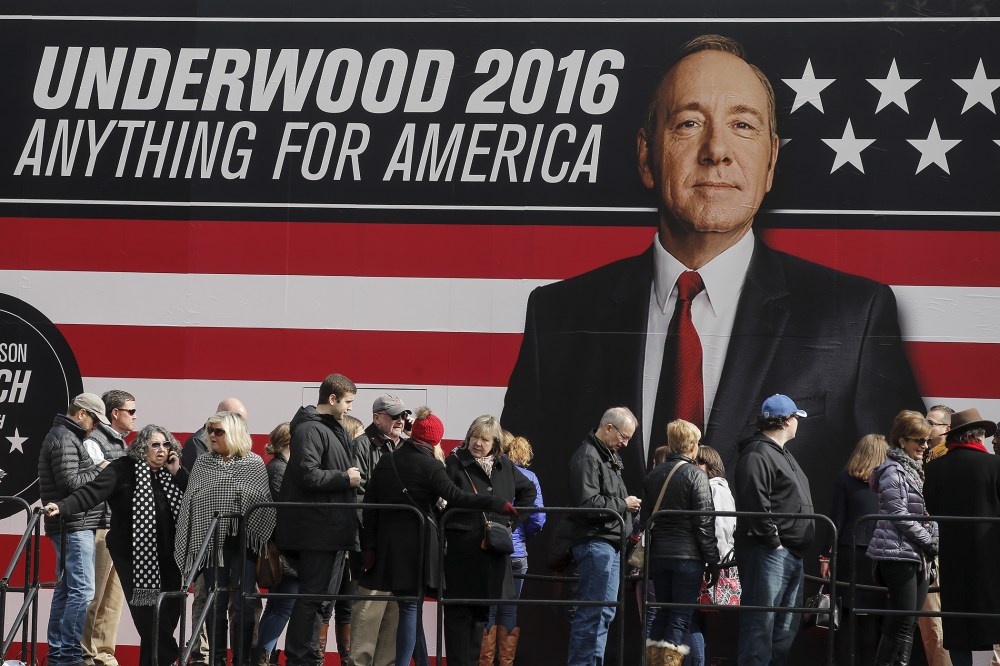
The fourth season of the hit Netflix series “House of Cards” debuted on Friday, and by many critics’ accounts, it marks a return to form for the ruthless political thriller. But it also arrives amid a campaign season that is arguably stranger than fiction with a real-life leading candidate who would easily upstage actor Kevin Spacey’s iconic antihero Frank Underwood.
Through the years, the Underwood character has lied, manipulated, even murdered to ascend to the presidency of the United States, and part of the show’s intrinsic appeal is its ability to make the patently absurd seem eerily plausible. But the 2016 campaign — which has been dominated by real estate mogul-turned-reality TV star Donald Trump on the airwaves and in the polls — may have usurped “House of Cards” in its ability to shock.
In the last week alone, Trump has had to defend his position on white supremacists, has been condemned as a “phony” and a “fraud” by the Republican Party’s last presidential nominee, and made allusions to the size of his own penis on a prime-time debate stage. And while the fictional President Underwood spent most of season three bogged down in policy debates with Congress, Trump has stubbornly refused to be pinned down by details or his own past public statements.
From the moment Trump launched his campaign last summer, pundits have attempted to find a corollary with some sort of cinematic precedent. The notion that his candidacy has resembled something out of a movie has inspired comparisons to the character of “Lonesome” Rhodes (played brilliantly by Andy Griffith) in the acclaimed 1957 media satire “A Face in the Crowd.” The Rhodes character is a common criminal (with lascivious tendencies) who evolves into a political demagogue when he becomes the star of a variety TV show that exerts incredible influence on an audience of earnest, but mostly under-employed and uneducated viewers. Sound familiar?
RELATED: ‘House of Cards’ debuts Frank Underwood campaign ad during GOP debate
Others, such as the publisher of The New Hampshire Union Leader, have seen a more apt analogy in the guise of the villainous Biff Tannen of the “Back to the Future” films. Even the writer of that series has claimed that the character’s transition into a greedy, grotesque, womanizing casino magnate was inspired by The Donald.
But perhaps the best modern equivalent can be found in legendary actor-director Warren Beatty’s acclaimed 1998 comedy “Bullworth,” in which he plays an aging senator who enthralls the public by profanely speaking from the heart as if he has nothing to lose. (The candidate has taken out an insurance policy on himself and thinks he will be imminently dying.) Coincidentally, all of these characters endure some form of comeuppance — which has so far eluded Trump. But the reality is there is no character and no scenario that can upstage what we are witnessing with Trump. Not unlike what happened with the Oscar-winning 1976 film ‘Network” — where even some of its wildest predictions about the direction of the entertainment industry have since proven true — the blood sport political antics of “House of Cards” may seem diluted, if not dated, now by current events. For instance, a plot point in the new season hinges around a billboard that links Underwood, who is running for re-election, to the Ku Klux Klan. But for viewers who have been hearing about support for Trump from the likes of David Duke and other white nationalist groups and individuals, this will feel no less surreal than what they digest every day from cable news. And Underwood’s ambitious “America Works” job program, which consumed much of season three, seems tepid compared to Trump’s wildly controversial plans to build a border wall along the southwestern United States, deport 11 million undocumented immigrants, and to “temporarily” ban Muslims from emigrating to America. Meanwhile, should Trump triumph in a slew of upcoming primaries this month, he will be, barring some calamity, the presumptive Republican nominee, despite hundreds of millions of dollars spent in opposition to him and several prominent Republican leaders declaring they won’t support him under any circumstances. A series of Trump victories in the next few weeks will almost certainly lead to a fight for the soul of the Republican party on their convention floor this summer, the kind of real-life political drama the nation hasn’t seen in more than 40 years. How can “House of Cards” compete with that?
Adam Howard Recommended


