








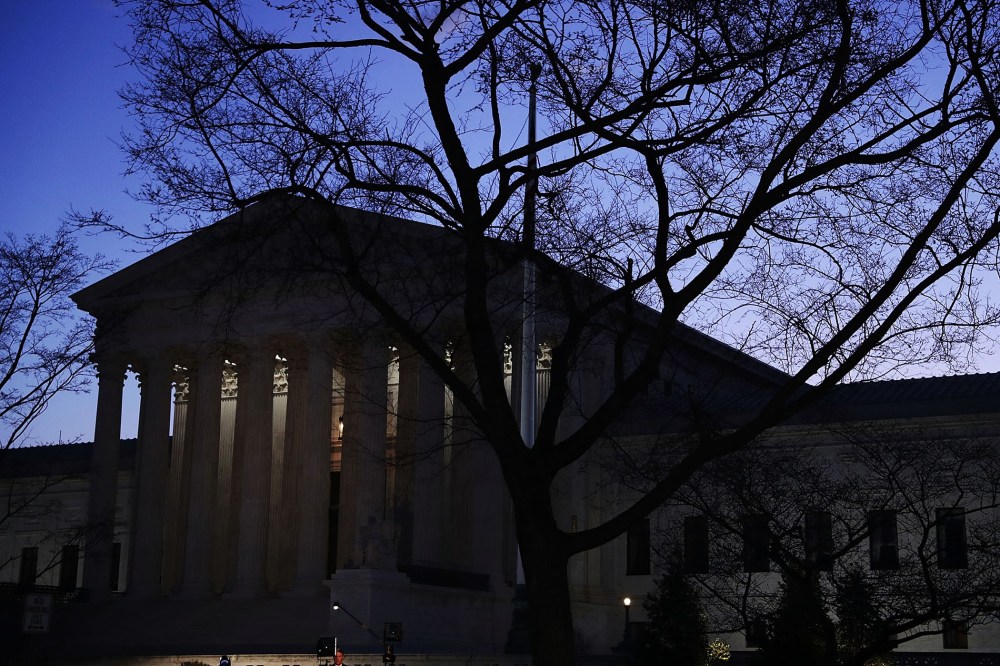
WASHINGTON – The anti-birth control coverage camp is returning to the Supreme Court Wednesday, and they’re feeling under siege.
“If you’re not for contraception, then you’re against women,” is how Catherine Szeltner, a reporter at EWTN, a Catholic news station, described the narrative they were up against. “Well, you could argue that contraception is a war against a woman’s body.”
She added, “As a woman myself, I don’t believe that contraception is healthcare. This case is a fight to live out our faith in the public square.”
Szeltner was speaking at a recent forum on the cases, known collectively as Zubik v. Burwell, at the offices of the conservative law firm Alliance Defending Freedom. Her employer is among nearly a hundred religiously affiliated nonprofits that have sued the Obama administration over what it calls an opt-out plan to contraceptive coverage under the Affordable Care Act.
RELATED: What happens to the big Supreme Court cases after Scalia’s death?
The road here was messy, but it comes down to this: All new insurance plans are required to cover contraception under the Affordable Care Act, just like they have to cover a list of services and medications billed to be preventative care. Religious conservatives have balked, citing the federal Religious Freedom Restoration Act. In 2014, five justices of the Supreme Court agreed in Hobby Lobby v. Burwell that corporations owned by religious people didn’t have to offer the coverage on their insurance plans. The question now is how far that opinion stretches.
The plaintiffs in Zubik start from a different place than those from Hobby Lobby: They were offered an “accommodation,” which the Obama administration says strikes a balance between respecting religious belief and respecting the rights of women who don’t share their employers’ view on contraception. The objecting nonprofits can simply notify their insurer or the government, and they don’t have to pay for any of it.
That’s still going too far for these groups, who say their insurance plans are being conscripted to cover medications they oppose.
“They call it an opt-out, which is utterly and terribly false,” said Gregory Baylor, an Alliance Defending Freedom attorney with several plaintiffs before the Supreme Court, at the event. “It’s a hijacking of our health plans. There is a real exemption and we don’t get it.”
What he meant is that the nonprofit plaintiffs want the government to treat them like churches, which are exempted from coverage altogether. Whether they prevail could also affect the for-profit employers like Hobby Lobby, who were offered the same accommodation.
RELATED: Supreme Court to hear another birth control case
But their prospects became bleaker in February with the death of Justice Antonin Scalia. That’s not just because Scalia was a staunch Catholic who might have sympathized with their plight. It’s because of what happened when the plaintiffs took their cases against the accommodation to appeals courts.
“Our side starts to lose,” is how Baylor put it. “We lose and lose and lose.”
In fact, they kept losing every single appeal, six of them altogether. Judges mostly told them that they had not proved that the accommodation substantially burdened their religious freedom, because it simply involved filling out a short form or writing a letter to their insurer or the government.
But the plaintiffs are asking the Supreme Court to agree that judges can’t make that call. “If a religious adherent sincerely believes that taking a particular action would make him complicit in the sin of another, then courts must defer to that belief,” the plaintiffs wrote in their brief to the court.
Their losing streak ended with the 8th Circuit ruling for Iowa’s Dordt College, and the Supreme Court promptly took a bunch of their cases. (Since then, they’ve lost at an appeals court a seventh time.)
Now that Scalia’s death has robbed the plaintiffs of a fifth vote, the nonprofit objectors face two unappealing outcomes: Losing entirely, or a 4-4 tie that leaves in place the lower court opinions that backed the Obama administration. In other words, a lose-lose. Baylor, publicly at least, refused to be pessimistic. “The assumption is the same four justices who voted against Hobby Lobby” – the four appointed by Democrats – “will necessarily vote against the plaintiffs,” he said. “I don’t think that’s a necessary assumption at all. I trust that the justices will look at the Hobby Lobby precedent. I hold out some realistic hope it won’t just be a 4-4 vote.” RELATED: Are you ready for a Hobby Lobby sequel? Hobby Lobby, of course, elicited one of the more vociferous dissents from Justice Ruth Bader Ginsburg. Justice Anthony Kennedy, while voting for the Hobby Lobby plaintiffs, wrote separately to emphasize that he thought the government had a compelling interest in contraceptive coverage for women, and referred to the accommodation as “an existing, recognized, workable and already-implemented framework to provide coverage.” But if there is a majority for the Zubik plaintiffs, at least one usual proponent of expanding religious freedom exemptions thinks it would harm religious freedom in the long term. Douglas Laycock, a law professor at the University of Virginia, wrote an amicus brief in support of the religious objectors in Hobby Lobby, but in a recent Washington post op-ed, he said the Zubik case went too far. “They say that only they can say what is a substantial burden on their exercise of religion; the courts must take their word for it,” Laycock wrote. “But that would give rise to even more extreme claims and discredit the cause of religious liberty.” He also disputed their claim that the Obama administration’s plan was invalid because it decided which categories of groups could get which kind of exemption. “If legislators and administrative agencies cannot enact a narrow religious exemption without it being expanded to become all-inclusive,” Laycock wrote, “many of them will not enact any religious exemptions at all.” Gretchen Borchelt, vice president for reproductive rights and health at the National Women’s Law Center, said she believes that if the court rules for the plaintiff, it would be a slippery slope. “If they now invalidate the accommodation, then what’s next? They’ve taken it so far, there’s no end in sight.” The plaintiffs have proposed that female employees get their contraceptive coverage by other means, such as through the Title X program for uninsured women or by offering separate, contraception-only plans on the exchange. Said Borchelt of those options, “All of these are unworkable and frankly insulting to women.”
Irin Carmon Recommended


