








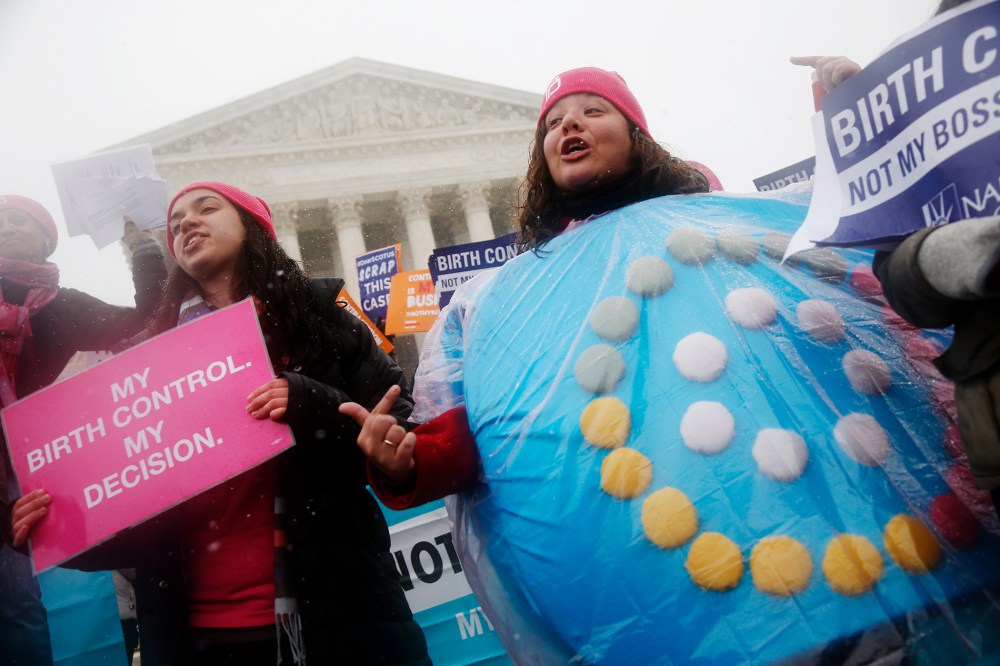
The Supreme Court on Friday said it will wade back into a years-long conflict between conservative religious groups and the Obama administration’s goal of expanding access to contraception. The court accepted seven different appeals from religious nonprofits that challenge a provision of the Affordable Care Act.
Here’s the key question, a sort of sequel to the 2014 case Burwell v. Hobby Lobby: Is the government’s “accommodation” of religious objectors to contraception itself a violation of religious freedom under the law?
RELATED: Are you ready for a Hobby Lobby sequel?
Instead of picking one vehicle, the court has accepted a group of cases and consolidated them. The best-known plaintiff is the Little Sisters of the Poor Home for the Aged, a chain of nursing homes whose members recently met with Pope Francis. Others — a mix of Catholic groups that object to all contraception and Protestants that object to four types — include the Roman Catholic Archbishop of Washington, Priests for Life, Geneva College, East Texas Baptist University, and Southern Nazarene University.
Under the Affordable Care Act, insurance plans must cover a list of preventive care services, including all forms of FDA-approved contraception. Houses of worship that object to contraception are exempt, on the theory that they mainly employ fellow worshipers, but the administration has offered a workaround to groups that employ people of all faiths. The nonprofits have asked the court for the same arrangement as houses of worship, in which no female employees get contraceptive coverage through their plan.

The so-called “accommodation” involves the groups filling out a form or writing a letter so the insurer provides the coverage independently, at no cost to the employer. The Obama administration says that strikes the right balance.
“In our pluralistic society, that sort of substitution is an appropriate means of accommodating religious objectors while also protecting other important interests, such as women’s interest in full and equal health coverage,” solicitor general Donald Verrilli wrote on behalf of the administration.
But an attorney for the Little Sisters of the Poor, Mark Rienzi, has said the form is really a “permission slip for abortion drugs and contraceptives.” (Abortion is not actually covered, though contraceptive methods regarded by some of the groups as tantamount to abortion, such as the intrauterine device, are.)
Other nonprofit organizations, including universities like Georgetown and the Catholic Health Association, have opted to sign the form. The accommodation has also been offered to for-profit organizations like Hobby Lobby, the craft store chain that won its 2014 case before the Supreme Court by arguing that it was a religious organization that should be exempt from the contraceptive coverage requirement. The majority in that case, led by Justice Samuel Alito, pointed to the nonprofit accommodation as proof the government had other options, but stopped short of endorsing the arrangement as legal. All the cases involve the 1993 Religious Freedom Restoration Act, which bars the government from substantially burdening religious freedom unless it furthers “a compelling governmental interest” and “is the least restrictive means” of doing so.
All but one federal appeals court has ruled that the accommodation shows appropriate regard for religious freedom, but that is enough for a circuit split, the traditional grounds for the Supreme Court to step in.
The question is whether the form and its arrangement for women to obtain contraception is a substantial burden — and who decides. “Some courts think they can look at this and say, ‘Sister, I know you think your God tells you that, but it doesn’t,’” the Little Sisters’ attorney, Mark Rienzi told msnbc. “Some courts say that’s not a role for judges.”
But the Obama administration has responded that the law doesn’t mean the objecting employers can “prevent the government from eliminating the resulting harm to their female employees and beneficiaries by arranging for third parties to provide those women with separate coverage.” On Friday, the clerk of the court sent a letter to the plaintiffs saying, “We expect argument to be held in our March argument session. The Court would like the parties to submit a joint proposal for briefing on the merits that will keep the number of briefs to a minimum and avoid repetition of argument.” The clerk set a deadline of Monday, Nov. 16, 2015. “It’s helpful that the justices took all of them because they will have a range of different fact patterns before them,” Gretchen Borchelt, vice president for health and reproductive rights at the National Women’s Law Center, told MSNBC. “That includes the different ways of providing insurance (self-insured, church plan, fully insured) and different methods of birth control.” She said the consolidated cases will likely be referred to as Zubik v. Burwell, based on that case having the lowest docket number. Conservative activists have focused on the Little Sisters of the Poor case, accusing the Obama administration of forcing nuns to offer birth control. But the government says that’s not true, both because the accommodation opts out the Little Sisters from financial involvement and because they have an exempted “church plan” that doesn’t have to offer contraceptive coverage in any case. The case injects the culture wars into the Supreme Court docket, with a decision likely to come in June, months before a presidential election. The starkly different framing of the cases was apparent in statements issued Friday. Gregory S. Baylor, senior counsel at the Alliance Defending Freedom, which represents some of the objecting religious nonprofits, said, “The government has no legitimate basis for forcing faith-based organizations to be involved in providing abortion pills to their employees or students. These Christian colleges simply want to abide by the very faith they espouse and teach. They should not be forced to choose between giving up their fundamental freedoms and paying financial penalties.” But Gregory Lipper, senior litigation counsel at Americans United for Separation of Church and State, which represented students at Notre Dame opposing the university’s objection to the form, wrote, “Far from raising actual burdens on religious exercise, these cases make a mockery of religious freedom. We hope that the Supreme Court rules that the plaintiffs have no right to veto their employees’ efforts to obtain reproductive coverage from others, and that the Court will preserve contraceptive coverage for the tens of thousands of women who will be affected by these decisions.”
Irin Carmon Recommended


