








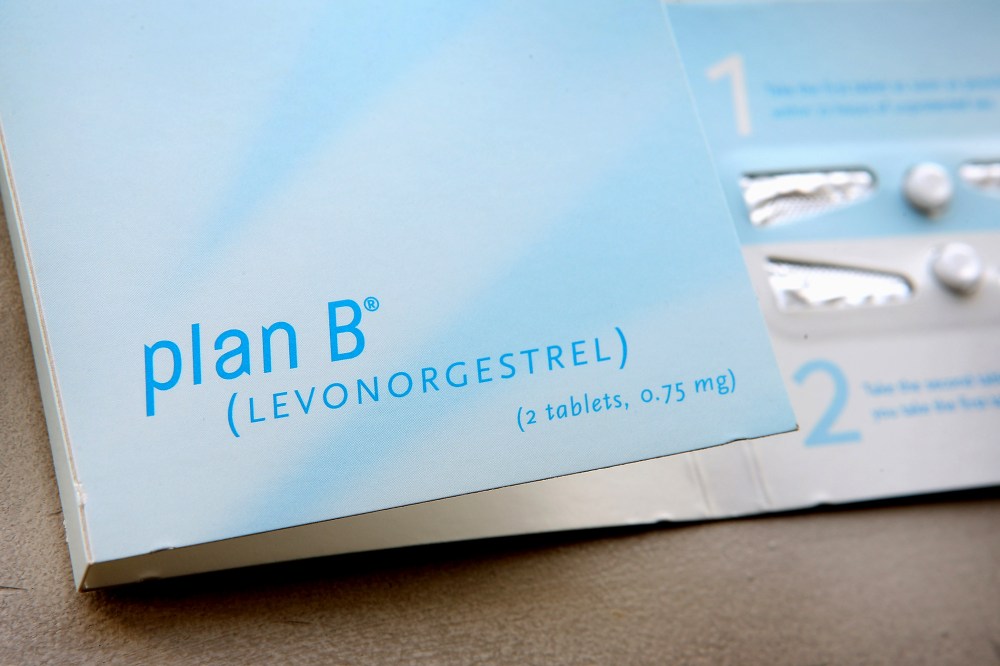
In the nearly two-decade struggle over access to emergency contraception in the United States, there has generally been one sobering constant: The politics of sex and reproduction have run the show.
“It has been pure politics trumping science,” said James Trussell, a professor of economics and public affairs at Princeton University who has conducted extensive research on emergency contraception.
Now, thanks to pressure by advocates, in court and beyond, that’s finally changed. But what’s left to navigate are the practical politics of access.
Last week, women’s health advocates cheered the Food and Drug Administration’s decision to allow generic versions of the emergency contraception to be sold over the counter, without having to show proof of age. Previously, only Plan B One Step, manufactured by Teva, was available under those terms, and only after years of litigation seeking to lift a requirement that women under 17 have a prescription. The generics will still have a label saying they are intended for women 17 and up, but without the requirement to show ID, it won’t be practically enforceable.
Because emergency contraception is more effective the sooner it’s used after unprotected sex, roadblocks like a photo ID or having to find a doctor to prescribe it can be the difference between the drug working and an unwanted pregnancy. The young and low income have mostly paid the price.
But even without those restrictions, pharmacies still exercise a tremendous amount of discretion on how they sell emergency contraception, including whether it’s placed in a locked cabinet or kept behind the counter to avoid theft — an obstacle for embarrassed purchasers, and one that force them to cross paths with a disapproving employee. At an average of $41, the newly, more-available generics are also only marginally cheaper than Plan B One Step, which can cost as much as $62.
According to a nationwide survey of 400 pharmacies conducted last year by the American Society for Emergency Contraception, “Even the lowest retail prices for EC are beyond the reach of many women.” The average price for the branded Plan B One Step is $48, and the generics are only 14% cheaper. That’s another way emergency contraception is unique: the FDA says generic drugs are usually 80-to-85% cheaper than branded products.
It’s also much more expensive than the drug costs in other countries. Sarah Rich, senior program officer at the International Consortium for Emergency Contraception, said that their research indicates that the average price in Europe for the same levonorgestrel-based pill is 15 euros – or about $20.
“It’s a relatively cheap product to manufacture,” Rich told msnbc, “so the $50 price is extremely high.”
Annie Tummino, the lead plaintiff in the lawsuit that lifted the age restrictions on Plan B One Step and an organizer with National Women’s Liberation, pointed out that “with the Affordable Care Act, birth control has become more affordable for a lot of people. But the morning after pill hasn’t really seen that shift.” Tummino said her group planned to have a petition on their website soon advocating for lower-cost access to emergency contraception.
Trussell said the price might go down if pharmacies stocked Plan B One Step next to the two newly-accessible generics, Next Choice and My Way. “I don’t think it would make much marketing sense to sell their product next to other ones that are the same but cheaper,” he said. The best case scenario for the price going down would be if, now that the FDA has stopped treating generics differently, other companies jumped into the market. Kelly Cleland, a researcher at Princeton’s Office of Population Research, said she expected that as many as five or six different brands would eventually offer emergency contraception. “There are pharmaceutical companies that are coming into the market that have not publicly announced it,” she told msnbc. Until getting rid of most of its age restrictions on the drug, the U.S. was one of the few countries to have age restrictions at all. Confusingly, the FDA’s most recent letter says the generics will be repackaged to say they are “for use by women ages 17 and up.” It appears that provision won’t actually be in force, since now no one is required to show proof of age, and that the new label is, according to the letter, intended to “appropriately carve out Teva’s exclusivity” per an earlier agreement. But the wording could still sow confusion in pharmacy aisles. The drug has repeatedly been shown to be safe for women and girls of all ages, but the specter of adolescents having sex has haunted American politicians. In 2005, the top FDA official for women’s health, Susan F. Wood, quit in protest of the Bush-era politicization of the agency, particularly around emergency contraception. Still, these have been bipartisan politics. In remarks that infuriated his allies, President Obama said in 2011 that “as the father of two daughters,” he supported Secretary of Health and Human Services Kathleen Sebelius’s unprecedented decision to overrule the FDA’s recommendation to lift the age restrictions. He added that Sebelius “could not be confident that a 10-year-old or an 11-year-old go into a drugstore, should be able — alongside bubble gum or batteries — be able to buy a medication that potentially, if not used properly, could end up having an adverse effect.” There is no evidence of any such adverse effect in the medical literature. (Where those unsupervised 10- and 11 year-olds were getting $50 for Plan B was another question.) The administration was eventually forced by a judge’s order to lift the age requirements on Plan B One Step. That judge called Sebelius’s decision “politically motivated, scientifically unjustified, and contrary to agency precedent.” A separate drug, Ella, was approved by the FDA in 2010 as effective in preventing pregnancy up for five days after unprotected sex, compared to Plan B One Step and the generics’ three-day window. The FDA is reportedly reviewing recent research indicating that Plan B is ineffective for women above 176 pounds; preliminary research in Europe shows that the weight threshold is higher for Ella. But Ella is prescription-only, and it appears that few people have heard of it.
Irin Carmon Recommended


