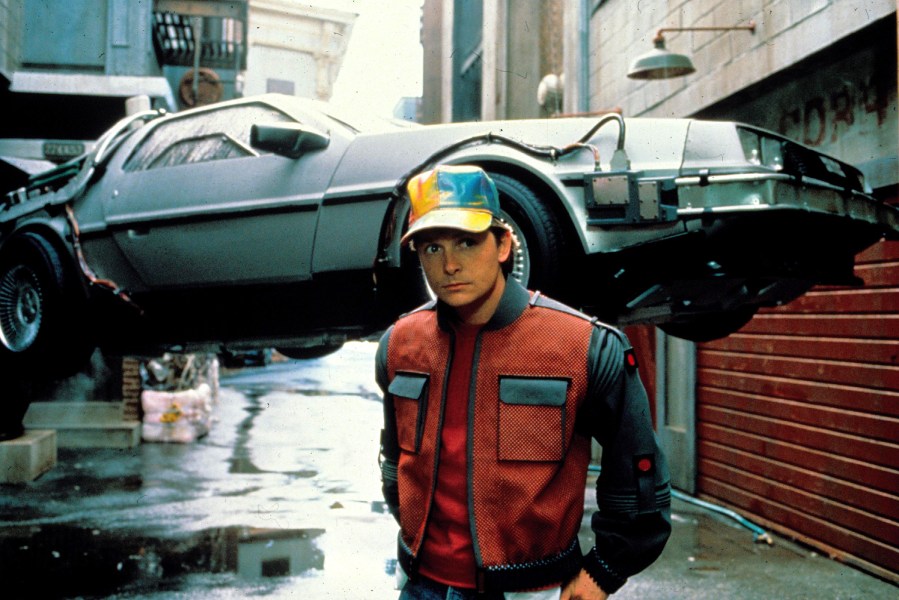
This year has been steeped in “Back to the Future” nostalgia. The original blockbuster was released 30 years ago this summer and its darker, arguably more complex 1989 sequel takes place in part on this day — October 21, 2015.
Much has already been made about the futuristic gadgets in that film that actually have come to fruition, from hoverboards to FaceTime, but what is often lost in the conversation about this underrated classic is that it also was prescient about the actual people of 2015.
RELATED: Great news for Marty McFly fans!
Here are five examples of how “Back to the Future Part II” was perceptive about the way we live, not just the things we have invented.
Extreme “helicopter parenting”: The central premise of “Back to the Future Part II” may go down as the most exaggerated form of what has now become known as “helicopter parenting” ever captured on film. Our hero Marty McFly (Michael J. Fox) and his girlfriend Jennifer (Elisabeth Shue), learn that their future child is destined to commit a potentially life-altering crime and they literally travel 30 years through time to ensure he makes the right life decisions. In the real-life 2015, over-protective parenting is all the rage, although some have argued that it could damage a whole generation of children.
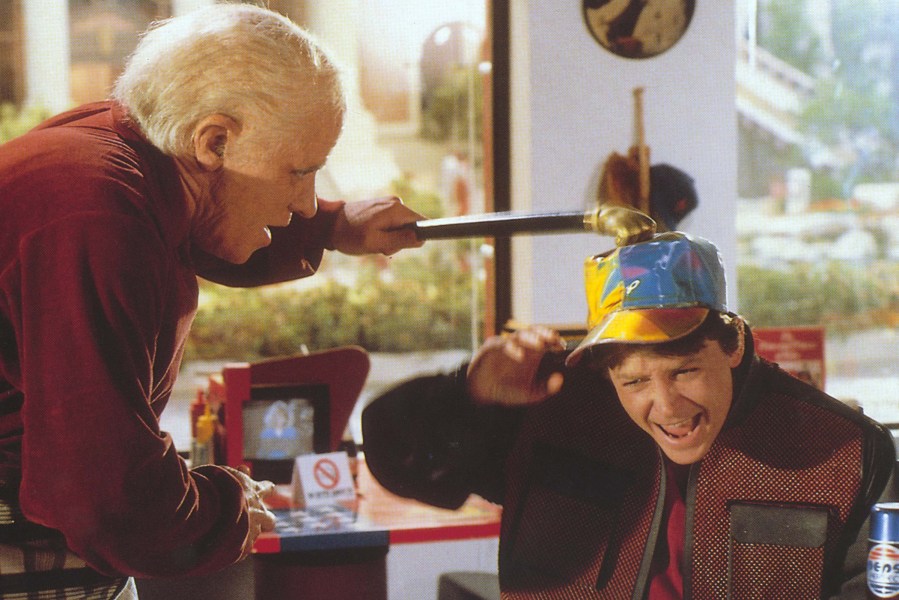
’80s nostalgia is ingrained in our culture now: We all take celebrating 1980s pop culture for granted now — with dance parties, movie reboots and more, but the concept was a novel in-joke when the movie was released in 1989. In a scene that is both visually clever and eerily accurate, McFly is confronted by the excesses and icons of the 1980s when he enters a theme cafe in 2015. As huge as former President Ronald Reagan and pop star Michael Jackson were at the time the film was made, few would have predicted how much they loom in the conversation now.
Bullying is literally timeless: The “Back to the Future” series’ great heavy is the boorish and prone-to-violence Biff Tannen. In 1989, bullying was not being shamed nationally like it is today — but it’s on display in a tour de force performance from actor Thomas F. Wilson in not one, but three different decades. Some critics at the time complained that Tannen dominated “Part II” too much, but one could also argue that he represents the dark id that still cuts across generations. His character was more of a figure of fun in the 1985 original, but he takes on terrifying dimensions in the second “Back to the Future” film that today read like an indictment of unbridled greed. In this wealthy 1985 iteration, one could almost see him as a savage spoof of Donald Trump — a “self-made” man who is anything but, who plasters his face on his own towers and markets his own success story for profit.
Families disconnected by technology: About a half hour into “Back to the Future Part II,” McFly’s girlfriend Jennifer stumbles upon her future 2015 home. She discovers a McFly family so overwhelmed with tools of communication and options to engage with media, that they are all hopelessly detached from each other. Without intending it, director Robert Zemeckis presented what could be called an early parody of the millennial generation, which is often maligned for needing constant stimulation from screens. A moment for discrimination: The “Back to the Future” films have never been applauded for their socially responsible portrayal of racial politics:, this is a series that suggests McFly, a white teen, taught Chuck Berry what rock n’ roll is after all. Still, there is a troubling scene in “Back to the Future Part II” that has serious implications, even if its played for subversive laughs. McFly returns to an altered 1985 from a 2015 that has been tainted by Tannen. He returns home to find a black family has moved into his home and his neighborhood has become a treacherous place with chalk outlines in plain sight. The message is implicit, that black presence connotes lowered values and the threat of crime. Still, in the midst of this problematic scene, the patriarch of the black family hollers at McFly, “Tell that realty company I ain’t selling … we ain’t gonna be terrorized.” This little line of dialogue, perhaps an attempt to humanize some of the only African-Americans to appear in the film, also speaks to the systematic displacement of black families, which continues to be pervasive today. Still, “Back to the Future Part II” is first and foremost a comedy, hence the elaborate slapstick chase in the finale (SPOILER ALERT) that features multiple McFlys and his sidekick Doc Brown desperately trying to alter 1955 so that 1985 and 2015 will be the one that they envision. Of course, in our culture and our politics we’re always rewriting history too, to serve our ideological purposes but to also give us a better perspective on our present day. The bottom line is this movie is about more than self-tying shoes, although those are pretty damn cool.
Adam Howard Recommended