








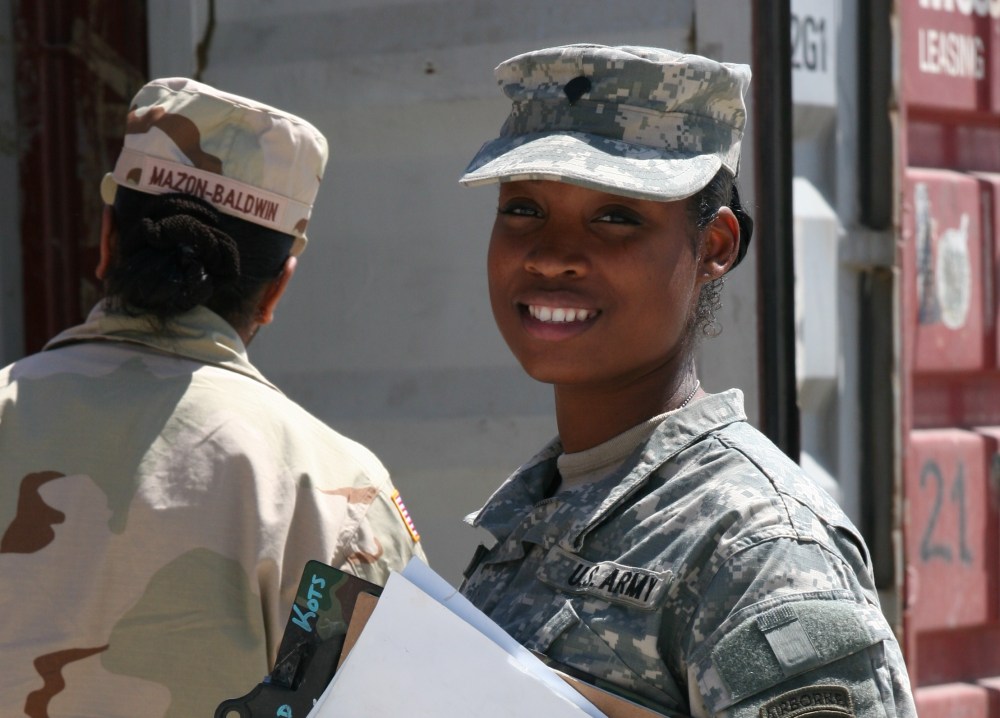
As a veteran living with PTSD, Nicole Baldwin wants to give back to her fellow military women who are struggling to adapt to life after serving. After starting her own skin care line in Afghanistan and working tirelessly to get it off the ground in the US, Baldwin realized the need for active support networks to guide women veterans as they readjust to the rhythm of civilian life. She hopes to help other women living with PTSD hit their stride in a society that often misunderstands their journey. Here, she shares her story.
MSNBC: What do you think is one of the most troubling challenges facing women who serve?
Finding employment outside of the military can be very discouraging for veteran women; they have a higher unemployment rate than their male counterparts. We’re held to the same performance standards as men, yet when you step into the civilian sector, you’re not always given the same opportunities. Some employers don’t recognize how skilled and powerful military women are. They are used to leading through selfless service and taking charge, but are often overlooked by employers who are unaware of their strengths and leadership potential.
MSNBC: What has been the most difficult part of your transition to civilian life after your time overseas?
Camaraderie. The military is based on team cohesion and teamwork. You know you have a good leader in the military by how successful his or her troops are and by how well your leader looks out for you. However, when you step out of the military and back into the civilian sector, it’s a little different. In corporate America, you have a rat race and everyone is trying to get to the top. Everyone wants to be the shining star. You leave a team environment and find yourself in a more competitive environment. In corporate America, it’s: “Look at me, Look what I did.” Whereas in the military, it’s: “Look at us, look what we did.”
MSNBC: You started your own skin care line while serving in Afghanistan. Was it difficult to launch your company overseas and continue to grow your business once you returned to the US?
I ran into the challenge of getting manufacturers to take me seriously. Here I was, a soldier entering a heavily-saturated market and trying to get people and companies to believe in my idea. I built my prototypes and then launched from Afghanistan. Once I was stateside, my biggest challenge was the heavy competition in the cosmetic industry.
MSNBC: Would you do anything differently if you could?
I would have built a more solid marketing plan and sales strategy. I strongly believe if I had focused more time on those two critical elements of my business and not spent too much time on working on product formulations and design ideas, Biao Skincare would be further along.
MSNBC: If you could go back in time and give yourself some more general career guidance, what would it be?
I would tell myself to be more patient. As an entrepreneur, I’ve learned you must be patient and trust the process. It’s okay to not move as swiftly as the crowd, as long as you are continuing to move at a pace that is getting you where you want to go. Learning to have patience allowed me to grow the way I needed to grow and build my business. It also helped me to stop comparing my success to the success of my peers.
MSNBC: What do you think our society should understand and appreciate about veterans who are living with PTSD?
People have so many stigmas with mental illness. However, just like the body gets sick, the mind gets sick – that’s why it is just as important for a person to have mental check-ups as it is to have physical check-ups. Service men and women with PTSD face this: you are trained for war, you are trained for death and you are trained to be in harm’s way. When in harm’s way, it is natural for us to be afraid and react in a fight or flight mode. For a person with PTSD, however, this reaction is damaged. This person may be out of a war zone and safe, but his or her brain stays in fight or flight mode and is triggered by certain events or memories. PTSD involves both biological and psychological trauma from events, shattering a person’s sense of security and making them feel more helpless and vulnerable in an unsafe world.
MSNBC: You’ve been forthcoming about your own struggle with PTSD and the challenges of adapting to civilian life. What motivates you to push forward?
Adversity motivates and inspires me. It teaches us resilience. Show me a person that is resilient, and I know that person has survived adversity. A lot of people have given up on their goals because they have allowed adversity to get the best of them. One of the things I learned from the military is how to overcome that. In business, life and relationships, I look at adversity as something I have to maneuver around and nothing that I have to stop for. It actually motivates me because it forces me to create a plan and solution.
MSNBC: You’ve always considered yourself an entrepreneur. What is the most rewarding part of running your own business? The most rewarding part of owning a business is that every day you wake up and are doing something that you are passionate about. You are surrounded by people that you can mentor, encourage and like being around. Entrepreneurship is part of my purpose and my destiny. True success comes from having inner peace and we only find inner peace through the things that uplift, encourage and motivate us. I have faced many challenges as an entrepreneur, but I find my strength and am able to keep going because I have inner peace in knowing that I am passionate about what I am doing. MSNBC: Was there a time when you couldn’t find that strength and inner peace? How did you overcome it? I found myself sabotaging my dreams and success because I lacked the self-confidence I needed to completely believe in myself. I had to step out of my shell and tell myself that I was not going to play my own game anymore. I wasn’t sitting around feeling sorry for myself or having internal pity parties anymore. It was time for me to get my self-confidence back. Sometimes as women, we self-sabotage ourselves and miss out on opportunities just because we lack something as simple as self-confidence. It was a ‘Know Your Value’ moment for me when I made up my mind that I was accepting myself, loving myself unconditionally and that I deserved to soar and become everything I was destined to become. MSNBC: You were selected as a Grow Your Value finalist – part of Mika Brzezinski’s Know Your Value initiative to empower women in the workplace. What inspired you to enter the competition? My new organization ITHRIVE inspired me to enter the Grow Your Value bonus competition. Having PTSD, a big part of my recovery has been having a support system and surrounding myself with successful people. I created ITHRIVE Network, a non-profit solely dedicated to helping women who have experienced trauma recover and then soar in life. We are only working with military women with PTSD right now because I want to approach what I know and then grow the organization to help more women after showing our proven results. I thought entering the competition would allow me to have a voice, break some of the stigmas surrounding PTSD and earn $10,000 that I could invest into ITHRIVE. MSNBC: What do you hope to gain from participating in the movement? I hope to become a voice and an advocate for military women with PTSD. While PTSD is being addressed, it hasn’t been completely addressed when it comes to women (who are often affected more than males). I hope to use the tools and the resources presented to me during this competition to continue growing my value and helping other women know their value through ITHRIVE. You can catch Nicole and the other Grow Your Value finalists compete for $10,000 at Orlando’s Know Your Value event on Friday, November 20 at msnbc.com/knowyourvalue where we’ll be livestreaming the event.
Kara Stiles Recommended


