








Under a warm spring drizzle outside of a Hilton Hotel in Washington, D.C., in 1981, a mentally disturbed man took aim at then-President Ronald Reagan with an illegally purchased .22 caliber pistol. The man, John Hinckley Jr., ambushed Reagan, firing off six shots and in the process wounding the president, a police officer, a Secret Service agent and Reagan’s press secretary, James Brady.
Although each of Hinckley’s victims would survive, Brady, who suffered a gunshot wound to the head, was left partially paralyzed for life.
The shooting would be a defining moment in the gun control movement. Brady’s family and advocates for stricter gun laws pushed Congress to take action. Hinckley, who had a history of mental illness, had purchased the gun from a Dallas pawn shop using an expired driver’s license and without a background check being conducted. And just four days prior to the assassination attempt, Hinckley was arrested in Nashville while trying to board a flight carrying three handguns and several rounds of ammunition.
Brady’s wife Sarah became a tireless advocate for stricter gun control measures, and pushed Congress to expand legislation that would tighten limits on who could legally purchase a gun. Sarah Brady argued that had a background check on Hinckley been conducted, perhaps the shooting could have been avoided.
On November 30, 1993, more than a decade after the shooting, President Bill Clinton signed into law the Brady Handgun Violence Prevention Act, which mandated federal background checks on gun purchases from federally licensed dealers.
This month marks the 20th anniversary of the bill’s signing, and while there is much to applaud about the bill’s impact—more than 2 million gun purchases, many of them by felons and fugitives, have been blocked, gun-safety advocates say —another important piece of gun legislation is set to disappear.
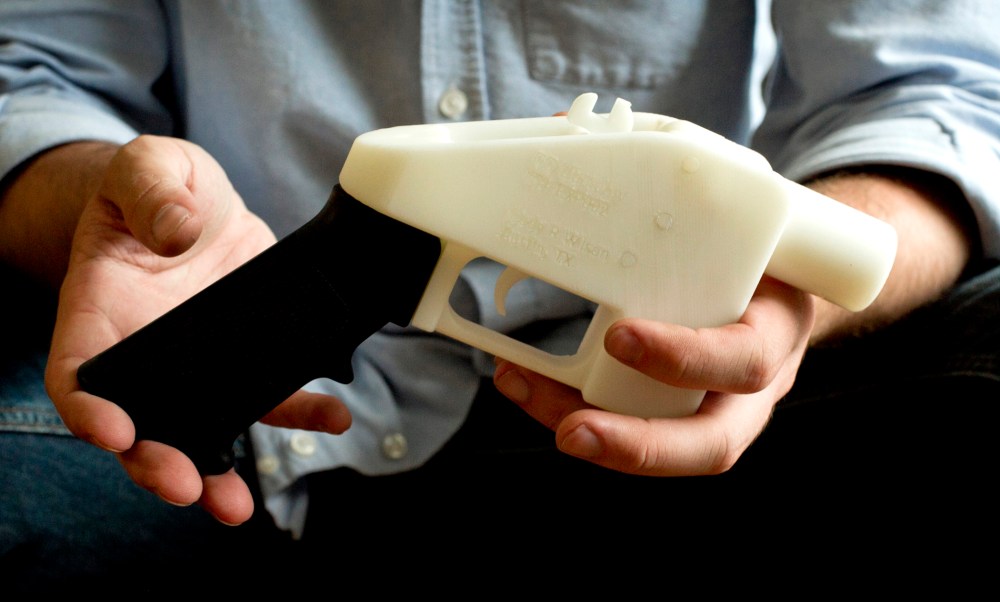
In less than a month, the Undetectable Firearms Act (which bans plastic weapons and those undetectable by metal detectors) expires. The ban expiration comes as technological advances have enabled 3-D industrial printers to produce guns made entirely of plastic.
Lawmakers have called for a renewed bans of such weapons.
“The expiration of this law, combined with advances in 3-D printing, make what was once a hypothetical threat into a terrifying reality,” Sen. Chuck Schumer of New York told the Associated Press. “We are actively exploring all options to pass legislation that will eliminate the problem.”
Federal law enforcement authorities and police leaders across the country are concerned that the ease with which these weapons are now able to be produced and the expiration of laws that have kept them illegal are a deadly combination.
The current law allows people to make plastic guns as long as there is enough metal in the gun to set off a metal detector. But there’s a loophole: gun makers could bypass the law by simply adding a removable piece of metal to the weapon. Downloadable directions for making plastic guns, which have shown success in firing several bullets before malfunctioning, have become widely available. According to Sen. Schumer, a blueprint for particular model was recently downloaded more than 100,000 times. “We are looking at a world in which anyone with a little bit of cash can bring an undetectable gun that can fire multiple bullets anywhere—including planes, government buildings, sporting events and schools,” Schumer said. “3-D printers are a miraculous technology that have the potential to revolutionize manufacturing, but we need to make sure they are not being used to make deadly, undetectable weapons.” The intersection of the anniversary of one bill and expiration of another comes as the country is again gripped in a debate over guns. Mass shootings in America have becoming more regular. The Obama administration and the Democrats have so far failed to pass a comprehensive new gun package that would require universal background checks on all gun purchases. At the same time the gun lobby has waged a war against politicians who support such bolstered gun control measures, with most of the casualties happening on the state level. Many Republican-led legislatures across the country have chosen to loosen gun laws in response to calls that they be tightened. “Background checks work and they save lives,” Sarah Brady, chair of the Brady Campaign to Prevent Gun Violence, said in a statement. “Twenty years ago this month Congress had the will to take on the corporate gun lobby and pass the Brady law. Since then, 2 million purchases have been denied to people like convicted felons, domestic abusers, and fugitives. There is still work to be done, thousands of sales go unchecked every day at gun shows and on the Internet.” “Now it’s time for Congress to finish the job and extend background checks to all commercial gun sales,” she said. Brady and Dan Gross, the president of the Brady Campaign to Prevent Gun violence, will be speaking at a National Press Club Newsmakers news conference on Tuesday morning to assess the success of the Brady Bill.
Trymaine Lee
Trymaine Lee is an NBC News correspondent. Recommended


