








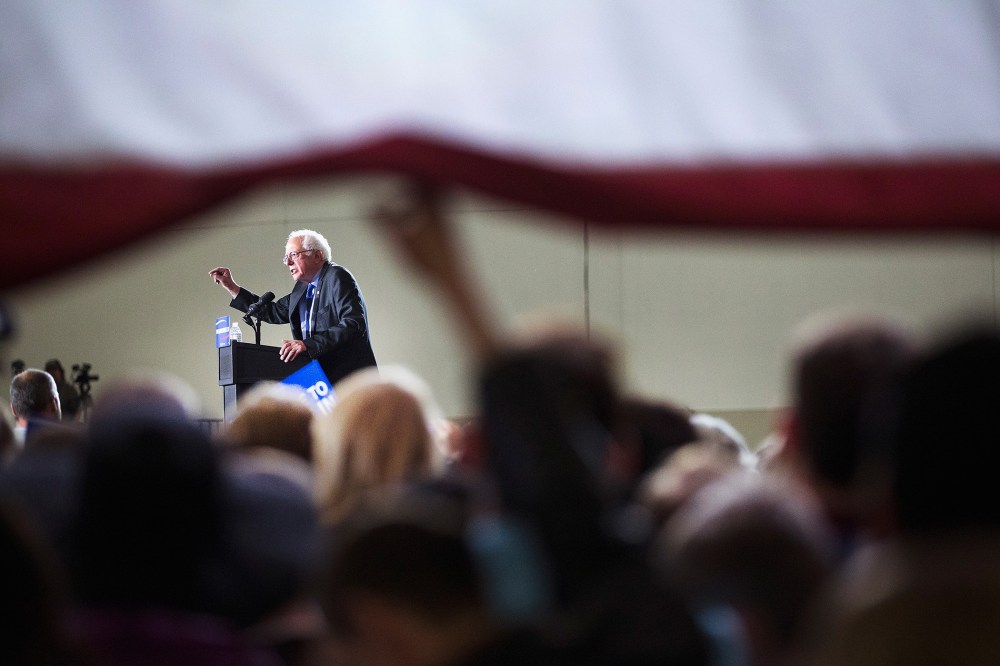
Wisconsin was one of the first places the Bernie Sanders phenomenon took root this year, and the underdog is hoping the state will deliver him another upset victory and some much-needed delegates in its primary next week.
Sanders put a sizable dent in frontrunner Hillary Clinton’s still-prohibitive delegate advantage last weekend, with caucus wins in Washington, Alaska and Hawaii. Now, he’s turning to Wisconsin, where he chose to give his first real victory speech Saturday night.
“Our campaign is the campaign of energy and momentum,” Sanders told more than 8,000 supporters in Madison. “We are making significant inroads in secretary Clinton’s lead and we have — with your support coming here in Wisconsin — we have a path toward victory.”
While the hat trick of wins, with massive margins, gave the Vermont senator’s campaign a meaningful batch of delegates and jolt of adrenaline heading into next Tuesday’s contest in Wisconsin, Sanders is still in a fight for his life in every single contest from here through June.
Sanders appears to be shooting for a majority of pledged delegates — with the expectation that superdelegates will come around — rather than an outright win, but even a single loss could potentially detail his already narrow track forward. And with only two state caucuses left on the calendar, Sanders is losing his best weapon against Clinton: the senator has won 10 out of 12 state caucuses thus far, and with the kinds of lopsided margins he needs to eat into her delegate lead.
RELATED: Wisconsin race tests impact of GOP campaign’s latest ugly turn
Wisconsin, which holds a respectable 86 delegates, seems like fertile ground for Sanders, with a long history of labor organizing and progressive politics, plenty of young people, and a mostly white complication. The Badger State was also the first state to turn out the kinds of massive crowds that have become the hallmarks of insurgent campaign.
Last July, after organizers had to scramble to upgrade to a series of successively larger venues, Sanders filled the a coliseum in Madison with what was, at that point, the largest crowd for any 2016 candidate of either party.
The crowd signaled real enthusiasm, but it also raised questions about whether his support would be confined to liberal enclaves like Madison, home of the University of Wisconsin and a progressive third party that has won numerous city offices.
The rest of the state is more conservative than Madison, and current Wisconsin polling, while very limited, shows Clinton ahead. Analyst Nate Silver’s FiveThirtyEight gives Clinton an 85% chance of winning the primary.
Still, Sanders has proved since that first big crowd in Madison that he can win outside college towns. And the Wisconsin numbers obscure more qualitative measures working in Sanders’ favor in the state.
As Sanders allies are quick to point out, he overcame an even larger polling deficit in next-door Michigan earlier this month. The two states share many characteristics, though Wisconsin is about half the size of its neighbor.
It’s also less diverse than Michigan, which should work in Sanders’ favor. Wisconsin is 88% white versus 80% in Michigan — according to Census data, and much of its minority population is concentrated in one city: Milwaukee, which is 40 percent African-American.
That city, the largest in the state, also historically has been a bastion of organized labor and has elected socialist mayors in the past. Sanders served as mayor Burlington as self-proclaimed Democratic-socialist.
If Sanders wins the state, the pre-election polling will give him another chance to claim a come-from-behind “shocking victory,” as his campaign manager Jeff Weaver put it in a fundraising email Sunday.
“Most folks in the political establishment were hoping we’d go away,” Weaver wrote. “But our campaign is still here, and we are stronger than ever.” Sanders returns to the state for series of events Tuesday and Wednesday, and will likely return later in the week. Meanwhile, the Clinton campaign anticipated a tough spell between March 15, when Clinton swept all five states up for grabs, and New York’s primary on April 19, when 247 delegates are at stake. Saturday’s losses did little to change the fundamental game plan. In an email from Clinton to supporters sent Monday, the frontrunner acknowledged the losses this weekend and looked ahead to contests in New York and Pennsylvania. The email made no mention of Wisconsin. Clinton is in Wisconsin Monday, where she is continuing to turn her attention to the general election. She devoted last week to undermining Republican frontrunner Donald Trump’s commander-in-chief credentials, and this week she’ll go after Republicans’ obstruction of President Obama’s Supreme Court nominee, according to a campaign aide. RELATED: What Sanders’ wins mean — and don’t mean At a speech at the University of Wisconsin-Madison Monday, Clinton will use the Supreme Court fight to underscore the stakes of the election, a theme she has hit all year, to quietly nudge Democratic primary voters to consider who would be a stronger general election candidate (most Democrats think Clinton, according to polls). In addition to hammering Republican senators Monday, Clinton will raise concerns about whom a President Trump might appoint to the high court, according to a Clinton campaign aide, and urge voters to keep the court top of mind as they vote. One thing is for sure: The pace of the calendar has significantly slowed, meaning each contest takes on added attention and significance. There are no contests this week and there is a two-week gap between Wisconsin and New York on April 19, which is already shaping up to be a major reckoning point in the primary, though Clinton currently has massive lead in polls there. Sanders on Sunday challenged Clinton to a debate in New York, where she lives and placed her campaign headquarters after serving two terms in the Senate. Sanders opened a campaign office in Brooklyn Saturday. The Clinton campaign has not yet responded to that request.
Alex Seitz-Wald Recommended


