








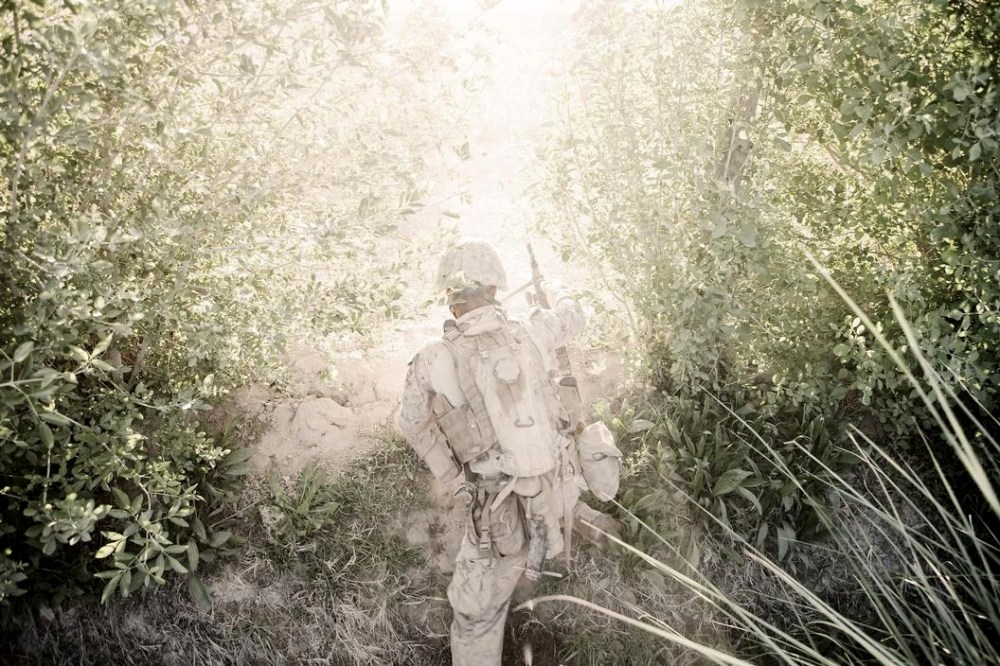
President Obama’s State of the Union address comes at a crucial moment. With the world in political, diplomatic and economic turmoil, there is plenty that he could say, but there’s one thing on which he should spend some time and effort: Afghanistan.
It has become something of a cliché to thank troops for their service, and there is truth to the notion that if you say “thank you” to a veteran it may be more satisfying to you than to the service member. But gratitude is easy, and it should be unstinting.
Each year, presidents stand in the center of the Capitol rotunda and thank our troops. Obama has been no exception. Last year, he said: “Tonight, we stand united in saluting the troops and civilians who sacrifice every day to protect us.” Then, to applause, he added: “Because of them, we can say with confidence that America will complete its mission in Afghanistan and achieve our objective of defeating the core of al Qaeda.
The president announced that over the next year, another 34,000 American troops would return from Afghanistan and that the nature of our commitment there would change.
He continued: “We’re negotiating an agreement with the Afghan government that focuses on two missions–training and equipping Afghan forces so that the country does not again slip into chaos, and counterterrorism efforts that allow us to pursue the remnants of al Qaeda and their affiliates.”
A year later, there is no agreement with Afghanistan, and the country seems at risk of failure once again.
The timing for this assertion is interesting, and there will be a great deal of ambivalence in the West Wing about bringing it up. The withdrawal from Iraq has had the salubrious effect of keeping Americans out of Iraq at a time when that country is going to pieces and is a surrogate battlefield for widespread sectarian animus in the region. There will be some who are critical, saying that the mess in Iraq would not be occurring if we had stayed, but that adventure would have required huge numbers of troops for decades, and there has never been much interest in that.
Candidate Obama cited Afghanistan as the good war, the just war, and he implied that he would commit the resources required to overcome the enemy there. But much has intervened, and with no more stomach for further combat he is withdrawing the majority of our troops. Among those who have served, withdrawal has generated great consternation. There is a sense of abandoning the troops and the anger that comes with the conclusion that their uncommon valor has been in vain.
War really is politics by other means, and in armed combat the military establishment fights for the nation and fights to accomplish the mission. But when a combat veteran’s memory turns to contemplate experiences in the horrible crucible of war, it is then that the truth emerges: troops really fight for each other. Fellow soldiers who perish are family. Not just in name alone are they “brothers” and “sisters,” and that is why withdrawal leaves veterans with anger that the nation has left behind those who paid the highest price. No matter how he deals with the issues attendant to our involvement in any of our recent conflicts, and if he wants to garner the longest, loudest applause of the evening, he should deliver to our veterans the thanks of a nation that has come to regard the efforts of these patriots as an entitlement. Because we don’t have to serve, we have become inured to the dedication of the few who are willing to shoulder the burden of defending the multifarious interests of a huge nation against a complex array of threats. Beyond the fulsome praise for our troops’ sacrifice in Afghanistan should be a real sense of what to expect there in the coming year and beyond. In last year’s speech, Afghanistan garnered three sentences. This year, it deserves more. Jack Jacobs is a retired U.S. army colonel and Medal of Honor recipient. He is a military analyst for MSNBC.
Col. Jack Jacobs Recommended


