








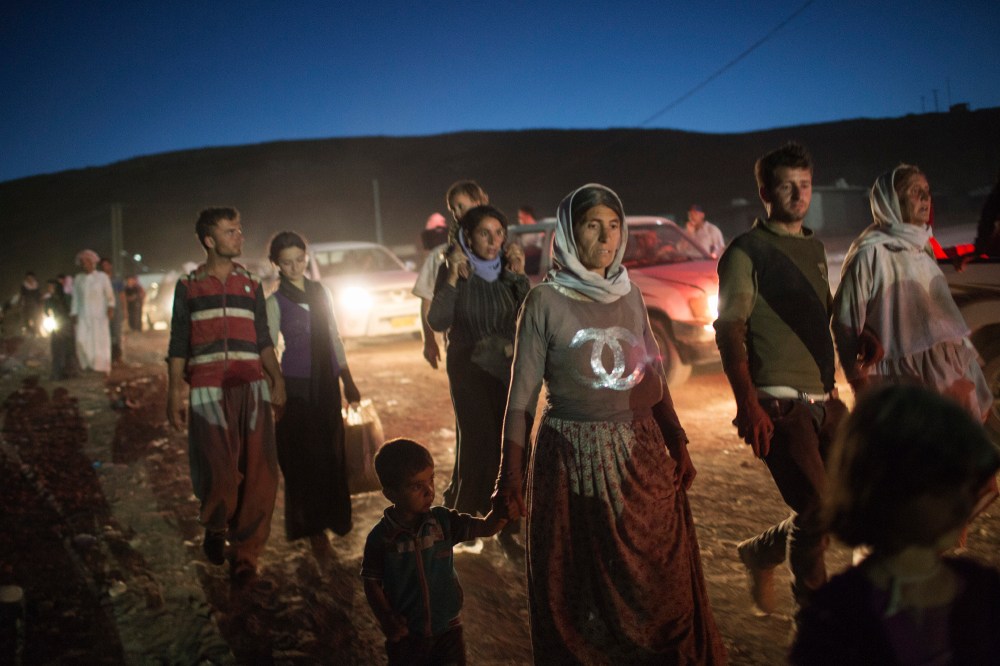
When President Obama laid out plans Wednesday to take military action against fighters who have taken control of parts of Iraq and Syria, he cleared the way for yet another open-ended conflict against militant forces. Reactions from members of Congress ranged from cautious support to calls for a more bellicose plan to combat the Islamic State in Iraq and Syria (ISIS), but human rights groups are already worried that Obama’s plans could have serious unintended consequences.
Even before airstrikes began in Iraq, drone strikes, raids, and other targeted killing missions have reportedly caused hundreds of civilian casualties in countries from Yemen to Pakistan, and millions of Syrians have been displaced by the civil war. And with Obama’s plan, hundreds more troops will find themselves on the ground, while bombs will drop and American weapons will arm forces in Iraq and Syria. But with so much focus on military action against a group that does not present an imminent threat to the U.S. homeland, there appears to be far less focus on the lives of civilians already living in war-torn countries.
PHOTO ESSAY: War-torn Iraq facing massive refugee crisis
After Obama’s speech, major human rights organizations were not necessarily opposed to military action, but they did call on the White House to follow international law and plan for contingencies like an increased need for humanitarian aid. “Islamic State has committed serious war crimes, but other militias supported by the Iraqi government have also attacked civilian populations in revenge and the Iraqi military itself has shelled residential communities,” Steven Hawkins, Amnesty International USA’s executive director, said.
“President Obama must make a public commitment that any U.S. airstrikes will be directed at bona fide military targets, with all reasonable precautions taken to prevent civilian death or injury,” he added. “Amidst the horrors caused by Islamic State, US policymakers should pause and ensure that U.S. policies do not do further harm to civilians caught in the ongoing conflict.”
Lama Fakh of Human Rights Watch told msnbc that when it comes to arming Syrian rebel groups, the U.S. will have to use care to ensure weapons don’t end up in the hands of militants who might supplant ISIS. “When arming non-state armed groups, you need adequate vetting and monitoring mechanisms, to make sure no arms are going to groups that are committing systematic abuse,” Fakh said.
At the same time, any action the U.S. takes has to include plans for the inevitable disruption of thousands, if not millions, of civilian lives, which means providing humanitarian aid and making sure new leaders don’t perpetuate violence, something that has already started happening in Iraq. In Syria, Fakh said, “When targeting Islamic state effectively removes the Islamic state from control, who is taking over after the fact? When these sorts of power vacuums exist, we want to make sure that the Syrian government isn’t taking over and perpetrating abuses.”
These same questions continue to plague observers of the nation’s recent wars, both started by Obama’s predecessor with little thought to how to end them. Win Without War Advocacy Director Stephen Miles said in response to Obama’s speech, “While we, like all Americans, share in the outrage over the violence of ISIS militants, an open-ended escalation of U.S. military force is not the answer. The instability we see today in the Middle East was, in many ways, sparked by President George W. Bush’s disastrous invasion of Iraq in 2003, and we must be skeptical of the belief that more American bombs will bring peace to a region embroiled in a massive, sectarian war.”
And after 13 years and thousands of lost American lives, even the presence of so-called advisers on the ground in Iraq represents a troubling escalation to some. “The U.S. is racing down a slippery slope toward war in Iraq and Syria,” said Veterans for Peace Vice President Gerry Condon in a statement. With more than 1,000 troops already on the ground and another 350 on their way, the lack of an explicit combat mission will mean little if the situation pulls them into violence. “Veterans know from first-hand experience that you cannot bomb your way to peace. More bombing will ultimately mean more division, bloodshed, recruitment for extremist organizations, and a continual cycle of violent intervention,” Condon said. President Obama did not name a single country that would be joining the coalition that will send support to Iraq, but international military action without simultaneous international humanitarian action will only cause strife. “We need a more robust international response to respond to the needs of civilians,” Fakh told msnbc. Paul Kawika Martin, the political director of Peace Action, echoed Fakh in his own statement on Obama’s plan. “True international support to deal with ISIS requires UN action and regional diplomacy,” he said. “More weapons in the Mideast is not the solution, and is more like pouring fuel on a fire.”
Meredith Clark
Meredith Clark is a freelance writer and editor. She was previously a senior news producer for "Patriot Act with Hasan Minhaj," a reporter with MSNBC.com, the digital politics and culture editor at Glamour and a senior news and politics editor at Refinery29. She has written for Vulture, Rolling Stone, Self, Marie Claire, Cosmopolitan, The Daily Beast and Bustle. Recommended


