








Introduction — The Heir
For an instant, she hurtled toward the floor. A slender, delicate right shoulder knifed downward, a cane flipped sideways. Nancy Reagan, tiny, fragile as a china figurine in an ivory-colored suit, was crashing.
Many in the capacity crowd at the Ronald Reagan Library in Simi Valley, California, couldn’t see what was happening. They clapped lovingly, oblivious. But before their applause gave way to gasps the synapses of the young senator escorting the former first lady to her seat fired perfectly. Marco Rubio, his hair parted just so, a valedictorian’s smile on his face, tugged the aging icon toward him. He leaned right and swung a hand beneath her left arm, catching the ninety-year-old just as she slanted forward, almost parallel to the floor and bound for a bone-chipping thud.
Rubio, a forty-year-old who looked a decade younger, moved with the sure agility that he once flashed on the high school football fields of Miami. He wasn’t fast, but he was quick, his high school athletic director, James Colzie, always thought. On the football field there’s a difference. Fast means you run at high speed; quick means you react at high speed. Quick means you get to the right spot on the field at precisely the right time.
Sometimes being quick is better than being fast.
It was August 23, 2011. The figurine didn’t shatter.
Read more Morning Joe book excerpts
Soon it was clear that this was a moment. A Los Angeles Times blog published a frame-by-frame sequence of photographs beneath the headline “Marco Rubio to the Rescue!” They showed Nancy and Marco smiling at each other, then Nancy happily looking into the audience, then starting a slow-motion tumble as the senator reaches over to pat her hand, then Rubio saving her. The former first lady’s anxiety at that second is written on her face as she grimaces and closes her eyes. Later ABC World News dedicated a segment to what the guest anchor George Stephanopoulos introduced as “that video that made so many of us gasp today.” He brought in the network’s medical expert, Dr. Richard Besser, to soberly explain the dangers of falls for the elderly.
Conservative bloggers and their readers, who had been reliably laudatory about all things Rubio during his quick ascent in the Republican Party, praised him. “Hero! Marco Rubio Saves a Falling Nancy Reagan,” said conservativebyte.com. The headlines might just as well have read “Marco Rubio Saves the Republican Party.” “This feels like an omen,” a commenter on The Blaze website wrote. “Saving Reagan I think is a sign from above,” a Human Events reader observed. Another asked, “Now will Marco Rubio SAVE AMERICA from its DOWNFALL? Is this a sign or what? ‘Ronnie’ saved the world from the Communists. Rubio can save America from its leftover Communists.”
Rubio, in a sense, was viewed as a political son of Reagan’s, an heir to his legacy of conservative principles. One of Reagan’s real sons, a cheeky liberal, reacted to the news more like a son worried about his mother than as a political enthusiast. Watching the video of Rubio escorting his mother before she tripped, Ron Reagan fumed: “He’s playing to the cameras. He’s not paying attention to her!”
Reagan, who calls Rubio “the guy who dropped my mom,” planned to lay into the senator if someone from the media called. But, he told me, no one called.
Nothing was going to shatter this moment.
Rubio’s reflexes had only sharpened the impression that a party looking for heroes had found a figure with great promise, an idol touched by serendipity. Rubio’s team couldn’t believe its luck. “We joked in the office that he tripped her,” a top Rubio political advisor told me not long after the greatest interception of Rubio’s career.
Extraordinary political careers can build momentum from an accretion of perfect moments, and this was just one more for Marco Rubio. American politics had never seen anything like him: a young, made-for-YouTube Hispanic Republican with realistic national prospects, establishment backing, and electoral appeal that extended well beyond his ethnicity. There had been Hispanic stars before. But they tended to be Democrats and they tended to fizzle like Henry Cisneros, the suave Mexican American housing secretary, or plateau like Bill Richardson, the Mexican American foreign policy maestro with the decidedly un‑Hispanic-sounding name.
Rubio had arrived on the national scene at a time when both parties were—again—forced to confront the enduring and growing power of Hispanic voters. Could they be wooed with promises of immigration reform alone, or must they be courted with some mix of social issues and religion, and promises of jobs? Might Marco Rubio be the solution?
Good timing matters, but it isn’t everything. Execution counts too. And each time Rubio’s timing has been good, his execution has been even better.
It was a blessing for him to come into Florida’s House of Representatives just when term limits were clearing away much of the competition for leadership spots. But then Rubio did something with his good fortune, strategizing behind the scenes and impressing his elders so that he could ascend. It was fortuitous for him to encounter a Republican primary opponent in a U.S. Senate race who had alienated the Republican Party. But Rubio also capitalized on that opportunity. He overcame polls that showed he had no chance and pulverized the once popular Florida governor Charlie Crist so effectively that Crist was forced to quit the Republican primary and run as an independent. Then Rubio found himself in a vote-splitting, three-way Senate race, and again he made the correct call, sweeping wide to the conservative right and finishing off Crist by trapping him on the left sideline.
In 2010 a national narrative evolved around the idea that Rubio was a product of the tea party, an amorphous movement of discontented Americans who wanted to wipe Washington clean. It was as if Rubio had sprung whole from a town hall meeting. Of course, nothing could have been further from the truth. His rise had actually been as conventional as they come. He’d climbed the staircase methodically, touching each step along the way rather than leaping from the landing to the top floor. In that same election season, there’d been a gusher of out-of-nowhere tea party successes. Christine O’Donnell, who had never won a major election, and Joe Miller secured Republican U.S. Senate primary victories in Delaware and Alaska before losing in the general election. Rand Paul, the son of Ron Paul, a Texas congressman and Republican presidential candidate, was elected to the U.S. Senate in his first attempt at political office.
But Rubio had been running for—and winning—elections for most of his adult life. West Miami city commissioner, Florida state representative, Florida house speaker, U.S. senator. Step, by step, by step.
A letter from Nancy Reagan inviting him to speak at her husband’s presidential library only confirmed what everyone knew: Rubio had arrived. “You’ve been identified as someone to watch on the national political scene,” the letter read. “I’m looking forward to watching you in your new role.”
The Reagan Library speech was a prestige gig, a way for Republicans to walk their finest past the gallery for inspection. With Rubio’s invitation to speak came an invitation to dinner, and as ever, he did not fail to impress. The meal was served in the library’s personal quarters. Gerald Parsky, a trustee of both the Ronald Reagan Presidential Foundation and the George H. W. Bush Presidential Library Foundation who had served in five Republican administrations, watched approvingly during the dinner as the young senator charmed the former first lady. “Very relaxed. Easy dialogue. Not nervous at all,” Parsky said of Rubio. “I was impressed.”
Rubio, who has a knack for a kind of self-effacement that draws him closer to his audience while simultaneously showing off his importance, later shared an intimate moment from that meal. “Mrs. Reagan,” he said—a bit formally, ever the polite young man—turned to Rubio’s wife, Jeanette, and told her that “Ronnie” used to “send [her] mom flowers” every year on Nancy’s birthday. The flowers were always accompanied by a note from Ronnie thanking Nancy’s mother for giving birth to her. “And he’d written over 700 love letters or something like that,” Rubio continued. “And I’m just thinking, man, I am in a deep, deep hole. I’ll never catch up to the Gipper.” Rubio was careful to note that he wasn’t calling Ronald Reagan by the diminutive “Ronnie”—that would be disrespectful.
In his speech at the library, Rubio positioned himself as a Reagan for the twenty-first century. Reagan had wanted to properly define the role of government; Rubio wanted to properly define the role of government. Reagan understood that Americans wanted a nation that aspired to prosperity and compassion; Rubio understood that Americans wanted a nation that aspired to prosperity and compassion. Reagan had his Morning in America, an image of a country growing stronger and prouder; Rubio promoted American exceptionalism, the notion that the United States is greater than any nation on Earth and has a solemn responsibility to maintain that status. It was one of Rubio’s mantras during his U.S. Senate campaign and it played well at a time when the housing market was a disaster, unemployment was soaring, and Wall Street chieftains were flying away in private jets with tens of millions of dollars in golden parachutes while their banks were collapsing.
Here was this young, Cuban American politician with dark brown eyes and a huge smile telling everyone that things were going to be okay in a manner that sounded off the cuff, like he really meant it.
On a phone call before his Reagan Library appearance Rubio explained to Parsky that he preferred to speak from notes rather than a full written text. “He made a point of that in the prediscus-
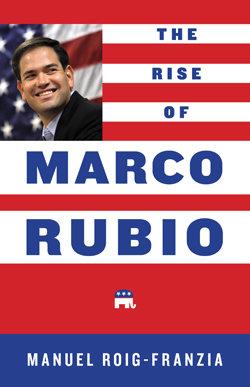
sion,” Parsky said. But Rubio’s speech that day revealed a young star still finding his footing. He lacked the crispness that he’d displayed in previous addresses, as if he’d grown a little cocky, a little too confident in his ability to wing it. Several times he stumbled over key lines or groped for words, but he still managed to wow his audience. Rhetorically Rubio had given himself a complicated task. His message of optimism, his fixation on American exceptionalism, had to be reconciled with his assertion that the United States was headed for disaster. He would have to explain why the very generations that so many thought had contributed to the nation’s greatness were also responsible for endangering its long-term solvency. Making that kind of claim required some rhetorical gymnastics. After all, the society that he was saying had screwed up so badly had done relatively well for itself in the twentieth century. It had defeated Hitler, built the largest economy ever seen, vanquished the Soviet Union, and landed on the moon. “It is a startling place to be, because the 20th Century was not a time of decline for America, it was the American Century,” Rubio told the audience. “And yet today we have built for ourselves a government that not even the richest and most prosperous nation [on] the face of the Earth can fund or afford to pay for.” He zeroed in on entitlement programs, telling his audience that when Social Security was enacted there were sixteen workers for every retiree, a ratio that had plummeted to three to one in 2011 and was headed toward two to one. Others had also been warning about impending doom. Special commissions had been formed and disbanded. The former U.S. comptroller general David M. Walker had been barnstorming across the country proclaiming that the exploding cost of Social Security, Medicare, and Medicaid would consume the entire federal budget as soon as 2025. Rubio presented an idealized view of times gone by. In another era, he told the audience, “If someone was sick in your family, you took care of them. If a neighbor met misfortune, you took care of them. You saved for your retirement and your future because you had to. . . . We took these things upon ourselves and our communities and our families and our homes and our churches and our synagogues. But all that changed when the government began to assume those responsibilities. All of the sudden, for an increasing number of people in our nation, it was no longer necessary to worry about saving for security because that was the government’s job. . . . And as government crowded out the institutions in our society that did these things traditionally, it weakened our people in a way that undermined our ability to maintain our prosperity.” That final observation—that entitlement programs had weakened Americans—was the point he clearly wanted to hammer home. He said it three times in the course of his twentythree-minute speech. The senator from the state with the second highest number of Medicare beneficiaries was giving a speech in the state with the highest number of Medicare beneficiaries and calling American retirees—many of whom were members of the so‑called Greatest Generation—weak. It seemed like sloppy speechifying. “It’s not as bad as calling Social Security a Ponzi scheme, but it’s not the best way to express it,” a prominent national Republican insider and admirer of Rubio’s told me. Or was it? In the days after the speech, liberal groups and left-leaning commentators pounced. On msnbc—which had become a counterpoint to the conservative Fox News Network— commentator Ed Schultz called Rubio “a political hack.” “For Marco Rubio to say programs like Medicare and Social Security weaken Americans is flat out Psycho Talk,” Schultz barked. On the same network host Rachel Maddow reminded her viewers about a previous speech in which Rubio had said that Medicare paid for his father’s health care during the illness that led to his death in September 2010. The government program had “allowed him to die with dignity by paying for his hospice care,” Rubio had said. Maddow argued that there was a glaring inconsistency. “What would he run as, the guy who says Medicare saved his father and his family but it’s also turned you weak and helpless?” she told her viewers. Yet the address she cited was an impassioned plea to save Medicare by reforming it. Rubio specifically stated that he would not advocate changing the system for anyone over the age of fifty-five. But by using an inflammatory word like “weakened” during his Reagan Library speech he had given his opponents an opening. It didn’t really matter that most of the criticisms ignored the substance of the point he was trying to make. He wasn’t advocating abolishing entitlement programs for current recipients, and he told the Reagan Library audience as much: “My mother just—well she gets mad when I say this—she is in her eighth decade of life and she is on both of these programs. I can’t ask my mom to go out and get another job. She paid into the system.” But he was calling for change to the system so that it had a chance to endure. “The truth is that Social Security and Medicare, as important as they are, cannot look for me how they look for her. My generation must fully accept, the sooner the better, that if we want there to be a Social Security and a Medicare when we retire, and if we want America as we know it to continue when we retire, then we must accept and begin to make changes to those programs now, for us.” As the clamor grew louder on the left, Rubio pushed back hard. He portrayed the criticisms as just another bout of whining from lefties. Here was a glimpse of another side of Marco Rubio—not the Florida politician who spoke about finding common ground with his political opposites—but the political brawler born of South Florida’s caustic campaigns. During his rise, Rubio had surrounded himself with scrappers, men who envisioned politics as a slugfest. Rubio did not like being challenged, and when he was, his reflex action was to punch back. He used the opportunity to argue for reforming entitlement programs and sought to hold himself up as a sage of fiscal responsibility. So confident that he’d gained an upper hand, he even used the hubbub as a fundraising pitch. “The speech drove extreme liberals crazy, and they are on the attack,” read an email sent by Reclaim America, Rubio’s political action committee. “We need your help to fight back and support limited government candidates who share Marco’s conservative vision for America.” Rubio was working from a time-tested political strategy: attack the media, especially outlets perceived as liberal. His base loved it, and Republican Party wise men such as Parsky applauded. “I think that he demonstrated courage in terms of a willingness to address the importance of addressing entitlements, especially Social Security,” Parsky said. The controversy invested in Rubio more stature as a conservative with substance and pluck. He’d already become one of the best-known Cuban Americans in the United States. His family history, their journey from Cuba to the United States, had become a core element of his political identity. And though that history, as he related it, would not entirely stand up to close scrutiny, its essence—that he was the product of the Cuban American experience—would prove resilient. But his popularity transcended and, in some ways, defied ethnicity. His national support seemed to derive as much from his conservative credentials as from the vowels at the end of his names. Two weeks after Rubio’s Reagan Library speech, Rush Limbaugh predicted, without equivocation, that Rubio would be elected president someday, the first Hispanic to hold America’s highest office in the land. The commentariat bubbled with speculation that Rubio would be a future Republican vice presidential or presidential nominee. An heir apparent had been crowned. It had happened, as Rubio’s old football coaches might say, “real quick.” From The Rise of Marco Rubio by Manuel Roig-Franbzia. Copyright © 2012 by Manuel Roig-Franzia. Reprinted by permission of Simon & Schuster, Inc. All rights reserved.
The place for in-depth analysis, commentary and informed perspectives. Recommended


