








In the hours after the assassination of John F. Kennedy, more than one person suggested to Jackie that she change clothes.
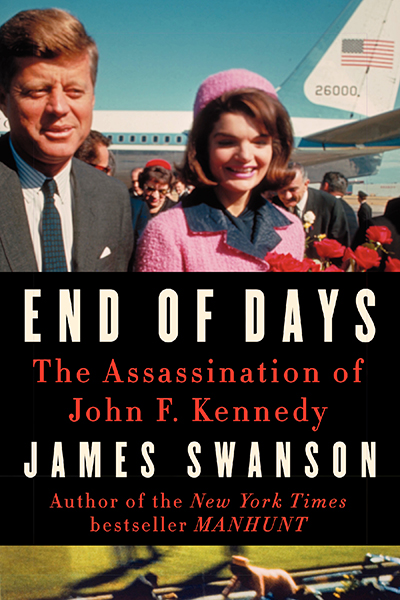
Her pink suit, white gloves and stockings were caked with dried blood — the bright red, wet blood spilled two hours ago had, after exposure to oxygen, solidified and taken on a darker color. Each time someone asked her, the more adamant she became. “Everybody kept saying to me to put a cold towel around my head and wipe the blood off.”
No, she insisted, she would not change. “I want them to see what they’ve done,” she repeated more than once.
To prepare, Jackie retired to a small bathroom. There, she said, “I saw myself in the mirror; my whole face was spattered with blood and hair . . . I wiped it off with Kleenex . . . then one second later I thought, why did I wash the blood off? I should have left it there, to let them see what they’ve done . . . If I’d just had the blood and caked hair when they took the picture . . . I should have kept the blood on.”
Some of Jackie’s aides were angry that Johnson wanted her photographed at the swearing in and surprised that she agreed. But Jackie said, “I think I ought to. In the light of history, it would be better if I was there.”
It was dark when Air Force One landed at Andrews Air Force Base outside the nation’s capital at 6:05 p.m. Crowds of mourners had flocked there to watch the jet land and to see Kennedy’s flag-draped coffin removed from the plane.
Robert Kennedy, members of the cabinet and senior government and military officials stood and watched. The president’s brother rushed to the plane and boarded it through a front door. He ran down the aisle, brushing past everyone in his path, including the new president. There was only one person in the world Bobby wanted to see, and she was at the back of the plane, sitting by a flag-draped coffin. They found each other and embraced.
“Hi Jackie, I’m here,” was all he could say.
The American people were about to get their first look at Jackie Kennedy since the assassination almost five hours ago. A rear door on the plane opened. An elevated platform was put in place to receive the coffin. Then Jackie Kennedy appeared in the doorway. Standing next to her was her brother-in-law, Robert Kennedy. The image was confusing. He had not been in Dallas, so how was it that he was exiting Air Force One with Jackie?
All across the country, millions of people staring at their television screens gasped when they saw the bloodstains on her clothing. Jackie had still not changed out of the clothes she had worn in Dealey Plaza.
On television screens, as she walked to the navy ambulance, viewers saw that her legs were smeared with copious amounts of blood. She wanted to sear these images into the collective memory of the American people so that they would never forget.
It worked. To this day, decades after the assassination, the mere sight of an image of her in that suit triggers flashbacks in the minds of every person who remembers November 22, 1963.
From Andrews Air Force Base, President Kennedy’s body was not yet ready to go home to the White House. First, accompanied by Jackie, a navy ambulance took him to Bethesda Naval Hospital, across the Maryland border from Washington. There would be an autopsy to document the official cause of death. Kennedy had been a naval officer, so Jackie, even before Air Force One had touched down, chose Bethesda Naval Hospital.
When Jackie entered the hospital, she was taken to a waiting room on the 17th floor. As she settled in for a long night, the president’s brother Robert told her that a suspect had been arrested for her husband’s murder.
“They think they found the man who did it,” the attorney general said. “He says he’s a communist.”
Jackie was aghast, and she said to her mother, who had joined her in Bethesda, “He didn’t even have the satisfaction of being killed for civil rights . . . It’s — it had to be some silly little communist.”
The next day, Jackie picked out a grave site at Arlington National Cemetery and began planning her husband’s public funeral. With Abraham Lincoln’s funeral as her inspiration, researchers had set to work. They uncovered historical details that had been forgotten since the Civil War, including the exact way that the White House entrances and East Room chandeliers had been draped in mourning with ribbons of black crepe paper.
One last-minute request Jackie made was for an “eternal flame” beside the grave. She said she wanted to light a flame at the climax of the service in Arlington that would burn forever in memory of her husband.
She recalled the day when she and the president had toured the Civil War battlefield of Gettysburg. There, at the Eternal Light Peace Memorial dedicated by President Roosevelt in 1938, she had seen an eternal flame — a gas-powered fire that burned day and night, around the clock — that illuminated the top of the tall monument. At Arlington, army engineers had one built at ground level next to President Kennedy’s grave site in less than 24 hours, and it was ready in time for Jackie to light it on Monday afternoon.
After the funeral service at St. Matthew’s Cathedral, Jacqueline Kennedy and her children, standing outside the church, watched the honor guard carry the coffin down the steps. A military band played “Hail to the Chief.” Jackie bent down and whispered in her little boy’s ear, “John, you can salute Daddy now and say goodbye to him.”
John Kennedy Jr. saluted his father’s coffin just as he had seen soldiers in uniform do. It was a heartbreaking gesture that became one of the most unforgettable images of the funeral.
The day after Thanksgiving, on Friday, Nov. 29, Jackie called Theodore White, Pulitzer Prize–winning author of the bestselling book The “Making of the President: 1960.”
White and John Kennedy had gotten to know each other, and the president had admired him. When Jackie called, White was not home.
As he remembered, he “was taken from the dentist’s chair by a telephone call from my mother saying that Jackie Kennedy was calling and needed me.”
He called her back. “I found myself talking to Jacqueline Kennedy, who said there was something that she wanted Life magazine to say to the country, and I must do it.”
She told White she would send a Secret Service car to fetch him in New York and drive him up to Hyannisport. But when White called the Secret Service he was, he wrote, “curtly informed that Mrs. Kennedy was no longer the president’s wife, and she could give them no orders for cars. They were crisp.”
It was impossible to fly that weekend. A nor’easter or a hurricane was coming up over Cape Cod. So White hired a car and driver and headed north into the New England storm. He called his editors at Life to tell them about his exclusive scoop, but they told him the next issue was about to go to press. They warned him it would cost $30,000 an hour to hold the presses open for his story. It was unprecedented.
But they would do it.
This meant that the most important photojournalism magazine in America would be standing still and delaying the printing of its next issue for a story that had not yet been written and would be based on an interview that had not yet even been conducted. Still, an exclusive interview with First Lady Jacqueline Kennedy was so coveted, Life was willing to do almost anything.
White arrived, he recalled, “at about 8:30 in the driving rain.”
Jackie welcomed him and instructed her houseguests, who included Dave Powers, Franklin D. Roosevelt Jr. and JFK’s old pal Chuck Spalding, that she wanted to speak with him alone. As soon as she sat down, White began taking notes as fast as his hand could scribble: “Composure . . . beautiful . . . dressed in trim black slacks . . . beige pullover sweater . . . eyes wider than pools . . . calm voice.” Then she spoke.
“She had asked me to Hyannisport,” White discovered, “because she wanted me to make certain that Jack was not forgotten by history.”
White was stunned. How could anyone ever forget John F. Kennedy? White was now ready to be hypnotized by a master mesmerist. Jackie complained that “bitter people” were already writing stories, attempting to measure her husband with a laundry list of his achievements and failures. Jackie hated that. They would never capture the real man. White asked her to explain, and then, for the next 3¹/₂ hours, she delivered a jumbled, almost stream-of-consciousness narrative about Dallas, the blood, the head wound, the wedding ring, the hospital, and how she kissed him goodbye. It was only a week after the assassination. Then she got to the reason she had summoned White: “But there’s this one thing I wanted to say . . . I kept saying to Bob, I’ve got to talk to somebody, I’ve got to see somebody, I want to say this one thing, it’s been almost an obsession with me, all I keep thinking of is this line from a musical comedy, it’s been an obsession with me.” She confided to White. “At night, before we’d go to sleep . . . Jack liked to play some records . . . and the song he loved most came at the very end of this record, the last side of Camelot, sad Camelot.” She was talking about the popular Broadway musical fantasy about King Arthur’s court. “The lines he loved to hear,” Jackie revealed, were, “Don’t let it be forgot, that once there was a spot, for one brief shining moment that was known as Camelot.” In case White failed to understand, she repeated her story. “She wanted to make sure,” the journalist remembered, “that the point came clear.” Jackie went on: “There’ll be great presidents again — and the Johnsons are wonderful, they’ve been wonderful to me — but there’ll never be a Camelot again.” White wanted to continue to other subjects, “But [Jackie] came back to the idea that transfixed her: ‘Don’t let it be forgot, that once there was a spot, for one brief moment that was known as Camelot.’ ” She was determined to convince White that her husband’s presidency was a unique, magical and forever lost moment. “And,” she proclaimed, “it will never be that way again.” President Kennedy was dead and buried in his grave, and she told the journalist she wanted to step out of the spotlight. “She said it is time people paid attention to the new president and the new first lady. But she does not want them to forget John F. Kennedy or read of him only in dusty or bitter histories: For one brief shining moment there was Camelot.” Around midnight, White went upstairs to write the story — Life needed it before he left Jackie. He came down around 2 a.m. and tried to dictate the story over a wall-hung telephone in her kitchen. He had already allowed her to pencil changes on the manuscript. As White spoke over the phone, Jackie overheard that his editors in New York wanted to tone down and cut some of the “Camelot” material. She glared at White and shook her head. One of his editors caught the stress in his voice and suspected Jackie. “Hey,” he asked White, “is she listening to this now?” It was Jacqueline Kennedy’s tour de force, her finest hour — actually more than five hours — of press manipulation. She had summoned an influential, Pulitzer Prize–winning author to do her bidding — and like so many men she had mesmerized before, he did it. White violated all standards of journalism ethics by allowing the subject of a story to read it in advance — and edit it. But he was not acting as a journalist that night — he was serving as the awestruck courtier of a bereaved widow. And it worked. Thanks to Theodore White’s essay “For President Kennedy: An Epilogue,” which ran in the Dec. 6 issue of Life, Camelot and its brief shining moment became one of the most celebrated and enduring myths in American politics. To Jackie, the assassination symbolized an end of days, not just for her husband, but also for the nation. From the new book, “End of Days: The Assassination of John F. Kennedy” by James Swanson. Copyright (c) 2013 by James Swanson. Published by William Morrow, an imprint of HarperCollins Publishers.
Morning staff Recommended


