








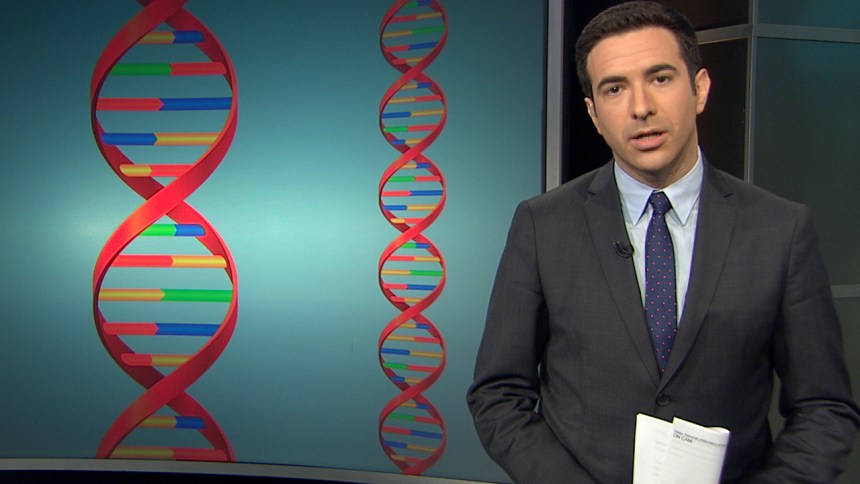
Here is a fundamental premise: you own your body. Now, it’s not exactly news that there are two powerful forces that try to steamroll that fundamental right—politicians and corporations.
But what you may not know is that three days ago, the Supreme Court struck back against one half of that problem. The Court got involved because medical companies have been pushing the boundaries of how to profit off DNA.
These corporations were claiming they could patent and own organic DNA—your DNA. The Court said no, rejecting privatized DNA. But when it comes to the government seizing DNA, most of the Justices lost their nerve. The surrender to aggressive police tactics came in a key case earlier this month.
The Justices okayed a huge and relatively new power for police: the power to search you, seize your DNA, and use it to track you in a database—even if you have never committed a crime.
DNA databases and crime tracking may sound like a faraway fantasy out of “Minority Report.” But the future is here. 29 states already take DNA samples of suspects for certain crimes. I’m not talking about convicted felons, either. The state already has the authority to gather information about them, which makes sense if they’re headed to jail. I’m talking about how police treat the rest of us.
We are all innocent until proven guilty, that is supposed to apply whether you’re minding your own business, talking to a cop, or being stopped, frisked and arrested by one. And that’s where these new DNA powers run into some very old police practices. We already know the systemic discrimination in our justice system.
African Americans make up 13.6% of the population, but constitute 40% of the FBI’s DNA database. That has two consequences: at this rate, the very first national database of DNA will be of Black America—one out of four black men are already in it. Second, the genetic pool for solving crimes will inexorably bend towards the people who have been swabbed. Towards black people. And since DNA cases are easier to solve with the available genetic evidence, black suspects will be more likely to face apprehension than similar white suspects. Now some say any police tactic that lowers crime is worth it. But that’s not how rights work. In a dissent from the court’s ruling, one Supreme Court Justice sliced through the idea that we should surrender to all police imposition to keep us safe: “Today’s judgment will solve more crimes…but so would the taking of DNA samples from anyone who flies on an airplane…or attends a public school. Perhaps the construction of such a genetic panopticon is wise. But I doubt the Founding Fathers would have been so eager to open their mouths for royal inspection.” Republicans take note—the man who wrote that objection to an endless police state was Antonin Scalia! Anyone who is serious about conservative, small government would have to agree with him—and they can join everyone who is serious about civil liberties and racial justice. Justice Scalia failed to address the racial discrimination here, so he came up short. That’s the next battle, because the science can further empower the state. And here’s a rule of thumb, since many policy makers and pundits don’t think of DNA as a civil rights issue—in a a justice system where the majority of official practices have a discriminatory impact, just about anything that system touches will become a civil rights issue.
Ari Melber
Ari Melber, an Emmy Award-winning journalist, writer and attorney, is the host of “The Beat with Ari Melber” airing nightly at 6 p.m. ET on MSNBC. He also serves as MSNBC’s chief legal correspondent and an NBC News legal analyst. Before joining MSNBC, Melber practiced First Amendment law and served as a legislative aide in the U.S. Senate. He received a J.D. from Cornell Law School and is a member of the New York Bar. Recommended


