








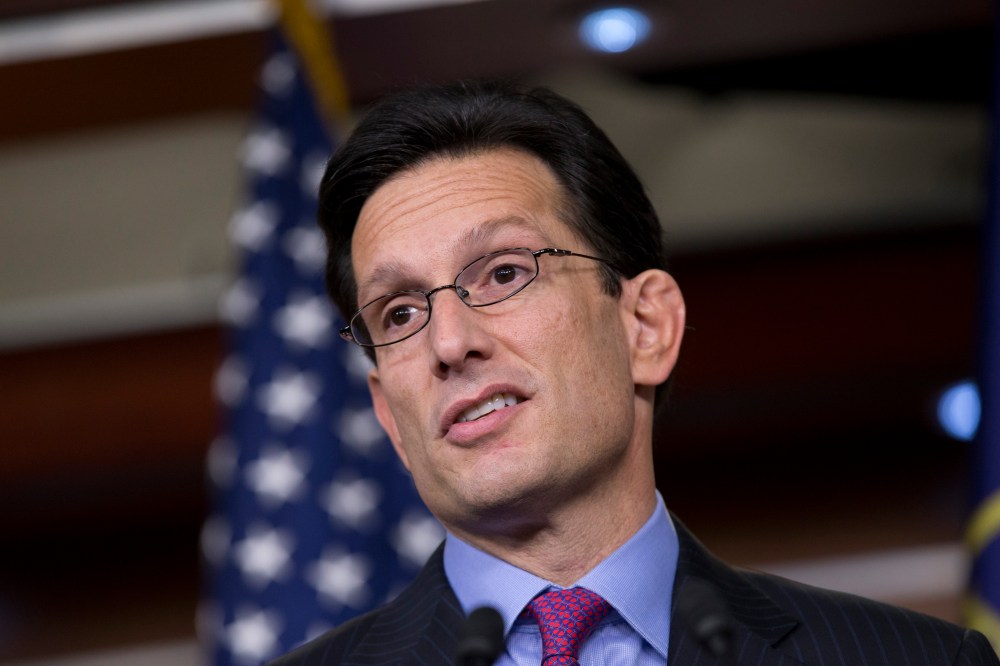
House Majority Leader Eric Cantor was reduced to a “walk of shame” out of the House chambers Thursday night after too few of his fellow Republicans failed to join him in voting for the so-called “Plan B” fiscal-cliff measure. As humiliating as the defeat was, Cantor doesn’t seem similarly embarrassed to hold up the re-authorization of the Violence Against Women Act. As the Christmas holiday approaches and politicians evacuate Washington today, it looks as though it won’t happen in this Congress.
As host Melissa Harris-Perry noted last Sunday, the Violence Against Women Act has been re-authorized every year since its 1994 inception. But ostensibly, Cantor is holding up the re-authorization because the Senate version, unlike his House version, protects too many women.
The Senate bill contains the newly-added tribal provision, which would provide American Indian tribes with limited authority to prosecute sexual-assault crimes on their lands, whether the crimes are committed by American Indians or not. Cantor is opting to hold up the VAWA for all women in order to eliminate this, going so far as holding a special meeting this past Wednesday to try to sway Republican women in the House. Prior to the meeting, Cantor spokesman Doug Heye released this statement:
“He will update the members on where we stand and again stress the need to seek common ground across party lines to reach an agreement and pass VAWA as quickly as possible so we protect all victims of these horrendous crimes, and fully punish those who commit them.”
Jonathan Capehart of the Washington Post, one of Harris-Perry’s guests in her Sunday show, came out swinging yesterday with a biting column that suggested Cantor and his fellow obstructionists are enabling rapists:
I was so incredulous that I said the House Republicans were trying to protect white men from prosecution. “It’s not ‘as if.’ That is what they are doing,” interjected Chloe Angyal, an editor of Feministing.com. I made an erroneous accusation there. I don’t know if all perpetrators of domestic violence and sexual assault against Native American women are white…
Basically, right now, if you are a non-Native American man who beats up, sexually assaults or even kills a Native American woman on tribal land, you’ll get away with it. That’s because tribal courts do not have jurisdiction to prosecute non-Indian defendants. In addition, federal and state law enforcement have limited resources and might be hours away from a reservation. And then there’s this: according to a General Accounting Office report on “Department of Justice Declinations of Indian Country Criminal Matters,” federal prosecutors declined to take action on 52 percent of violent crimes committed on tribal lands. Of those declined cases, 67 percent were sexual abuse and related cases.
When I spoke to National Organization for Women president Terry O’Neill last week, she examined the argument that it is somehow unconstitutional for tribal authorities to have this jurisdiction over violent crimes against women committed on their lands. “It’s clearly false,” she said. “A first-year law student could take two looks at their argument, look at the Supreme Court precedent on tribal authority jurisdiction, and conclude that that argument is simply ridiculous. So, the constitutional argument holds no water whatsoever.”
Though Cantor has said he’s willing to negotiate on the House bill’s exclusion of undocumented, lesbian, and trans women, NBC Latino contributor Victoria DeFranscesco Soto noted in the discussion that dangling deportation over undocumented immigrants could be a motivation. But why target American Indian women, whose ancestors were here long before Cantor’s arrived?
Tulalip Tribe Vice Chairwoman Deborah Parker powerfully evoked the need for VAWA: It’s not only Native American women. Last night, I received a call from a non-Native woman who had the perpetrator drag her to what he thought was a reservation, and you know what? He missed the mark. It wasn’t reservation land. He raped her, he abused her, he left her there for dead. And guess what–she survived! And he got a long sentence. But she had told me last night that had that been reservation land, he would’ve gotten away with it. Ten House Republicans signed onto Democratic Congresswoman Gwen Moore’s letter last week urging Cantor and company to pass the Senate version of VAWA. Every Democratic woman in the Senate has signed a letter to the Republican women in the House Cantor sought to convince on Wednesday. And if advocates like Parker lose? They’ll have to start all over again with the new Congress. Perhaps that’s the real point of Cantor’s obstinance. O’Neill noted why that is so damaging. “It is draining the resources of the advocacy groups that have been working on re-authorization for two solid years. Many of the advocacy groups also provide services; their resources are being drained. I don’t think that’s a mistake.” See below the second half of the MHP discussion about VAWA re-authorization.
Jamil Smith Recommended


