








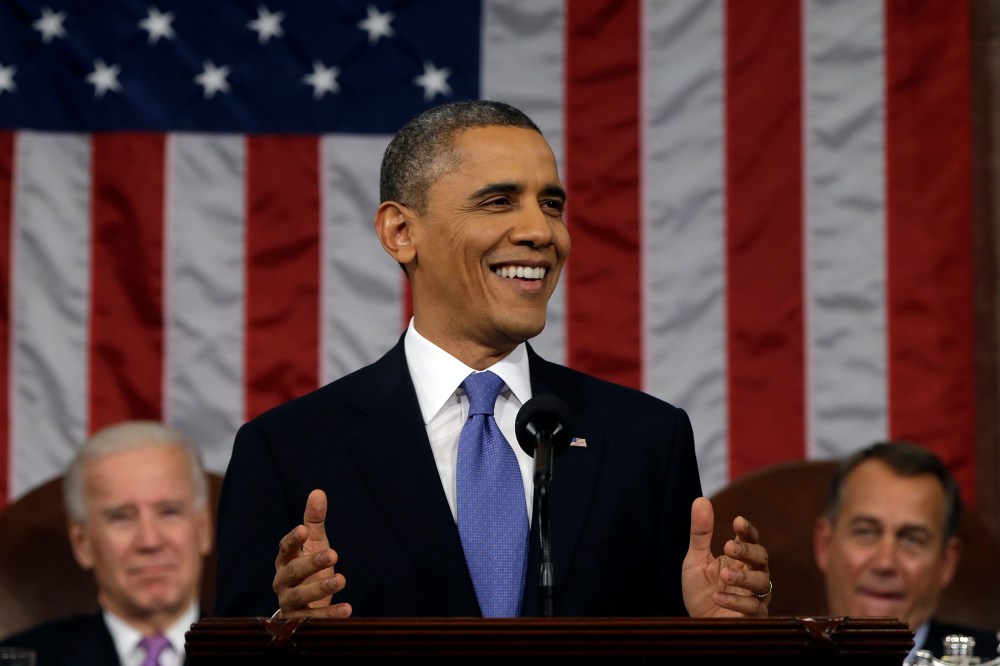
President Obama’s State of the Union address on Tuesday covered many of the expected topics. He highlighted the need for gender quality in the work place, he touched on the importance of immigration reform, he noted the vital need to implement universal pre-k and strengthen our middle class, and he concluded his speech by recapping our military accomplishments and honoring Army Ranger Sgt. First Class Cory Remsburg who suffered a massive, nearly fatal injury in Afghanistan during his 10th tour. In his roughly 65 minute speech one topic in particular immediately stood out as the defining thesis of President Obama’s remaining years in office.
Right off the bat, the president announced that this year he was not going to let bipartisan gridlock stop him from creating more economic opportunity for American families, even if that means bypassing Congress and using his power of executive action to get the job done. His words gained uproarious applause from his supporters and stirred the ire of some of his critics. But the use of executive action will not necessarily result in sweeping policy change.
On Saturday’s Melissa Harris-Perry, Melissa and her panel will discuss the limits of executive action and what President Obama can realistically accomplish alone and what he will have to accomplish with help from Congress.
One billion is a big number, especially when we are talking about people. It’s almost ten times the number of people who watched last year’s Super Bowl. It’s almost the entire population of China. It’s also the number of women in the world who will be raped or beaten during their lifetime. Last February 14, men and women came together across 207 countries to raise awareness as part of the One Billion Rising for Justice Campaign. Participants marched and danced as they called for an end to violence against women and girls. This year, the event’s organizers are hoping for an even greater turnout as they continue to advocate for women.
Eve Ensler, the founder of V-Day, the global movement to end violence against women and girls and UCLA Law School professor Kimberle Crenshaw, a board member at V-Day will join us on set this Saturday to talk more about their organization and the power of the “One Billion Rising for Justice” movement. Among the plethora of State of the Union responders was Congresswoman Cathy McMorris Rodgers who delivered the official GOP response. Rep. McMorris Rodgers is the highest ranking Republican woman in the House, but that’s not the only reason she was chosen to deliver the rebuttal. Speaker John Boehner, acknowledged in a tweet, that along with being Chair of the House GOP, Rep. McMorris Rodgers is “most importantly, a mom…” McMorris Rodgers spoke about the Republican vision for equality, but offered few specifics. However, her speech helps illustrate the differences between the parties when reaching out to women. On Sunday, Melissa and her panel will discuss what women really want from those in government. We’ll have all this, plus the latest on today’s breaking news out of New Jersey regarding Governor Chris Christie. Be sure to read what we’ve linked above, and watch Melissa Harris-Perry Saturday at 10 a.m. EST on MSNBC! Also, don’t forget to join us on Facebook and Twitter with the hashtag #nerdland.
Rachel Zuckerman Recommended


