








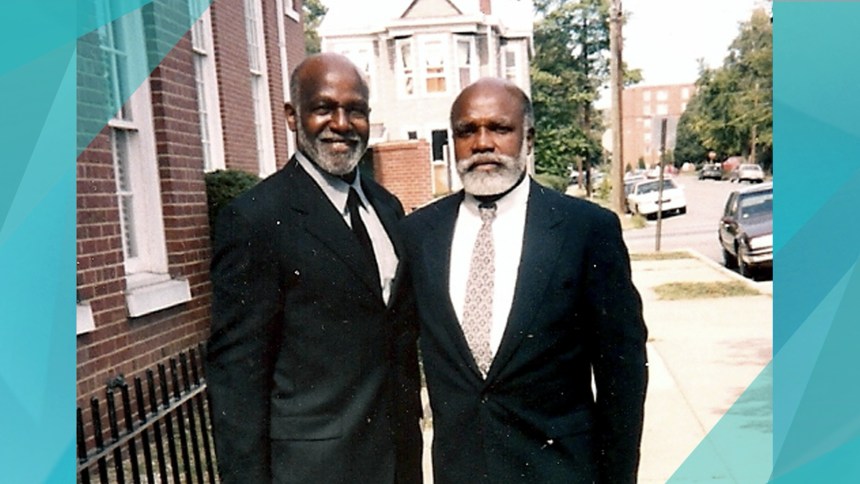
William and Wesley Harris, twin brothers, were born in 1941 into a poor, African American household and community in Richmond, Virginia. They were nine years old when a heart attack claimed their father’s life, leaving their mother—a domestic worker and seamstress—to rear the boys and their three older siblings. They had few economic resources and spent their childhoods in the shadow of Jim Crow repression.
These boys—my father William and his brother Wesley—became extraordinary men. After graduating from Richmond’s segregated Armstrong High School in 1960, they became the first in the family to attend college.
In August of 1963, as rising seniors at their respective universities, my dad and my uncle came together to join the hundreds of thousands gathered on the National Mall for the March on Washington for Jobs and Freedom. In advance of today’s 50th anniversary, I spoke with them about the months leading up to the march and their experiences on that day. Excerpts from our conversation are below.
I want to start by thinking about where you were in your life in the summer of 1963.
Wesley: In 1963, I was a rising senior going back to the University of Virginia. I was feeling very distressed about race in America at that point. In the spring of 1963, Dr. Martin Luther King, Jr did visit UVA and gave a major presentation in Cabell Hall. I had the good fortune of meeting him, dining with him, walking along the grounds and introducing him. Your father, Bill, traveled down from Howard University to also join Dr. King in the presentation in Cabell Hall.
William: Not only was (Wes) the one to introduce Dr. King, but King came to UVA at Wes’ initiation. The president of the University of Virginia at the time would not even host Dr. King. I don’t know if he attended the lecture or not. I think he did not. So, the context was not a very enjoyable one. The turnout in Cabell Hall was certainly good, but the community, the white community at the University of Virginia, was certainly stressed and strained about King’s coming.
So my uncle had invited and hosted Dr. Martin Luther King, Jr, at the University of Virginia just months before the March on Washington? A bit of digging turned up a brief announcement in the school paper about Dr. King’s impending visit and another critical assessment of his remarks a few days later. But I was most struck by a 2008 article in a local Charlottesville publication “The Hook,” which assesses Dr. King’s visit to UVA as a turning point in the spring of 1963 as he prepared for the Birmingham campaign—and ultimately, the March on Washington.
Uncle Wes said in a 2008 interview, “To see him up close, to shake his hand, to share a meal with him, just King himself, alone and without an entourage, it was an important event in my life—a cornerstone in my experience.” While one of the seven black students enrolled at the University of Virginia, he battled for the university to recognize the civil rights struggle. My dad attended the historically black Howard University in Washington, D.C., where students were taking up key leadership positions in the struggle.
William: Melissa, I wanted to back up some, before 1963, when I was in segregated schools in Richmond. I came from a system where I found a great deal of experience, a great deal of love. Wes and I were poor kids from the lower section of Churchill but that never seemed to have made a difference. I went to Howard and at that time Howard University was the center of civil rights-based activity. Because of my experiences, I had a strong sense that I didn’t need white people—didn’t hate them, but didn’t need them. And at the same time, had a sense of being fortified against whatever we might face.
I was part of that student leadership. Stokely Carmichael and I were in the same class. We would leave campus and go out to march or demonstrating for desegregation of restaurants, hotels, and that kind of thing. And we students at Howard at the time did not let the administration off the hook. For example, the university was not using black contractors to build some of the new projects that were under construction and we organized vigorously against the administration. And we were there under the tutelage of some of the finest, finest instructors in the nation who were not afraid of talking about race. They talked about race and the responsibility of a Howard student to go out and change the world.
It was from this position as student activist on two very different campuses that my father and my uncle joined together to attend the March on Washington.
William: Wes and I met early the morning of the March. We’d had a late breakfast and he and I walked over to the Lincoln Monument. We were early, and Wes and I were concerned about whether there would be sufficient numbers of people there to be impressive. Just as our thoughts were beginning to gather, and some level the frustration on that, huge numbers of buses were rolling in, people, the crowd just magnified itself tremendously.
And for me, I gotta tell you, were it not for skin and bone, my heart would have leaped right onto the ground. Just to be in that the huge crowd and the level of kindness and pride. I left that place and I can tell you I felt unencumbered.
Wes: Bill and I walked together down 14th Street toward Constitution [Avenue]. As we got to Constitution and made that right turn going towards the Lincoln Memorial, it was like the gates of heaven had opened up. It was a sight to behold, it was just so energizing. Clearly it was a moment that will last with me forever. We had the opportunity, we had the courage, the wisdom, the motivation, the patience, the persistence, to actually obtain our freedom, our freedom. I left Charlottesville to meet Bill with some concern, given the history that you have already asked about. But, once we arrived and made that right turn on Constitution Avenue, all of the energy, all of the hope, all of the aspiration just welled up and said: “This moment is ours; the victory, freedom, jobs, was within grasp.”
William: The impressive thing was not so much the speeches. They were certainly very captivating and powerful, but I had never been in a crowd so large of black folk who came with the level of seriousness—and I’m not romanticizing it, a level of commitment, and a level of courage. If you go back to 1963, lynchings and violence, the number of beatings, the water hoses, the dogs. All of that was still extremely commonplace. And yet there was not even the most modest sense of fear or reservation.
Have you ever, in all of the activism and work that you’ve done since, experienced anything else like this moment? Wes: For me, no. William: No. I’m proud of all of those moments, but none comes anywhere near having a positive impact on me and my spirit and my sense of awareness of being an African American as that day in 1963. Daddy, I still have most of the birthday cards that you’ve given me over the years, and I ended up making a television commercial about the fact that even from my little girl days, you always signed them: “the struggle continues.” And I’m wondering, as you think about this idea of the struggle continuing, what do you see right now as the biggest challenges facing us, and are they different than they were 50 years ago, and different how? William: There are five things that I think are still critical. One, the economic exploitation of African Americans continues. Second, we must have a renewed commitment from the religious community in support of issues of justice and equality. Number three, school desegregation has failed miserably in this country. Four, there has been a substantial reduction in both the number and production of black teachers. And that’s K through Ph.D. And fifth, Melissa, there continues to be a great disparity in the health care for African Americans and particularly for African American women. And indeed, I strongly still believe—and I say the same thing, by the way, to your brother and your sisters about the struggle continues. It does. And the real sense of that is that we have an obligation. Wes: Melissa, the complexity of the world increases, resources for some people in the world have increased as well, but I think, Bill, your father, my dear brother, said five things that the nation, and that black folks in particular must focus on. And we need to stay focused, we need to persevere, and not be diverted by anything else. Time is of essence. If we don’t stay focused, we will lose even more ground. My father and uncle are the giants of my childhood. Daddy graduated from Howard, earned a Ph.D., and became the first Dean of African American Affairs at the University of Virginia. My uncle is an honors graduate from UVA and became the first African American to earn a Ph.D. in engineering from Princeton University. Later, he served as chair of Aeronautical Engineering at the Massachusetts Institute of Technology. Men of such accomplishment always expected academic seriousness from their children, but my siblings and cousins were always expected to be more than personally successful. These men reserved their greatest pride for the moments when we demonstrated that we were in service to others. William and Wesley are witnesses to history and they are creators of the future.
Melissa Harris-Perry Recommended


