








I just finished reading a novel that presented a scenario in which George Wallace became the president of the United States. I won’t tell you which novel, since I don’t want to spoil the ending, but Wallace’s presidency was an unfortunate consequence of well-intentioned mucking around in the past done by the time-traveling protagonist. Make-believe though this was, the presidency was something Wallace – the former governor of Alabama and an infamous famed advocate of segregation – sought in real life, running unsuccessfully three times between 1968 and 1976.
The fictional scenario of Wallace as president inspired me to look up his 1998 obituary in the New York Times, perhaps to fully embrace the horror of what that may have been like. It was headlined as follows:
“George Wallace, Segregation Symbol, Dies at 79”
Instantly, as I read that headline, I didn’t think of Wallace. I thought about Michael Bloomberg, who has tossed away a large part of his legacy and forever been branded as the champion of the New York Police Department’s racially discriminatory and obsolescent police tactic of “stop-and-frisk.”
Bloomberg and his police commissioner, Ray Kelly, cursed Judge Shira Scheindlin in August when she ruled that the way the NYPD employs “stop-and-frisk” violated the Fourth and Fourteenth Amendments. Making noise in the media about the judge’s public comments and alleged biases bore fruit for Bloomberg last week when the U.S. Court of Appeals for the Second Circuit – without provocation from the city’s planned appeal – removed Judge Scheindlin from the case and blocked the planned reforms for which she’d called, including cameras on officers and the installation of an independent monitor for the NYPD.
Though the mayor celebrated the rebuke of Judge Scheindlin, let me be clear: Bloomberg’s belligerent defense of the NYPD’s controversial use of the largely ineffective “stop-and-frisk” tactic is not George Wallace saying, “Segregation now! Segregation tomorrow! Segregation forever!” While we’ve learned that the NYPD’s version of “stop-and-frisk” relies upon racial profiling and artificial quotas, it isn’t Jim Crow. And Bloomberg isn’t literally standing at a university entrance in a vain attempt to block the admittance of black students, as Wallace did.
But Bloomberg was all too ready, in the dying days of his political career, to do everything he could to stake his reputation on a similarly doomed policy. It’s why Bob Gangi, director of the Police Reform Organizing Project at the Urban Justice Center, told me that he’s “not too disappointed” in last week’s blocking of “stop-and-frisk” reforms.
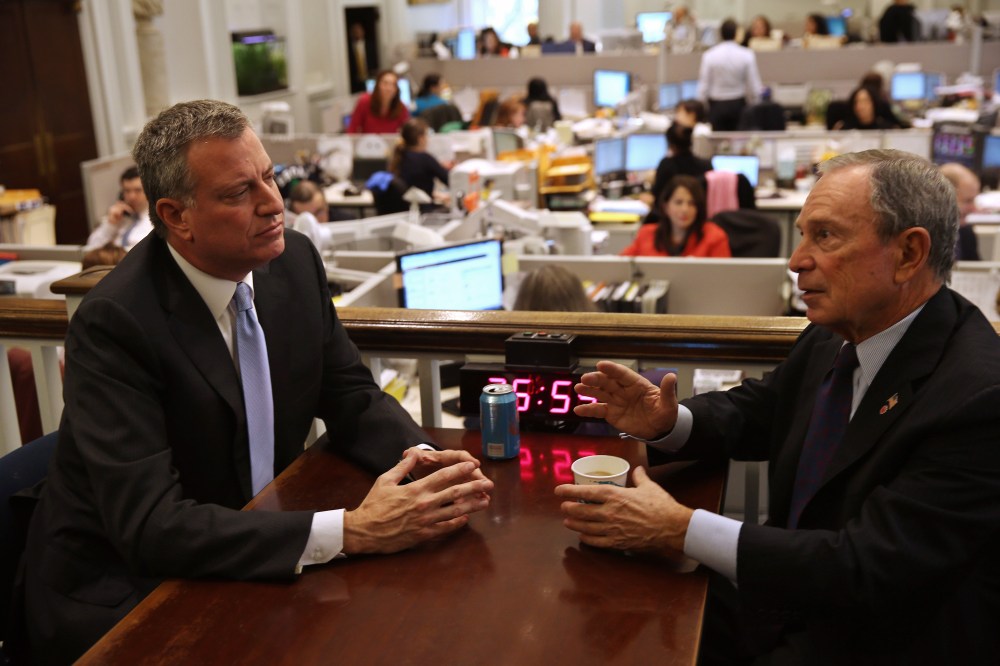
Gangi is encouraged, given that mayor-elect Bill de Blasio, the city’s outgoing public advocate and one of the most forceful critics of “stop-and-frisk,” is about to succeed Bloomberg – and he’s promised to drop the city’s appeal and let the reforms take hold. “It’s important to remember that the ruling by the appeals court didn’t overturn the historic decision in our case,” said Center for Constitutional Rights executive director Vince Warren, who spearheaded the case Scheindlin decided. “It didn’t address 8,000 pages of evidence that we presented at trial or the 200-page decision finding the NYPD ‘stop-and-frisk’ policy unconstitutional.”
Even if the appeal hadn’t been dropped, Bloomberg wouldn’t have been in office to see action taken on it. He had to know that his appeal of Scheindlin’s August ruling was all for show, and for what? To stand in the figurative doorway of progressive policing?
The point is not that Bloomberg reminds me of George Wallace. It’s that as far as his legacy goes, he’s going out like Wallace.
The New York City mayor’s 12-year run in office has long been in his lame-duck days, but he’s now reached his symbolic end. Elected mere months after 9/11 and presiding over a grievously wounded city, Bloomberg rebuilt and reshaped New York City with the bluntness of a CEO breathing rarefied air, answering to virtually no one, and always in possession of the best ideas. His prior life as the billionaire founder of a financial media empire trained Bloomberg well for this.
That foundation enabled Bloomberg to do the mayor’s job in a way that most politicians, pardon the expression, simply can’t afford. Under Bloomberg, the New York City mayoralty continued to serve as a de facto national one, and he used that platform to advocate against illegal guns. But as he did so, he spoke and behaved with the casual bluntness of someone used to not having to mind his or her words and actions, because privilege buys a lot of leeway.
He used much of that leeway to improve the city in quite visible ways. That is true in few other areas outside of real estate, as his administration rezoned about 25 percent of the city and built beautiful new public spaces and urban reclamation projects like the noted High Line park. But I’d agree with critics who allege Bloomberg’s emphasis on attracting the wealthy to the city – his “tax base,” as he called him in a recent New York magazine interview – has sped the widening of the income gap in the city, and created a perception that he’s governed primarily for the One Percent.
That perception is probably the main reason why de Blasio is the next mayor. But it’s “stop-and-frisk” which will have a prominent place in Bloomberg’s career epitaph.
You can’t tell Bloomberg and his police commissioner, Ray Kelly, that “stop-and-frisk” not only is ineffective, but alienates communities and makes them suspicious of the police who are there to serve and protect them. The men’s collective hard-headedness on this issue knows no bounds.
But we’ve seen the numbers many times; “stop-and-frisk” not only unfairly targets people of color – but also, as practiced by the NYPD, it has proven to simply be an ineffective tool for finding guns and other illegal weapons. Whatever they’re doing, it isn’t making New Yorkers safer. “The numbers are gonna eat him. The same number that he’s putting out there, and defending, is a number that doesn’t help. He’s saying how great the job that was done, because it’s not his kid that’s getting stopped,” said NYPD officer Adhyl Polanco, a fierce “stop-and-frisk” critic now serving under modified assignment. But Bloomberg and Kelly have maintained that not only is “stop-and-frisk” essential to modern-day policing in New York City, but also that police aren’t stopping enough black people. Saying stuff like that, especially in 2013, gets you remembered for stuff like that. Amongst New Yorkers of color in particular, Bloomberg will be forever known as the “stop-and-frisk” mayor. Let’s be real here. Who cares if Bloomberg opposes illegal guns if he backs an unconstitutional strategy for finding them? If he believes the best way to find them is to allow police to racially profile the city’s residents, how does this earn him credit? In reality, it does just the opposite. “Stop-and-frisk” is now carved into the Bloomberg legacy. And unlike Wallace, I predict Bloomberg’s privilege will keep him from offering up the mea culpa Wallace tried to sell in his later years. But he still has hope of history giving him some slack. It all depends upon whether or not we’ve seen the last of “stop-and-frisk” in its current form, and that’s now is up to de Blasio, and to the NYPD itself. Gangi told me that residents of the most highly stopped-and-frisked areas of New York City say that despite the August ruling and lower-reported “stop-and-frisk” numbers, the police harassment has not abated. Whether they’ll pay attention to an independent monitor or do what it takes to make Scheindlin’s reforms work is “the $64,000 question,” he told me. “How effective is the court ruling when the department itself, including the 35,000 to 40,000 police officers, have no intention of changing their behavior in the community?” And whether or not de Blasio keeps his promise will determine whether he joins Bloomberg in ignominy. “I fully expect that he will live up to his word and abide by the court orders that set forth the meaningful reforms we’ve sought,” Warren told me. But Polanco was a bit skeptical. “Politicians are, at the end of the day, politicians,” he said. The stage is set for “stop-and-frisk,” as we New Yorkers know it, to die with Bloomberg’s mayoralty. We can only hope de Blasio doesn’t ruin the ending. A version of this column was published originally in theGrio.
Jamil Smith Recommended


