








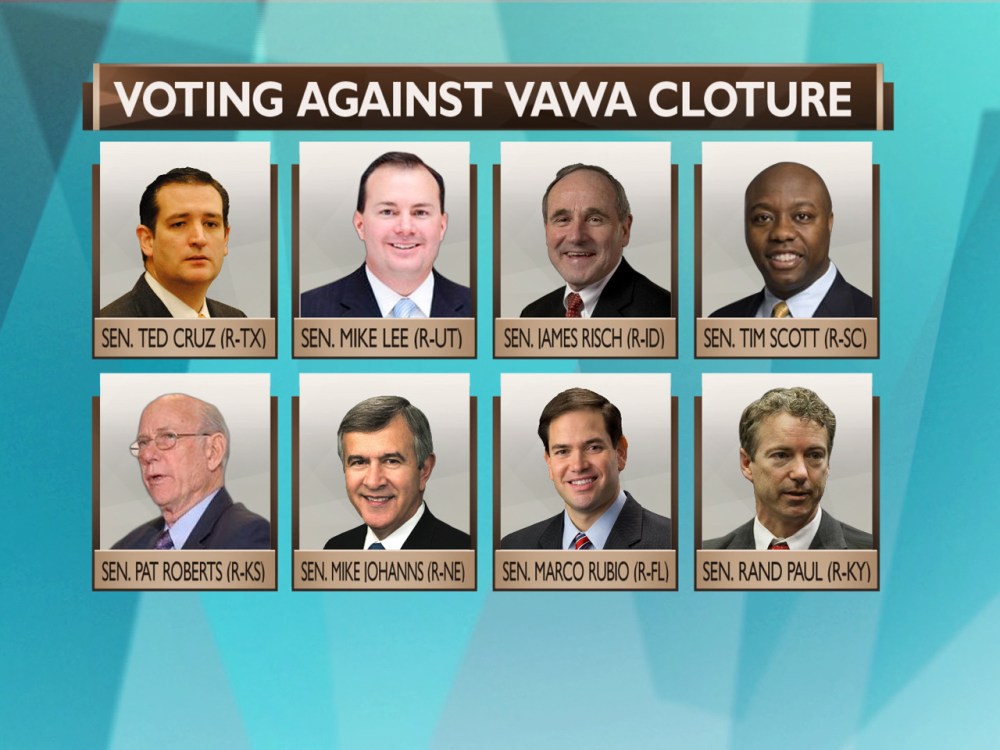
When eight men in the U.S. Senate opposed the Violence Against Women Act (VAWA) from even coming to a vote last week, then later joined 14 others in voting against it unsuccessfully on Tuesday, I was incensed. I come from a family of five generations of mothers and daughters who all suffered and survived more than sixty years of domestic violence, so I have a personal stake and passion for any matters concerning violence against women.
My grandmother was powerless as my grandfather mercilessly beat her and her eight children until they were all bloody. My mother, her lungs crushed by my father’s vicious beating, was told to kiss her five children goodbye from her Philadelphia hospital bed.
My daughter’s father kicked me in my belly and spit on me as I lay on the ground hemorrhaging, eight months pregnant. And that same daughter’s boyfriend, years later, strangled her while their six-month-old baby girl, named Promise, lay on the bed beside her.
To the 22 men who voted against the VAWA, tell me: What is so “unconstitutional” about giving legal protections to women like us?
Does the Constitution not protect our rights? If my family’s stories are not worthy of the same protections afforded to all of our fellow citizens, what stories are? The pain that my family has endured for more than sixty years is, sadly, America’s story.
As I watched the re-authorization of the VAWA transform into a political farce over the past year, I grew weary of the fiasco and all who were involved. I continued to wonder why not one soul talked about the real issue of violence against women, instead of whether the VAWA was unconstitutional, or whether protection for American Indians, undocumented immigrants, or the LGBTQ community should be included. To me, that’s a no-brainer: all victims of violence should be covered, regardless of their ethnicity or sexual orientation. After all, are we not the land of the free, the home of the brave?
Conversely, our time would have been better spent assessing why the National Intimate Partner and Sexual Violence Survey—a year-long study conducted by the Centers for Disease Control and Prevention—revealed that sexual violence, stalking, and intimate partner violence have become a “widespread public health problem.”
How is it possible that we haven’t addressed those findings when we’re about to spend yet another $659 million on VAWA, not to mention the billions spent each year to address health care, lost productivity and other related costs of abuse?
Moreover, what is or is not working and what should we be doing to fix it? While VAWA is very important legislation and is absolutely critical, isn’t it time we reexamine it and raise the bar? For example, why doesn’t the United States have a comprehensive strategic National Action Plan similar to that of countries like Australia, France, and Liberia which foster greater prevention, education, and awareness to prevent violence in the first place? And finally, the name “Violence Against Women Act” alone suggests that things need to change. This is no longer just a women’s issue—women, men, children, families and whole communities are affected by this terrible pandemic. This is an American issue! Shame on you and all who spent the last year playing political ping pong and did nothing to leverage this opportunity to address the real problem, one that could have showcased what you truly stand for. I honor the legacy of my grandmother and my mother, both of whom are no longer with me—and I can speak with confidence when I say that I will not allow their memories to be compromised by political gain. In closing, while the VAWA has been passed in the Senate, I suggest that this is the beginning, not the end. We have an indelible responsibility to my family and the millions of others to figure out how to bring about real change. I hold firm to the challenge that I made on Melissa Harris-Perry this past Sunday, and I ask you Senators (and members of the House of Representatives), in honor of my grandmother, my mother, myself, and my daughter; and especially little Promise, to learn about Saving Promise, reach out to me and let’s talk about how you can help me save Promise, and all those like her. L.Y. Marlow is the award-winning author of “Color Me Butterfly” and founder of Saving Promise, a national movement to change how to talk about and prevent intimate partner violence in America. When she discovered that her 22-year-old daughter was trapped in an abusive relationship that also threatened her granddaughter, a little girl named Promise, now the fifth generation, she founded Saving Promise with the intention of saving her.
L.Y. Marlow Recommended


