








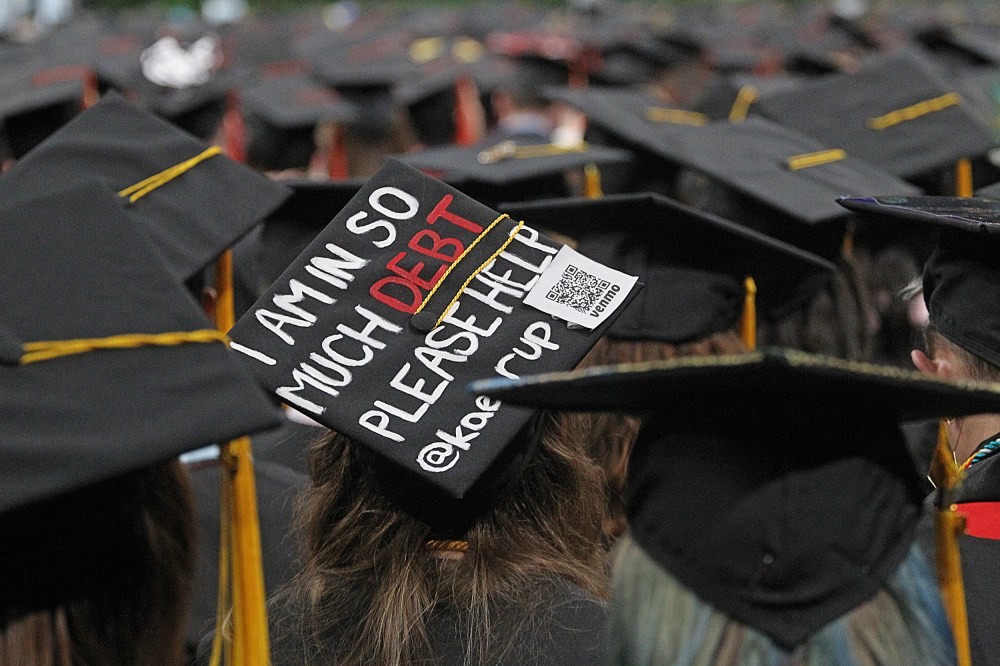
It’s a reasonable life plan: You graduate from college and get your first “real” job that pays enough that you can afford to live independently and maybe even stash away some money for a rainy day.
Unfortunately, living that dream remains out of reach for too many women. The American Association of University Women’s new research shows that student debt is making it close to impossible for many recent graduates to meet basic living expenses as they launch their careers.
Even more troubling is the likelihood the Covid-19 pandemic and consequent economic downturn will make a bad situation worse. Most of the layoffs over the past year were in women-dominated fields, and many more women voluntarily left their jobs to deal with childcare and homeschooling. With so many still out of work, countless women will find it impossible to pay back student loans. If we don’t address the student debt crisis right away, we could see an even greater setback in women’s progress in the years ahead.

Skyrocketing College Costs
This problem has been decades in the making: A generation ago, one year of college cost about 22 percent of the median household income. Today, that number has soared to 43 percent. It’s no wonder that Americans carry an eye-popping $1.7 trillion in student debt —a figure that has doubled over the past 10 years, increasing at nearly six times the rate of inflation.
Sadly, women—especially women of color—are bearing the brunt of the student debt crisis. Women take on more student debt than men for a variety of reasons: they tend to earn less at their jobs, some don’t get as much help from their family as men get, and women are more likely to go to for-profit colleges, where debt levels are higher. On top of that, when women do graduate, the gender pay gap means women have less money to pay back their loans. How could it not be more difficult to meet your financial obligations if you’re only making 82 cents for every dollar a man is paid?

Our analysis found that women who graduate from college with student debt have a monthly loan payment of $307 per month. We added this into other living costs new graduates typically have: A monthly average of $920 for housing, $396 per month for a car loan, $387 for food, $163 for utilities and $113 for medical care.
We then compared these expenses to the typical salary women expect their first year out of college, which is just under $30,000 after taxes . When we did the math, we discovered that the typical woman has a mere $148 in remaining funds for such necessities as clothing, household products, gas, and tolls—never mind putting away money to build an emergency fund or save for retirement. Even worse, a working mom — which account for 16 percent of new graduates — has to pay for child care, and ends up having more basic expenses than she can possibly afford.
A societal problem
Even before Covid-19 threw a major wrench in the works, student debt was preventing many young people from achieving the life milestones they quite reasonably expected: building savings, buying a home, getting married and starting a family. And the consequences of this extend beyond any individual to our society’s overall economic wellbeing.
Debt forces many new graduates to take lower-skilled jobs rather than wait to find the better jobs they are educated for. Delayed homeownership puts stress on an already-stressed rental market. Tight budgets can make it hard for people to pay for health insurance, and bad credit ratings can prevent aspiring entrepreneurs to start new businesses, which are crucial to our nation’s economic health. Suffice it to say that it’s time to address the student debt crisis once and for all. The temporary student debt relief provided during the pandemic needs to be extended—a band-aid won’t work, we need systemic change. States and federal government must take action on loan forgiveness programs, making sure that the people who need help most actually get it. Looking ahead, policymakers need to make sure that higher education is funded in a way that keeps tuition more manageable. Until that happens, women with outstanding loans should do their best to get out of debt as quickly as possible. Save money in interest by paying more than the minimum each month, which no doubt will involve short-term sacrifices. If you have good credit and a good job, consider consolidating your various loans into a single private loan with a lower interest rate. (You should also see if your employer offers loan repayment as a benefit; not many do, but you should investigate and inquire in your compensation negotiations) Enroll in autopay so you never get a late fee, and when you get extra money (a raise, a bonus, a generous birthday gift) use that to pay down your debt and begin to build your nest egg for financial security. Experts say it can take about 20 years to get rid of student debt completely, but the sooner you can do so, the better. It will bring you one step closer to living the post-college life you’ve earned. Kim Churches is the CEO of the American Association of University Women, a nonprofit organization that advances gender equity for women and girls through research, education and advocacy.
Kim Churches Recommended


Dealing with student debt
