








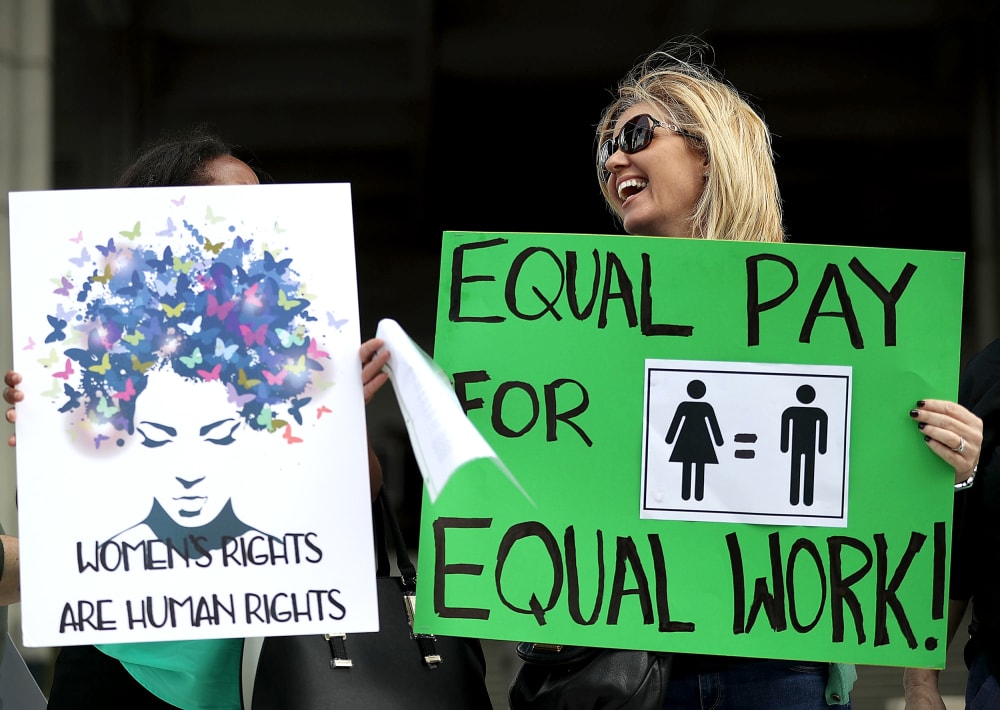
Women are paid less than men in every country, according to the World Economic Forum. In fact, in the U.S., women earn about 20% less than men. But some countries, like Iceland, have taken steps to end the disparity. In fact, this past January, the Nordic country implemented a new law that requires all companies with at least 25 full-time employees to obtain government certification that verifies that they provide equal pay.
“We’re absolutely thrilled that the legislation was passed,” said Brynhildur Heidar-og Omarsdottir, executive manager of the Icelandic Women’s Rights Association. “The legislation is based on the equal pay standard that was developed here in Iceland and provides guidelines that companies can implement to make sure they are paying men and women equally.”
The guidelines were introduced in 2012, and dozens of companies used these standards to certify themselves as equal pay employers. But the change wasn’t happening fast enough, so the Icelandic Parliament passed legislation to make it a requirement, Omarsdottir said.
If companies don’t implement the new standards by the required timeframe, which varies from Dec. 31, 2018 to Dec. 31, 2021 (depending on the number of employees within the company) they could face penalties of up to around $500 each day.
“Since the law was passed, many women in Iceland have seen their pay go up considerably,” Omarsdottir said.
Although the U.S. passed the Equal Pay Act in 1963, which made it illegal for employers to pay men and women differently for similar work, legislation hasn’t been very effective. Women have continued to receive less money for comparable jobs, and the act came with several loopholes that allowed men to be paid a higher wage than their female counterparts on the basis of seniority, merit, productivity or another differential factor other than gender.
Here are some lessons that the U.S. could learn from Iceland’s actions.
A front-end approach to equal pay matters
“Iceland is taking a front-end approach to pay disparities by putting the responsibility on the employers,” said Andrea Johnson, senior counsel for state policy for the National Women’s Law Center in the U.S. “This is a shift away from women employees having to stick their neck out there and fight for their own equal pay.”
A big step forward for greater pay transparency in the U.S., however, was shut down last year, when President Donald Trump halted an Obama-era rule requiring large companies to report how much they pay workers by race and gender. Years earlier, in 2014, Senate Republicans blocked a bill called the Paycheck Fairness Act, which would make it illegal for employers to penalize employees who discuss their salaries and by requiring the Equal Employment Opportunity Commission to collect pay data from employers. Nevertheless, individual states are now taking measures to help protect employees.
“I think we will see most immediately more states passing initiatives that require employers to report pay data at aggregate levels to get a sense of wage gaps and where there could be problems,” Johnson said. While the initiative isn’t as sweeping as Iceland’s legislation, it’s still a step in the right direction.
The equal pay standard was written for every country
The equal pay standard was designed so that it could be easily adapted to labor markets across the world, Omarsdottir said. “The equal pay standard was written to international code … so companies around the world can implement it.”
As other countries take notice of Iceland’s efforts, they could potentially follow suit by applying the same standards within their country’s workplaces.
Negotiation is a valuable tool One of the benefits of Iceland’s legislation is that all pay data will be made public to help promote transparency. America’s culture, on the other hand, is weighed down by secrecy around pay, which is preventing the country from making progress, according to Johnson. “In many cases, people are rightfully fearful about bringing up their pay or talking to their employer about what’s going on,” she explained. To bring forth change, this must end, and employees shouldn’t shy away from water cooler conversations about bonuses or sharing salary information with trusted colleagues, she noted. In addition, a number of states, such as Delaware, Maryland, Massachusetts and California, have passed legislation that bans employers from asking applicants for their salary history—which is another step forward to help close the wage gap. Johnson also encourages prospective female employers to negotiate their salary to help bring us all closer to closing the wage gap. They should research the position’s salary range and industry pay data ahead of time to help them determine how much money to ask for. Iceland still has more work to do Iceland’s equal pay law will certainly bring the country much closer to eliminating compensation disparities, but there are still some obstacles in the way. Since it’s designed as a management tool, it tackles discrimination within a specific company, but doesn’t indicate whether that company is paying fair wages in line with industry standards, Omarsdottir explained. “The main reason for the gender pay gap in Iceland is the fact that professions that are female-dominated tend to get lower wages than professions dominated by men,” she said. “The next step in Iceland is to find a way to adapt these standards on a larger scale and make sure that female-dominated professions are identified as being as valuable as male-dominated professions.”
Renee Morad Recommended


