









For years now, “cancel student debt” has become a growing chorus nationwide, and those of us with loans have been eagerly waiting for a formal proposal that we could count on. On Wednesday, the news finally came — President Biden will cancel up to $10,000 in student loans or $20,000 for Pell Grant recipients. The pause on federal student loan payments was also extended through Dec. 31.
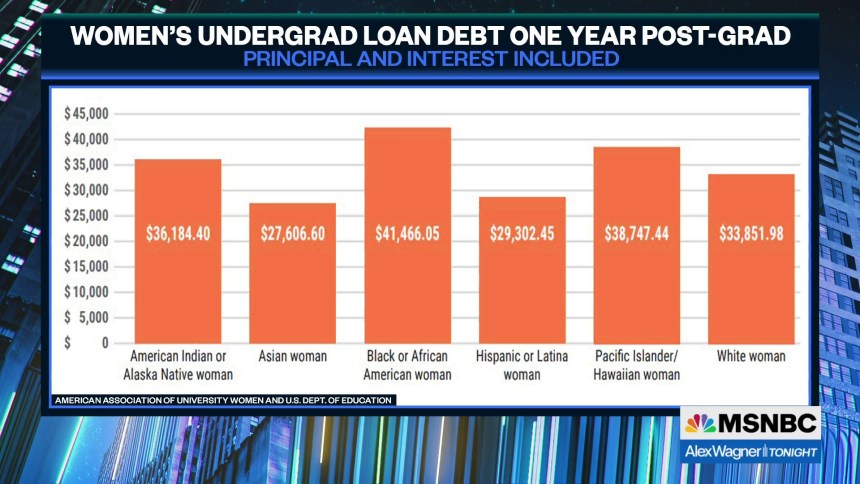
And while this news will come as a welcome relief to all borrowers, it’s women who may benefit the most. Women hold about two-thirds of all student loan debt in the country, and graduate with roughly $22,000 in loans, compared to $18,880 for men. And while that’s not an enormous difference, it’s what happens after graduation that matters most: women with bachelor’s degrees go into the workforce to earn 26 percent less than their male peers, according to a study by the American Association of University Women.
In other words, women take on more debt than men, only to earn far less, thus hampering our ability to pay down what we borrowed. And that’s just the average woman — Black women graduate with around $38,000 in student debt, and earn just 61 cents on the dollar when compared to men. Black women borrow in greater numbers as well — 70 percent of Black students take student loans, compared to just 56 percent of white students.
Over the course of their lives, women are also more likely to experience disruptions in our earnings, due to caregiving responsibilities. The breaks we’ll take from the workforce to fulfill unpaid caregiving responsibilities mean we’ll miss out on $324,044 worth of lost wages and Social Security benefits over the course of our lifetimes.
Since it’s clear that women – especially women of color – have been disproportionately impacted by the weight of student loans for decades, it’s my hope that the $10,000 forgiveness will enable them to shed at least a portion of that burden, see the light at the end of the debt repayment tunnel, and narrow the gender wage gap.
Here’s a look at what women — and all borrowers — need to know in order to make every penny count.
Who gets the $10,000?
For the estimated 15 million Americans who owe less than $10,000, your student debt is about to be canceled entirely. But $10,000 will hardly feel like a drop in the bucket for the roughly 3.2 million borrowers who owe more than $100,000. Borrowers will qualify for the $10,000 forgiveness if they earn less than $125,000 as a single person, or less than $250,000 as a married couple filing jointly. The loans being forgiven are federal student loans — government loans. (Private student loans are held by a private company, and the government has no jurisdiction to “forgive” someone’s debt to a corporation.) It’s unclear when, exactly, borrowers will see the debt cancellation hit their accounts, though those who already have their information on file with the Department of Education should see movement soon.
If you’re in repayment (or riding the repayment pause)…
President Biden tweeted this week that borrowers should “prepare to resume student loan payments in January 2023.” It’s safe to assume that this repayment extension will be the final one we’ll see, and borrowers would be wise to use these next few months to plan.
With inflation at a 40-year high, you’ll want to reevaluate your budget to ensure this line item can slide comfortably into your mix of essentials. Also, revisit your repayment plan. The announcement included a new repayment plan for undergraduate debt, and the capping of payments for undergrad loans at 5 percent of discretionary income, so you might find an option that works better than what you had pre-pandemic.
If you’re a Pell Grant recipient…
An estimated 60 percent of federal student loan borrowers are Pell Grant recipients, and an estimated 60 percent of Pell Grant recipients are women. Pell Grant recipients have double the forgiveness available — up to $20,000. If you received a Pell Grant, you’re eligible, so no need to take any additional action.
This announcement shouldn’t change your plans if you’re still weighing where — or whether — to pursue an education. My general rule of thumb is to look at your dream schools, but also look at the cost of those schools. Think about what you want to be when you grow up (we realize you may not know specifically, but you probably have an idea if you’re headed toward a higher or a lower-paying field) and then take into account what you expect your first year’s salary to look like out of college. You should try not to borrow any more than that in total over the four years (or so) that it takes to earn your degree. For an elementary school teacher, this figure will be far different than for someone in a science, technology, engineering and math (STEM) field. (It’s worth pointing out that although women make up just 28 percent of the workforce in STEM today, we’ve seen serious gains in recent years. In 2020, women represented 45 percent of students majoring in STEM fields, up from 34 percent in 1994.) No matter your major, we know that students who take on greater amounts of debt feel more burdened by repayment costs each month than those who try to keep borrowing costs down. Don’t forget that starting at a smaller and much more affordable community college can be a wonderful path to getting the diploma you want most. If you have federal student loans, make sure your contact information is current with both your loan administrator (FedLoan or Nelnet, for example) and the U.S. Department of Education. You can do this on the National Student Loan Data System (NSLDS) website. While you’re there, you can also review your loans and balances, interest rates, and more. Get a handle on what your repayment plan may need to look like moving forward if you have more than $10,000 in loans. Most importantly, know that investing in yourself and your education is never a bad thing — and every day, women are increasing their earning power via education. In 1970, just 43 percent of women held bachelor’s degrees. Today, nearly 60 percent of women do. Since 1973, we’ve closed the gender wage gap from 56.6 cents to 83 cents — a gain of 26.4 cents. Just 17 more cents to go. And that’s my 2 cents worth. Jean Chatzky is the CEO and co-founder of the digital media company HerMoney, the best-selling author of 11 books, an award-winning magazine columnist and the host of the HerMoney podcast.
Jean Chatzky Recommended


If you’re just considering college…

For anyone with active student debt…
