As the nation reels from COVID-19, economic collapse and raging protests across the country over racism and policing, one crucial group of women could play a game-changing role in the 2020 presidential election: Guardian Women.
Guardian Women are those who value security and view themselves as protectors of their families. They may be the most critical swing voters this November, according to new polling from my non-partisan organization, All In Together, whose goal is to advance women’s civic leadership.
In partnership with Emerson College Polling and Lake Research, we recently surveyed 1,000 registered females. And Guardian Women (like soccer moms, waitress moms, and Reagan seniors in previous elections) defined the key swing vote in our study.
The Guardian Women group is split in terms of political identification and presidential vote with 46 percent leaning to Democratic nominee Joe Biden and 42 percent for Republican Donald Trump, with 12 percent undecided. The majority in this group, 62 percent, strongly agreed their political participation matters now more than ever to protect the U.S. and their families.
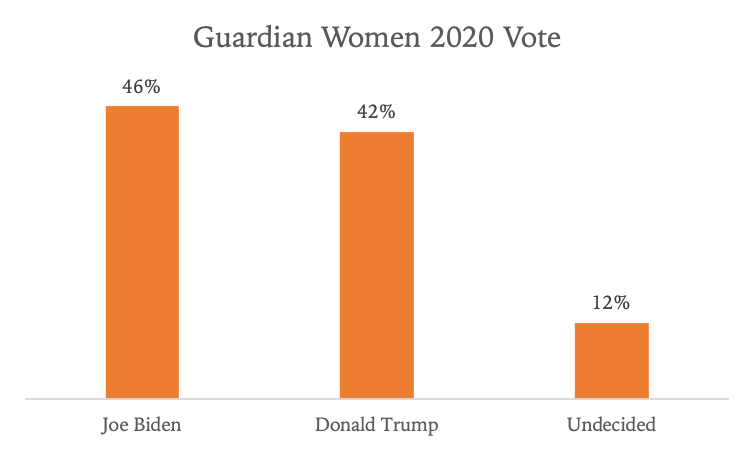
While Biden has a narrow four-point lead among these women, the undecided Guardian Women lean to Trump, though the margin is small. By comparison, women overall vote for Biden by 16 points – 53 percent to 37 percent and the undecided women lean solidly to Biden.
Who exactly are Guardian Women?
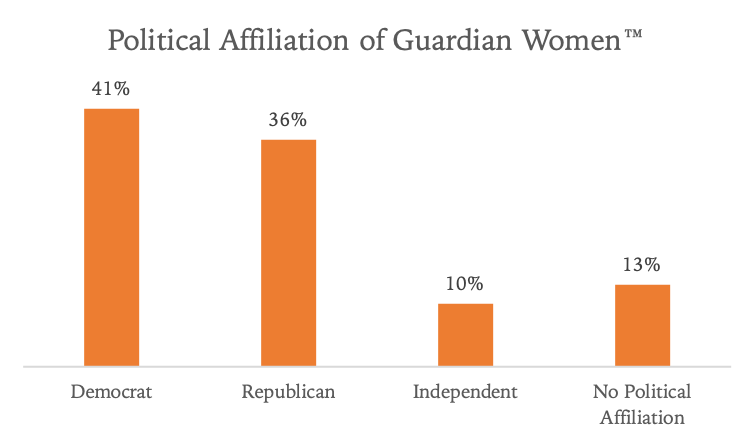
They tend to be over 50, white, non-college educated, married, and have an annual household income above $50,000. Just under half, 45 percent, of Guardian Women live in the suburbs, 29 percent live in cities. They are different from women overall in that they are older, slightly less Democratic and Independent, and more Republican or nonpartisan, less liberal and more moderate, more non-college educated and less college-educated, wealthier, whiter. They are less likely to be Latina, and more Northeastern and Midwestern and less Western.
What stands out about these Guardian Women is that they vote as an act of service to their country and community. Nearly universally, they agree that their political participation “matters now more than ever to protect our country and families” (88 percent agree, 62 percent strongly agree), and they feel they have a very important role protecting their family and community (90 percent agree, 66 percent strongly agree). Perhaps given this sense of duty, they have a high probability of turning out, with 85 percent saying they are almost certain to vote.
What does this mean for the candidates? Each party has their base voters that reliably drive turnout year after year but in a closely divided nation, in closely divided battleground states, swing voters, and in this case, female swing voters, have an outsized power to turn the election. Trump and Biden will have to work hard to win this group over. It’s easy to think Guardian Women should just all agree, but the fact is, women have never voted as a uniform block. White women, non-college educated women split the vote in 2016 and were a huge factor in Trump’s win. Swing voting women will be critical in this cycle too. Given the power and potential of Guardian Women voters, their commitment to country, community and democracy, it’s imperative the candidates work for every one of their votes. They are trying to do right by the nation and deserve the focus and attention of those seeking their votes. While many factors will play out between now and election day, the commitment of Guardian Women to serving through voting, to making our nation better may very well be the story of the 2020 election. Lauren Leader is co-founder and CEO of All In Together, a non-partisan, non-profit women’s civic education organization.
Lauren Leader
Lauren Leader is the co-founder and CEO of All In Together. She is a frequent contributor to Know Your Value. She tweets @laurenleaderAIT Recommended