








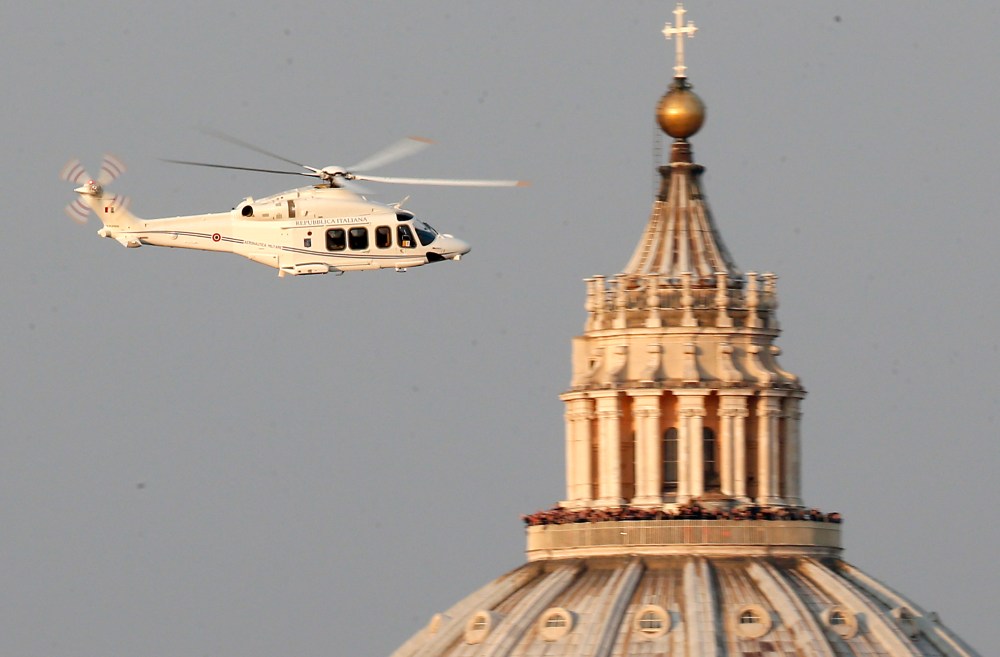
Pope Benedict’s abdication and departure from the Vatican Thursday marked a watershed moment for the Catholic Church, as its leader transitioned to a role as “pope emeritus” and pledged his obedience to his successor for the first time in six centuries.
Now the Cardinals assembled in Rome face a daunting task: choosing Benedict XVI’s successor.
In the coming days, 117 electors will consider who among them is best suited to ascend to the papacy. In what could be a sharp deviation from the Vatican’s storied Euro-centricity, strong candidates from the developing world are under consideration. A distinct possibility of electing the first black Pope has captured global attention. From nationality to age, and the less tangible aspects of charisma and “media savvy,” the character of the papacy’s front-runners will be under a microscope until Easter.
“Each cardinal is looking for three things in the candidate,” Father Thomas Reese, S.J., a senior fellow at Georgetown University’s Woodstock Theological Center told msnbc.com. “First, somebody who will be a good pope–which should be translated as somebody who agrees with the cardinals’ values and vision for the church. The second thing they’re looking for is someone with whom they can have a good personal relationship…and third, they’re looking for someone who will be well received in their own country.”
Reverend Monsignor Tom McSweeny, a former National Director of The Christophers, says the expectation from the American perspective is to find a new pope who embodies the stagecraft of former Pope John Paul II with the ability to connect with a “new approach to the next generation of believers, so they can live out their faith on a day to day basis.”
Praised for possessing an uncommon ability to connect with younger Catholics, Pope John Paul II was the second-longest serving Pope and the first non-Italian since the 1500s. He was also one of the most-traveled Popes in recent history, having visited over 100 countries. “Pope John Paul II taught us a very vital lesson: whatever evangelicalization means, it cannot happen within the walls of the Vatican,” McSweeny told msnbc.com.
Pope Benedict XVI made headlines when he joined Twitter in December 2012, disseminating 140-character messages to millions in English, Spanish, Italian, Portuguese, German, Polish, Arabic and French. “Thank you for your love and support,” he tweeted Thursday on his English-language account. “May you always experience the joy that comes from putting Christ at the centre of your lives.” With over 1.5 million Twitter followers on the English account alone, the Vatican’s embrace of the micro-blogging service has acted as an olive branch toward tech-savvy young Catholics – a demographic the Church is eager to attract.
According to Father Reese, the cardinals may consider choosing a younger man to be pope, thanks in large part to Benedict’s decision to abdicate.
“The fear of electing a young man is that he’ll live forever. He’ll be pope for 20,30,40 years,” Reese said. “I think now that the pope has set the precedent that we’re not going to have somebody in there forever, you could resign at 80.”
A number of the top contenders for the papacy are in their mid-60s, including Ghana’s Peter Kodwo Appiah Turkson, 64, and Brazil’s Odilo Scherer, 63. Canada’s Marc Ouellet, perhaps North America’s strongest candidate, is 68. At 55, the Philippines’ Luis Tagle is the youngest cardinal assumed to be under consideration.
The rise of Turkson along with Nigeria’s Francis Arinze, now 80, has created a buzz around whether the Catholic Church could choose its first-ever black pope. Brazil’s Scherer, the Archbiship of the Sao Paolo dioces–the world’s largest Catholic congregation–along with the 65-year-old former archbishop of Brasilia Joao Braz de Aviz could lend a new focus to the developing world.
Still the greatest force in the Vatican, the Italians, who make up a quarter of the College of Cardinals, retain a significant advantage with Milan Archbishop Angelo Scola and Cardinal Tarcisio Bertone as strong frontrunners. The online prediction market Intrade puts the likelihood of an Italian successor at an overwhelming 35%, ahead of the North Americans’ 14%, due in large part to the popularity of Ouellet. Two candidates, one from New York and another from Boston, are rumored to be under consideration from the United States. “The cardinals will certainly be paying much more attention to some of the third-world countries,” McSweeny said. But if that increased attention would translate to a successor from the developing world, he said, “Certainly it would be a possibility, but given the nature and structure of the current college of cardinals, I’d probably say the odds are not there right now.” The conclave may instead choose to focus on the issues that have dogged the Catholic church in recent years, chief among them a widespread sex abuse scandal. “The problem area is the first world: North America and Europe,” Reese said. “If we could find a cardinal who could turn that around, that would be the ideal.” As the College of Cardinals prepares to enter the conclave, a deeply religious process by which they choose the next pope, many wonder whether Benedict XVI’s successor will be considerably like-minded, since many of the cardinals in a position to select the next leader were chosen by Benedict himself. In fact, Benedict fortified the conclave’s heavily Italian presence, raising the number of Italians eligible to vote on a successor by a third since his election to succeed John Paul II. “They will always look at the Italians first,” Reese said.”The odds are in favor of a European pope but we can always be surprised.”
Erin Delmore Recommended


