








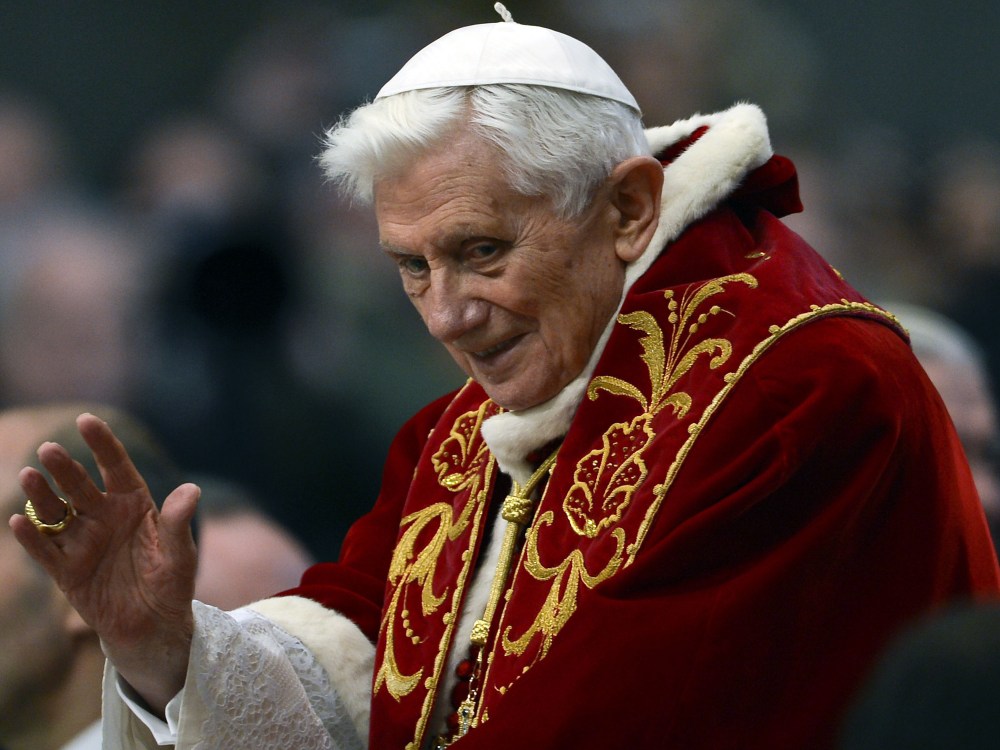
Pope Benedict XVI shocked the world on Monday when he announced his abdication—the first time a pope has stepped down since 1415.
So how will the 85-year-old—who cited his health as the reason for stepping down—be remembered? Mostly, Benedict –who’s tenure was overshadowed by clerical abuse scandals—will leave behind a legacy of traditionalism and institutionalism.
Here’s a look at some of his most controversial positions since being elected in 2005.
On gay marriage:
The pope used his much-anticipated Christmas Day speech in 2012 to denounce homosexuality, arguing that gay marriage destroyed the “essence of human creature.” The pope, born Joseph Aloisius Ratzinger, argued that gender identity is handed to people by God, and same-sex marriage therefore a “manipulation of nature.”
“People dispute the idea that they have a nature, given to them by their bodily identity, that serves as a defining element of the human being,” he said. “They deny their nature and decide that it is not something previously given to them, but that they make it for themselves,” he said.
On climate change:
Benedict has been hailed by some as “the Green pope,” trying to make the Vatican more energy efficient and calling on the world to offer a “responsible, credible response” to climate change. Still, Benedict’s positions here are not entirely without controversy. In 2009, he suggested atheists were to blame for environmental destruction.
“Is it not true that inconsiderate use of creation begins where God is marginalized or also where his existence is denied? If the human creature’s relationship with the Creator weakens, matter is reduced to egoistic possession, man becomes the ‘final authority,’ and the objective of existence is reduced to a feverish race to possess the most possible.” he said.
On evolution:
The pope seemed to break ranks in 2007, arguing that evolution can coexist with faith and that the battle of creationism vs. evolution was an “absurdity.” He said there was scientific evidence to support evolution, but that God was involved.
“They are presented as alternatives that exclude each other,” the pope said. “This clash is an absurdity because on one hand there is much scientific proof in favor of evolution, which appears as a reality that we must see and which enriches our understanding of life and being as such.”
On Islam:
The pope created a firestorm in the Muslim world in 2006 after quoting a 14th century Christian emperor who said the the Prophet Mohammad had brought the world “evil and inhuman” things. The Vatican later released a statement saying Benedict did not mean to offend anyone. “It is clear that the Holy Father’s intention is to cultivate a position of respect and dialogue towards other religions and cultures, and that clearly includes Islam,” chief Vatican spokesman Federico Lombardi said. But that did not quell criticism abroad.
On HIV/AIDS: The pope raised many eyebrows in 2009 during a trip to Africa when he claimed condoms could make the African AIDS crises even worse. He said the condition was a “tragedy that cannot be overcome by money alone, that cannot be overcome through the distribution of condoms, which even aggravates the problems.” A year later Benedict seemed to backtrack, arguing if a male prostitute were to use a condom to reduce the risk of infection–it could be morally justified. On the clerical sex abuse scandal: The pope was criticized by many for his handling of the clerical sex abuse scandal, which grew under John Paul II and overshadowed much of Bendict’s tenure. Critics say he perpetuated an environment for concealing the abuse and should have prompted a larger investigation. On women: Benedict maintained a highly patriarchal role during his tenure. Last spring, he reiterated his stance on the church’s ban on women priests. It was in response to a gorup of Austrian priests who openly challenged the church’s practice of now allowing women’s ordination and pushing preistly celibacy. That same year he also criticized American nuns for focusing too much on poverty and economic justice instead of speaking out against abortion and gay marriage. With Jeffrey Lapaix Tune into Hardball at 5 and 7 p.m. ET for the politics of picking a pope.Recommended


