








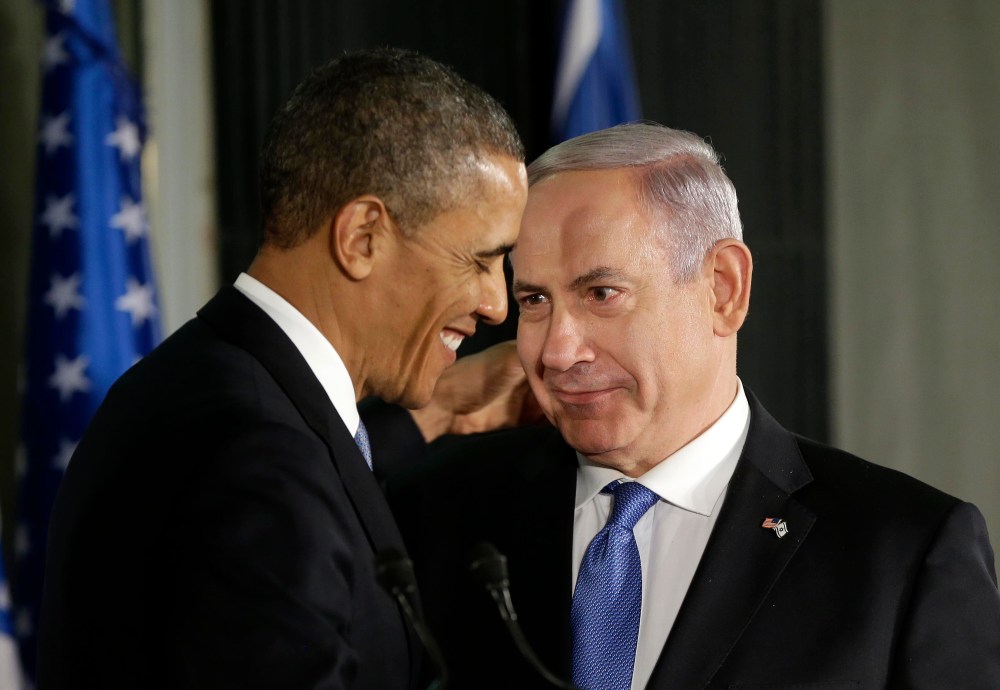
President Obama is visiting Israel—his first trip to America’s closest Mideast ally since he became commander-in-chief more than four years ago.
Obama’s relationship with Israel has been famously tumultuous, prickly, and sometimes downright uncomfortable. On Wednesday, the president —who was greeted by Israeli Prime Minister Benjamin Netanyahu at the Tel Aviv airport—reconfirmed America’s commitment to Israel.
The “United States is proud to stand with you as your strongest ally and greatest friend,” said Obama, adding that “I see this visit as an opportunity to reaffirm the unbreakable bond between our nations, to restate America’s unwavering commitment to Israel’s security, and to speak directly to Israel and to your neighbors.”
At home, Obama’s support among Jews has decreased since 2008. Four years ago he won 78% of the Jewish vote, compared to 69% last year. Here’s a look back at what’s happened since 2008:
2008 – Obama confirms commitment to Israel
The last time Obama visited Israel was as a presidential contender in 2008. At the time, he was trying to ameliorate skepticism that he wasn’t committed to the country. He had come under intense criticism for his ties to former pastor Rev. Jeremiah Wright, who delivered harsh rhetoric about Israel. He was also being dogged by baseless rumors that he was a Muslim. His opponent, John McCain, sent out a fundraising letter that Obama’s foreign policy had “even won him praise from Hamas leaders.”
2009—Obama’s speech in Cairo ruffles feathers
President Obama delivered a speech in effort to reach out to the Muslim world. He came under scrutiny for ripping the Israeli government for new construction on land occupied in the 1967 Israeli war—territory that Palestinians claim as their own. At that time, Obama declared that the U.S. “does not accept the legitimacy” of the settlements. Afterward, Obama reconfirmed his commitment to Israel, but was criticized by some for not visiting the country himself.
March 2010—Sparks fly in Jerusalem
In March, Vice President Joe Biden visited Israel. At the time the country approved more construction of settlements in Palestinian claimed East Jerusalem. Biden skewered the decision, saying it hurt upcoming peace talks. At first, Netanyahu claimed the decision wasn’t made by him, but by the Interior Ministry. He later said Israel had the right to build there.
September 2010—Peace talks fail
Obama renewed the Mideast peace effort, inviting Netanyahu and Palestinian Authority President Mahmoud Abbas to the White House. All parties agreed that peace was a necessity. But nothing materialized after Netanyahu lifted a ban on West Bank housing construction.
May 2011—Netanyahu visits White House
Netanyahu visited the White House, just a day after Obama delivered a major foreign policy speech in which he called for a two-state solution to the Middle East conflict—and asked that Israel accept the pre-1967 borders. Netanyahu, clearly irritated, said at the meeting that the 1967 borders were “indefensible,” that “Israel has certain security requirements,” and wouldn’t negotiate with a Palestinian government that was “backed by Hamas.”
Sept. 2011—Obama says no to Palestinian Authority’s bid for statehood President Obama argued that “peace will not come through statement and resolutions at the U.N..” instead saying the solution was peace talks. It fared well with Israel. However, the General Assembly voted the following year to grant Palestine limited recognition of statehood. November 2011—Obama caught on hot mic griping about Netanyahu Thanks to a hot mic at the G-20 summit in Cannes, France, Obama was caught complaining about Netanyahu to French President Nicolas Sarkozy. It began when Sarkozy complained he “cannot stand” Netanyahu and that “he is a liar.” Obama responded, “You’re fed up with him, but I have to deal with him every day.” Oops. September 2012—Netanyahu: U.S. needs to draw a clear line in the sand with Iran Netanyahu said the U.S. and Israel need to draw a clear line in the sand with Iran, insisting the country was six months away from having 90% of the enriched uranium that would be needed to create a nuclear bomb. The Obama administration said it wanted more time to try non-military options, including diplomacy and sanctions. September 2012—Netanyahu essentially backs Romney Netanyahu and Obama’s relationship become somewhat tense when the Israeli leader warmly embraced the GOP presidential nominee Mitt Romney—his former colleague at the Boston Consulting Group—and skewered Obama over his handling of the building nuclear crisis with Iran. The Israeli newspaper, Israel Hayom (which is viewed as a mouthpiece for Netanyahu) ran a number of op-eds endorsing Romney, arguing that he’d be better for Israel. On the campaign trail, Romney accused Obama of “throwing Israel under the bus.”Recommended


