








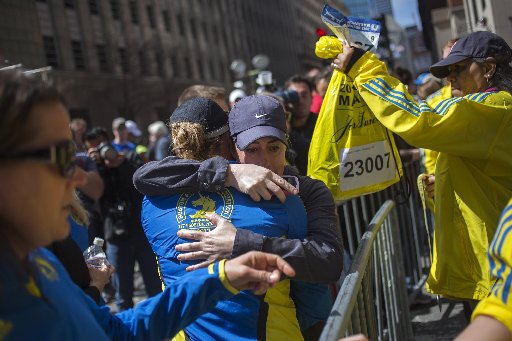
Just a day after the deadly bombings at the Boston Marathon, officials in cities across the country –and the world– including in Chicago, Philadelphia, London, Buffalo and even Honolulu are looking to see if their safety procedures should be adjusted for their upcoming races.
Monday’s explosions, which killed three people and injured more than 170, prompted questions about security at large-scale public events. Could anything have stopped this? And how do we stop tragedies like this in the future?
With 27,000 participants and more than half-a-million spectators, the Boston Marathon presented attackers with the opportunity for a “perfect storm,” says David Holley, a senior managing director of global investigation and risk mitigation firm Kroll’s Boston office.
Unlike other sports, “the spectators are really part of the event,” said Holley, who has been offering security consulting advice to clients for more than 20 years. “They’re cheering, supporting their friends with water and snacks…The audience stands, they are right there in the action.” He pointed out that unlike entrances at stadiums and arenas, there’s no traditional security with identification and bag checks. And of course, securing a 26.2-mile course winding through suburbs and a big city is no easy feat.
For Boston, in particular, Holley said, there are so many entrances to get to Boylston Street, near the finish line and the site of the attack, that it makes the spot “an open target.”
As of Tuesday afternoon, no one had taken responsibility for the explosions, and there is no known motive. However, law enforcement officials told NBC News on Tuesday that the bombs had been composed of explosives and shrapnel packed into pressure cookers that were hidden in backpacks. Investigators believe they were set off using a timer.
Apart from the physical problems of securing a site, there are psychological hurdles as well. Michael Greenberger, director of the Center for Health and Homeland Security at the University of Maryland, said it’s “human nature to let your guard down”–which has happened since the Sept. 11 attacks in New York City, he said. He pointed to several plots that were thwarted. That includes the attempted car bombing of Times Square in 2012, which was foiled when two street vendors alerted police to a suspicious vehicle on the street. Federal agents later arrested Faisal Shahzad, a Pakistan-born U.S. citizen who admitted to the plan. And then there’s Nigeria’s Abdul Farouk Abdulmatallab, the so-called “underwear bomber,” who was arrested in 2009 after passengers jumped him to avoid detonating an explosive device in Detroit. For nearly 12 years, we’ve been spared a major domestic attack.
But to keep America safe, authorities and an alert public have to succeed every time, while would-be attackers need to succeed only once.
The security at future marathons is likely to be more visible. “There’s going to be much more interaction between the spectators and law enforcement,” said Holley. “It might not be any greater, but it will be felt more. People may be asked to open their bags, or if a bag is seen sitting along the route someplace, it might instantly be treated as suspicious.”
And perhaps spectators won’t have access to the entire route, he suggested.
Greenberger said funding for greater security–which took a hit after the recession—will likely be revved up again. And the public will be reminded to be vigilant (if indeed they need a reminder, after the Boston attack).
The slogan “’If you see something, say something,’ has turned into background music….This event will inspire a lot of people to be more vigilant in that regard,” said Greenberger. Despite the bombings, the London Marathon will still be held this Sunday. Organizers said they are still reviewing their security plans. Nick Bitel, London Marathon’s chief executive said he was “deeply saddened and shocked” by the Boston attack. “Our security plan is developed jointly with the Metropolitan Police and we were in contact with them as soon as we heard the news,” he said. Met Police Chief Superintendent Julia Pendry said in a statement that “a security plan is in place for the London Marathon. We will be reviewing our security arrangements in partnership with London Marathon.” No further details were provided. There will be a 30-second silent tribute to the Boston victims planned at the start of the race, which attracts hundreds of thousands of spectators every year. The London Marathon course is different than the 2012 Olympic route, which also took place in the city. The Telegraph reported that securing the Olympic marathon route was “made easier because it was contained with an eight-mile circuit in the centre of the capital” and the start and finish areas were restricted to those with tickets, in addition to having airport-style screening. The London Marathon, on the other hand, “follows a twisting but linear route” and “offers countless potential hiding places.” New York Road Runners, which puts on the New York City Marathon in the fall, put out a statement that “our thoughts and prayers are with the victims and their families of the bombings at the Boston Marathon.” Mary Wittenberg, the president and chief executive officer of the group, said, “The safety and security of all New York Road Runners’ races is, and will always be our top priority. We will continue to work hand in hand with the City of New York and the NYPD as we plan for upcoming events.” Russian officials are thinking ahead to the 2014 Olympic games in Sochi. President of the Russian Athletics Federation, Valentin Balakhnichev, told Interfax news agency that the Boston bombings revealed “problems” in ensuring security at outdoor events and expressed worry that it may inspire “other organizers of terrorist attacks.”Recommended


