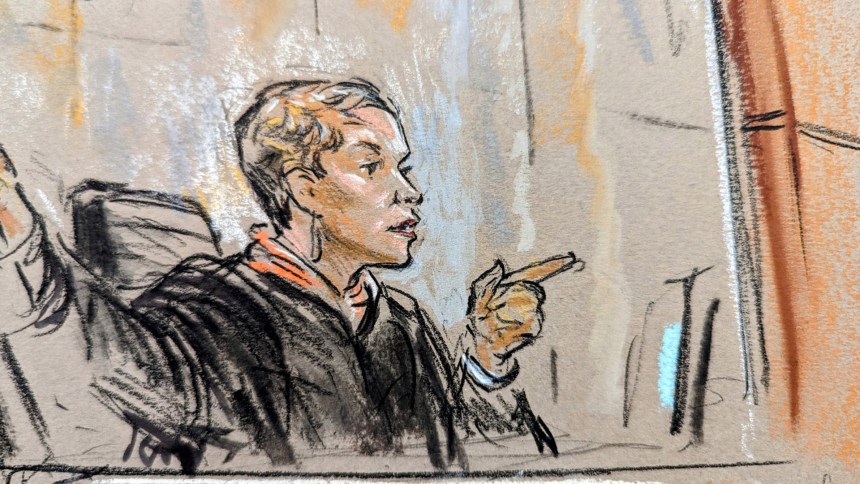


Donald Trump’s attempt to get U.S. District Judge Tanya Chutkan recused looked weak from the start. But the Justice Department’s opposition to Trump’s effort even further underscores that the former president should fail in his quest to stop her from presiding over his federal election interference case. The 20-page retort from special counsel Jack Smith’s office emphasizes not only that Chutkan doesn’t have to recuse herself, but also that if she doesn’t, appellate courts are unlikely to disagree with her.
As the DOJ bluntly observed in its opposition filing late Thursday: “There is no valid basis, under the relevant law and facts” for Chutkan’s recusal, and Trump’s motion “takes out of context the Court’s words from prior judicial proceedings and misstates the proper legal standards governing judicial recusals.”
And which words of Chutkan’s did Trump take out of context? Those were in two sentencings of lower-level Jan. 6 defendants. The former president’s motion noted that in one of the cases, Chutkan said the defendant’s “blind loyalty to one person who, by the way, remains free to this day”; in another, she said the defendant had a “very good point” that “the people who exhorted you and encouraged you and rallied you to go and take action and to fight have not been charged,” and she added: “I have my opinions, but they are not relevant.”
But the context for those comments, the DOJ pointed out, is that Chutkan was “appropriately responding to — and ultimately rejecting — a common argument raised by scores of January 6 offenders: that they deserved leniency because their actions were inspired by, or were not as serious as, those of others who contributed to the riot but had not been held responsible — including former president Donald J. Trump.”
That is, Chutkan wasn’t randomly trashing Trump. She was doing her job.
That is, Chutkan wasn’t randomly trashing Trump. She was doing her job.
That last point is crucial — that the comments came in the context of Chutkan doing her job. The distinction matters because, as the government explained, there’s a tougher standard for recusal in such “intrajudicial” (as opposed to “extrajudicial”) situations. That’s why Trump argued in his motion that “the public can reasonably understand that her views on President Trump derive from extrajudicial sources.” His motion didn’t explain how Chutkan’s views would have come from extrajudicial sources, so his unsupported claim essentially served as an admission that he doesn’t have a good argument.
So what’s the standard Trump has to meet? As DOJ explained, quoting Supreme Court precedent: “Where, as here, a recusal motion is based on statements made by a judge during judicial proceedings in response to facts and arguments placed before her, recusal is warranted ‘only in the rarest circumstances’ where the statements ‘display a deep-seated favoritism or antagonism that would make fair judgment impossible.’”
Prosecutors with Smith’s office picked up on that as well, writing in their opposition: “Tellingly, the defendant does not cite a single case in which recusal has been warranted on remotely similar facts.” It’s unclear how Trump wins under that tough standard. As I wrote when Trump filed his motion, he didn’t cite any cases showing defendants winning recusal in situations like his — probably because there isn’t any such precedent. Prosecutors with Smith’s office picked up on that as well, writing in their opposition: “Tellingly, the defendant does not cite a single case in which recusal has been warranted on remotely similar facts.” Prosecutors also pointed to precedents that might resonate broadly with Trump. One case they recalled was from Watergate, where recusal wasn’t needed when defendants sought it based partly on the judge’s comments in an earlier trial that “expressed a belief that criminal liability extended beyond the seven persons there charged.” DOJ’s opposition filing also noted a more recent recusal failure, in the case of Michael Flynn, a former Trump national security adviser. Flynn couldn’t disqualify a judge who had said: “Arguably, you sold your country out. … I’m not hiding my disgust, my disdain for this criminal offense.” Both cases came from the U.S. Court of Appeals for the District of Columbia Circuit, the appeals court that binds Chutkan and her Washington trial court colleagues. So when will Chutkan issue a decision on whether she’ll recuse? Possibly this coming week. But first, Trump can file a reply within three days. If his legal team is going to try and convince Chutkan under the applicable legal standard, and within the full context of the relevant facts, then we should expect his reply to argue that the Barack Obama appointee’s comments somehow reflected such “deep-seated” antagonism. Again, it’s hard to imagine Trump succeeding on that point. But it’s the task he has ahead.
Jordan Rubin is the Deadline: Legal Blog writer. He was a prosecutor for the New York County District Attorney’s Office in Manhattan and is the author of “Bizarro," a book about the secret war on synthetic drugs. Before he joined MS NOW, he was a legal reporter for Bloomberg Law.
Latest Post
Recommended