











Social media was ablaze on Monday with news that Donald Trump bought a gun during a South Carolina campaign stop. That is, until his campaign walked back that claim and stated he didn’t purchase the firearm after all.
But what’s the legality of all of this, anyway?
Let’s take a look at Title 18 of the United States Code, Section 922 — or, 18 USC § 922 as you might see it written in legal opinions. (Some of Hunter Biden’s charges in his indictment fall under that law.)
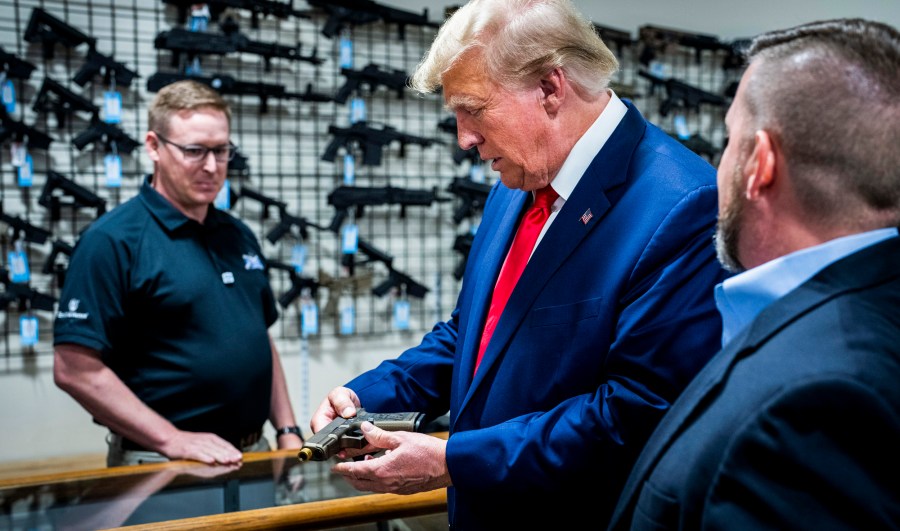
When it first seemed like the former president, who’s facing four criminal prosecutions, was buying the gun, it appeared that 18 USC 922(d)(1) could be relevant. That section says it’s unlawful to “sell or otherwise dispose of” a firearm to someone who’s under indictment for a crime punishable by imprisonment for a term exceeding one year.
After it appeared that Trump might not have purchased the gun, that still raised the question of whether he violated 18 USC 922(n), which says it’s unlawful for people under indictment to “receive any firearm … which has been shipped or transported in interstate or foreign commerce.” MSNBC legal analyst Andrew Weissmann seemed to think so:
So this photo is proof of the crime: he is in receipt. https://t.co/7xVvFrsXUW
— Andrew Weissmann (weissmann11 on Threads/Insta)🌻 (@AWeissmann_) September 25, 2023
Why, then, hasn’t Trump been charged under that law, or why won’t he be if he isn’t?
For one thing, could it be that “receive” may require more than holding a gun in a gun store (if that’s all that happened) and instead require something closer to keeping it? Perhaps. Safe to say, if Trump actually bought the gun, he’d be closer to trouble (as his spokesperson likely realized or was quickly reminded). Even if Trump didn’t purchase it, the incident is still worth investigating, to find out how the leading GOP presidential candidate’s campaign wound up boasting, even temporarily, that he committed a crime while already under several indictments.
But a more overarching issue is also at play. That’s the Second Amendment revolution that Trump helped bring about, by appointing half of the Supreme Court’s Republican supermajority. It was last year’s Bruen case, decided along 6-3 party lines, where the court expanded gun rights even further, leading lower courts since then to question a host of laws — including 922(n). To take one relevant example, a Trump-appointed federal judge in Texas said, citing Bruen, that 922(n) is unconstitutional. For what it’s worth, that judge defined “receive” broadly in the course of ruling against the prohibition. At any rate, the judge’s ruling didn’t strike down the law across the country — the Supreme Court would need to do that. But that Texas ruling and a series of others in Bruen’s wake reinforce the shaky ground on which all manner of gun laws stand, whether it’s ones that apply to Trump, Hunter Biden, or regular people. Whatever comes of Trump’s latest campaign stop and the campaign itself, with the Supreme Court set to consider the latest big gun appeal this coming term, the incident serves as a reminder of the revolution and potential wreckage he and the GOP have wrought.
Jordan Rubin is the Deadline: Legal Blog writer. He was a prosecutor for the New York County District Attorney’s Office in Manhattan and is the author of “Bizarro," a book about the secret war on synthetic drugs. Before he joined MS NOW, he was a legal reporter for Bloomberg Law.
Latest Post
Recommended


