








There was an unusually large crowd at the town meeting on Nov. 9, 2007, Kyle White remembered thinking.
“Normally there’s a few of the elders and a couple other village males,” White, then a 20-year-old Army specialist stationed in East Afghanistan, said. “But on that day, it seemed like every male fighting-age and above was there in attendance.”
The crowd was White’s first red flag. When the unit’s interpreter began picking up radio chatter in an unfamiliar language, the Americans and their accompanying squad of Afghan National Army soldiers knew it was time to leave.
The first shots – small arms fire and RPGs –rang out just a half hour after the Americans left the Shura meeting, and seconds after the Afghan villagers who had been tagging alongside them broke off and disappeared behind a ridge.
“They knew what was going to happen,” White said, “and so they were turning away, or getting to higher ground to watch.”
Over the next four hours, White and his fellow soldiers endured one of the fiercest battles seen by U.S. troops in Afghanistan. Six Americans died in the attack. None escaped without wounds.
“The whole valley erupted,” White recalled. He fired his first magazine at the insurgents and went to reload another, “and then it was lights out.” Moments later, he regained consciousness face-down on a rock with shrapnel embedded in his head.
“I checked my face with my hand, pulled it away, and my hand was covered in blood,” White said. “I gave my face a once-over and… everything was still there, so I knew it hadn’t been a really bad [hit].” An RPG had struck the back of his head.
Before long, White, platoon leader 1st Lt. Matthew Ferrara, Marine Embedded Training Team member Sgt. Phillip Bocks, Spc. Kain Schilling and the interpreter were separated from the other ten patrol members, who had slid down a ridge under a hail of enemy fire from the high ground.
White applied a tourniquet to Schilling’s arm before he noticed Bocks, 10 meters away, badly wounded and making little progress crawling toward their position.
“That’s when I basically said, screw it, and he needed help, so I just ran out to him,” White said. “But I came to the conclusion quickly that they weren’t shooting at him before, but they were shooting at him now, because I’m out here… So I made the decision just to drag him a few feet and then run back to where Kain Schilling was, just to kind of draw their fire… So I just waited a couple seconds back at Kain’s position and then run back out and repeat that for like three or four times.” Bocks later died of his injuries.
“I knew with Bocks, if the roles were reversed and I were out there, he would come get me. And I would want somebody to come get me,” White said.
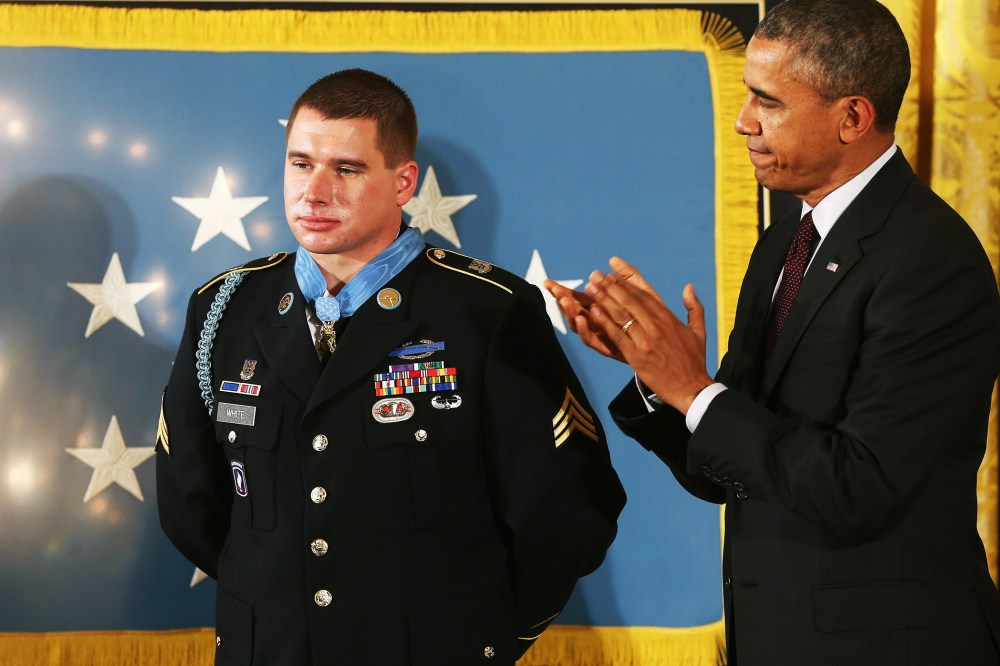
More than six years later and a world away from Nuristan Province, White – now in his mid-20s with a college degree under his belt and a full-time job with the Royal Bank of Canada in Charlotte, N.C. – says being awarded the military’s highest honor is “overwhelming” and “bittersweet.” “The memories are still vivid,” White said. “I can still close my eyes and be anywhere back on that trail. You could smell the gunpowder in the air, feel the temperature, everything.” White is the 10th American to be awarded the Medal of Honor for actions in combat since September 11, 2001, and the seventh surviving recipient. “It was emotional, and when [President Obama] was hanging the medal around my neck, all I could think about were the guys who lost their lives that day,” he said. The Medal of Honor ceremony had officially been three months in the making. White saved his lunch hour for the congratulatory call from Obama, after quietly breaking the news to his stunned supervisor at RBC, who told the director. “They couldn’t believe it,” White said. “The rest of the office didn’t find out till about a month later.” After the Battle of Aranas, White said, “something just changed with me in the Army. It didn’t change my opinion of it and it wasn’t something that was good or bad, it was just different.” When it came time to consider reenlisting in 2011, White forged a new path: getting his college degree, and taking to his studies with a seriousness of purpose that he’d cultivated in the Army. With the Medal of Honor comes a national spotlight, and White is making his journey from the military to school and then to the workforce his platform. “I want to go around and try to talk to service members who are thinking about separating from the military and get them thinking about, if they are getting out, are they going to college? Are they getting a job? What is their plan?” With the reduction in the size of forces, White said, “there’s going to be a lot more people looking for alternative plans for the future.”
Erin Delmore Recommended


