








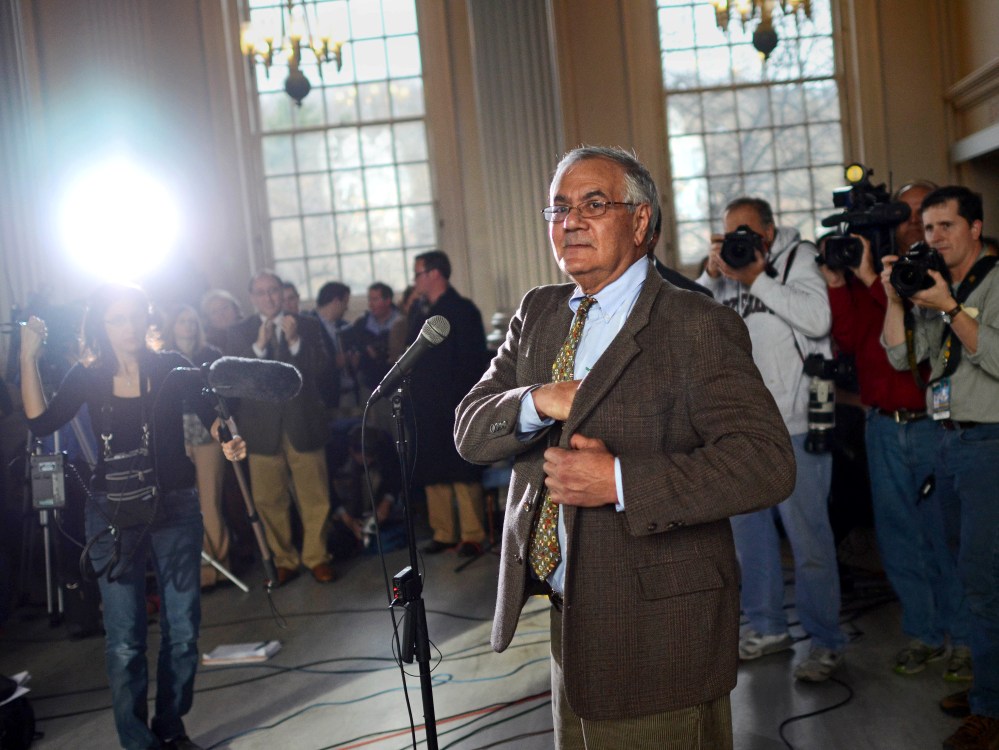
Five years ago this Sunday, Lehman Brothers went bankrupt after its huge bets on subprime mortgages went bad. Days later, insurance giant AIG plunged into crisis due to its own bets on risky mortgages in the form of complex financial instruments like credit default swaps. Thus began the financial crisis that would upend the global markets and the U.S. economy, which still bears the scars of the meltdown. MSNBC spoke with former Congressman Barney Frank, the Massachusetts Democrat who co-authored the eponymous Dodd-Frank Wall Street Reform Act to prevent such a catastrophe from happening again. Frank retired in January after serving for 32 years in Congress.
MSNBC: I want to start with a basic question—do you think that Wall Street has changed, and that the financial system is safer now?
Barney Frank: Very much so. You never get 100%. But we outlawed the worst kind of loans. Secondly, the banks are much more highly capitalized. Third, one of precipitating situations was that AIG, it turned out they owed something like $200 billion in credit default swaps they couldn’t pay off. We are well underway to regulating derivatives—not fixing prices, but requiring them to be done openly on exchanges. Derivatives were a large, unregulated element, and what we did with derivatives was what they did in the New Deal with stocks. We created the Financial Stability Oversight Council and made it less likely for big institutions to fail.
There needed to be risk requirements for [mortgage] securitization. I’m unhappy—I think that’s one area where they didn’t do as much as was needed. I wanted there to be three kinds of mortgages—mortgages you couldn’t give because they were bad; mortgages that you can give, but have risk retention; and mortgages that are super safe. They merged the last two categories, so I’m worried they’ve done too little on the risk requirements.
The whole question of high-speed trading—I would look at that if I were still around, but I’m not.
MSNBC: The implementation of the major rules has taken much longer than expected. Do you think this is a problem, and are you satisfied with how Dodd-Frank has been enacted?
Frank: First of all, I’m very satisfied. No harm has been done due to the fact the rules haven’t been adopted—It’s not the case that people saw the rules haven’t been adopted and then gone in and done things that are being banned.
The Republicans have choked off funding for the Commodity Futures Trading Commission, which has got the greatest implementation of new authority. Derivatives were totally unregulated, and we gave the SEC and the CFTC the power to regulate this. Republicans have succeeded unfortunately in getting the funding cut. They also appointed judges in the [DC Circuit Court] that have knocked out a couple of things that regulators are trying to do to.
[Regulators] have do very extensive analysis of all comments, and financial institutions are flooding them. That’s the major reason for the slowdown. I am confident that by the end of the year, all the important rules will be done.
MSNBC: To what degree do you think that lobbyists have influenced how the rules have been written?
FRANK: I do not think it’s the case that lobbyists have had undo influence except the combination of inadequate funding for the agencies and a very conservative court have allowed them to clog the system.
MSNBC: But what about things like loosened regulations on U.S. derivatives overseas, which has been described as a triumph of lobbying?
FRANK: As of December, they will be regulated—the overseas activities of American institutions. What slowed [CTFC Chairman Gary] Gensler down there was not so much the financial institution as the other countries.
MSNBC: What do you think still needs to be done? Some folks have argued that we still need stronger capital requirements for banks. Do you agree?
FRANK: The capital requirements will come in part from Basel III. I think they were done right.
I would like them to revisit the risk-retention thing [for mortgage securitization]—that troubles me the most.
MSNBC: Are there things you wished we had done differently over the past years, either during the financial crisis itself or in our response to it?
FRANK: We tried to get some more money released to help with mortgages, and it suffered because it was in the interim between the Bush and Obama presidencies. I was successful in getting $1 billion through for helping the unemployed with mortgage payments. Here I blame [Housing] Secretary Donovan. He didn’t care about the program—he spent barely half of it and left half a billion dollars on the table.
MSNBC: Speaking of mortgage payments, are there other things we should have done differently in terms of helping people facing foreclosure?
FRANK: The problem with all that mortgage stuff is there is no magic formula. You’ve got to have the money. Where’s the money going to come from? Who’s going to take the loss? There was never a source of money. MSNBC: What about the state of Fannie Mae and Freddie Mac? FRANK: While we made some bad decisions with subprime mortgages, they maintained the overall value of the houses, and they are going to pay us. I still think they ought to be abolished. I like the approach that Geithner put forward…We now have an affordable housing trust fund—it’s what we should do, not for home ownership but rental housing. We’ve taken one step by outlawing the bad mortgages, but we need to take another one by funding affordable housing. MSNBC: I know a lot of people are wondering why Wall Street has bounced back, the markets are doing fine, but that hasn’t meant the rest of the economy has recovered. Why aren’t we doing better? FRANK: [Wall Street] is not the whole of the economy. To the extent that the fiscal crisis was a problem, we’ve overcome that. The European crisis has been a major problem for the economy—Europe is a major customer. Secondly, it’s easier to prevent bad things from happening than to make good things happen. There are still people in debt. Housing prices haven’t fully recovered, so people aren’t as rich as they once were. MSNBC: Is there anything you’re seeing now that you’re worried could result in the next financial crisis? FRANK: I’m out of the business, I retired in January. But high speed trading—I would have looked at if I were still there. MSNBC: There’s also been the question of why CEOs weren’t prosecuted, and there’s this feeling among many folks that banks have come out on top—that they ultimately didn’t have to pay for what they did. FRANK: First of all, the major reason there haven’t been more criminal prosecutions is that a lot of bad stuff wasn’t illegal. That’s precisely why we had to pass these laws. I tell my liberal friends, to succeed in criminal prosecutions, you have to prove beyond a reasonable doubt, and you have to show that people we were prosecuting had good reason to know what they were doing was illegal. As for the public’s perception—some of the bank stocks took a big pounding. CEOs, many of them left. Their profits went down some because we increased capital requirements. Part of the problem is that the media tends to focus almost exclusively on the negative. MSNBC: Looking back over the last five years—the crisis and what we’ve done in response to it—what’s your main takeaway? FRANK: The basic problem was that innovation in the financial community allowed them to take risks and avoid responsibility when the risk went bad. What we tried to do is reconnect those—and that why my biggest concern is over risk. I think it’s a pattern in American history that the private sector innovates, then that innovation outstrips the regulations and we have to have new regulations to catch up.
Suzy Khimm Recommended


