








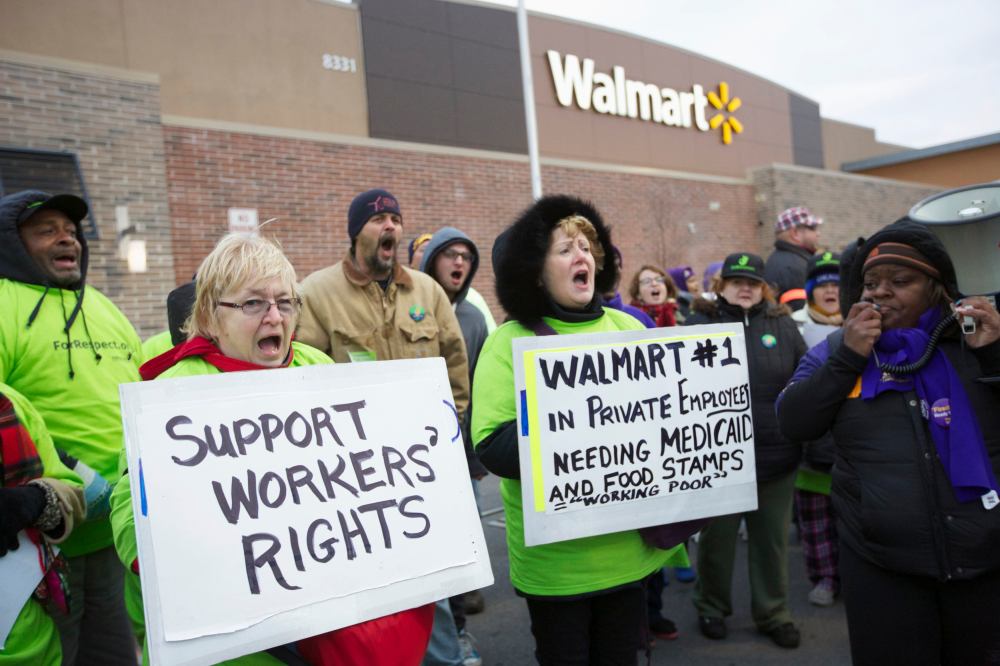
About 100 Walmart employees from various stores around the country went on strike Tuesday morning, saying they would not return to work until at least June 7, the date of Walmart’s annual shareholder meeting. This walkout, though fairly small compared to similar events which occurred in the past six months, is expected to last significantly longer.
A Walmart spokesperson called the strike a “publicity stunt.”
Though the past six months have been a period of particularly intense and widespread labor unrest in the low-wave service and retail industries, the recent strikes have been short term affairs.
“We have to turn it up a notch,” Dominic Ware, a Walmart employee in southern California, said on a Tuesday conference call with reporters. “I wish we didn’t have to, but Walmart is showing that the one- to two-day strikes, they’re not scared of that.”
Ware is a member of OUR Walmart, a workers’ group affiliated with the United Food and Commercial Workers (UFCW) union. The group made national headlines last year by leading what they say were hundreds of employees nationwide in a day-long strike on Black Friday, typically the biggest shopping day of the year. In the months leading up to the strike, numerous other labor actions occurred at Walmart stores and warehouses around the United States.
Since the Black Friday strike, OUR Walmart has been relatively quiet. However, a surge of labor unrest at other retail and fast food outlets followed in that strike’s wake. The fast food industry in particular has been subject to worker demonstrations cities like New York, St. Louis, Detroit and Milwaukee. In Chicago, striking fast food workers were joined by employees at retail outlets such as Macy’s and Sears. Most recently, low-wage workers in federally contracted workplaces engaged in a similar strike in the nation’s capital.
Nearly all of these strikes lasted for only a day or two days at most. OUR Walmart’s pledge to keep these workers off the job for a minimum of 11 days is taking the wave of low-wage worker unrest in a new direction.
“This is an escalation, absolutely,” said Dan Schlademan, the director of UFCW’s Making Change at Walmart campaign. “OUR Walmart is a prominent fixture inside Walmart, and there will continue to be escalations until real change starts.”
At the top of OUR Walmart’s list of grievances this time around: Allegations that Walmart management has attempted to silence and intimidate dissident Walmart employees and organizers, often by using tactics which the workers’ group insists are illegal. OUR Walmart reports having received over 150 individual complaints of worker harassment, intimidation and retaliation, according to a new report from American Rights at Work. The complaints include allegations of wrongful firings, cuts to hours on the job, and open threats against employees who protest their working conditions.
Last week, OUR Walmart filed 30 unfair labor practice charges with the National Labor Relations Board (NLRB). At least one of the charges relates to what the group says was the wrongful termination of Carlton Smith, an employee in Paramount, Calif., who was dismissed from his job after 17 years.
OUR Walmart says Smith was fired simply for being a member of the organization and organizing other workers, but the company disagrees. Walmart spokesperson Brooke Buchanan dismissed the charges of intimidation, saying that organizers had illegally trespassed on store property and that Walmart management had a strict-anti-retaliation policy.
“If an associate has filed a retaliation investigation or if an associate has expressed some concerns, we look at every single one of those,” she said.
Buchanan called the latest strike a “publicity stunt by the unions and the subsidiaries of OUR Walmart.” WORKERS’ TO CONFRONT SHAREHOLDER MEETING OUR Walmart also kicked off a nationwide “Ride for Respect” bus tour on Tuesday, which will bring a caravan of protesting workers and allies to almost 30 cities across the country before arriving in Bentonville, Ark.. Bentonville will be the site of the Walmart shareholders meeting on June 7 when members of the Ride for Respect will attempt to confront of the company’s executives and shareholders. Sarita Gupta, executive director of the labor coalition Jobs with Justice, argued that the Walmart riders were “picking up the baton of economic justice” left behind by the civil rights campaign and Dr. Martin Luther King Jr.’s latter-day focus on class and poverty. “We believe that workers, people who work there, should not have to rely on food stamps and other public assistance to survive,” she said, a reference to the large number of Walmart workers who collect various forms of social welfare to supplement the wages they receive from their employer. This is not the first time that activists have drawn parallels between the modern low-wage workers movement and the struggles of the civil rights era. In Detroit, Reverend Charles Williams II predicted a 1967-style “long hot summer” for striking fast food workers. In New York, fast food employees explicitly modeled their campaign’s message after that of the 1968 Memphis sanitation workers’ strike. And Color of Change executive director Rashad Robinson also referred to the Walmart uprisings as “just part of the legacy of civil rights in this country.” “I think history will really teach us that if we don’t stand up to this kind of corporate power, this grab that Walmart is making, we will all suffer in the end,” he said.
Ned Resnikoff is an urban policy analyst, researcher, writer, and editor. His byline has appeared in a variety of publications, including the New York Times, San Francisco Chronicle, Dissent, and The Nation. He writes the newsletter Public Comment, which can be found at publiccomment.blog. Recommended


