








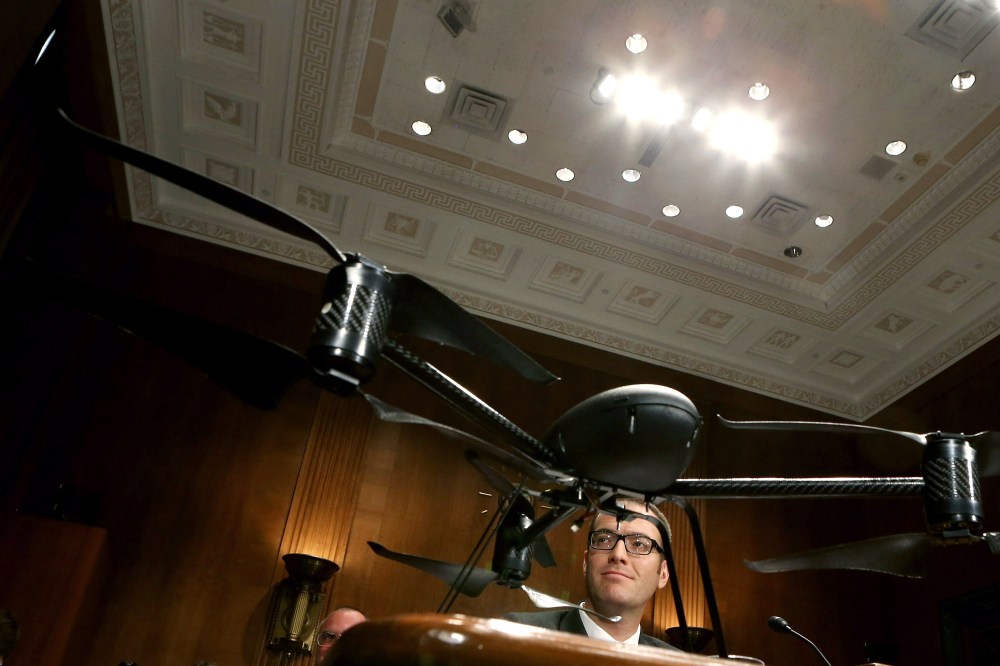
Republican Senator Rand Paul’s hypothetical U.S.-controlled drone that could be used to target American citizens made no appearance in Wednesday’s Senate Judiciary Committee hearing on domestic drone use and privacy concerns. The hearing focused heavily on regulation, in particular the question of who would be responsible for overseeing local and state drone programs.
As with many other rapidly developing technologies with potential law enforcement uses, the specter of an Orwellian surveillance machine loomed. “I am convinced that the domestic use of drones to conduct surveillance and collect other information will have a broad and significant impact on the everyday lives of millions of Americans going forward,” Committee Chairman Patrick Leahy said in his opening statement.
The witnesses seemed to agree that unmanned aerial systems, or UASes, will be a standard tool of law enforcement agencies in the near future, and while it became clear over the course of the hearing indicating a consensus that there must be some sort of standard for collecting, processing, and disposing of any data collected through unmanned aerial systems, no one was able to articulate exactly who should be in charge of creating and administering that standard.
UASes are already used for a wide range of tasks previously done by local and state agencies, ranging from mapping wildfires and floods to patrolling the U.S.-Mexico border. At this point, privacy issues related to drones are governed by laws that will not keep pace with the speed at which the technology develops. Agencies at the federal, state, and local level must currently apply to the Federal Aviation Authority for a license called a Certificate of Authorization. There is currently no privacy component to the FAA licensing process.
The two witnesses with legal expertise disagreed over what sort of laws should be–Amie Stepanovich of the Electronic Privacy Information Center argued for a federal privacy standard, while University of Washington law professor Ryan Calo suggested that those laws might be better crafted at the state level. Both Stepanovich and Calo supported adding a privacy safeguard component to the FAA’s current drone licensing procedures, but the merits and potential problems of delegating information security and privacy protections to a safety agency were not addressed in detail. Leaving legislation to the states has led to a number of bills meant to prevent surveillance without a warrant or imminent threat. The Florida house unanimously passed a bill earlier this month that would greatly restrict police use of surveillance drones, and a Texas legislator introduced the strongest anti-drone bill in the country; last year a Texas county sheriff’s officer indicated that his department was considering equipping drones with crowd control methods like tear gas and rubber bullets. While the surveillance potential of drones at the state and local level has yet to progress far beyond hypothetical questions of jurisprudence, the question of how to create restrictions on these “flying cell phones,” as Calo called them, that do not become obsolete will be an essential part of future hearings on the issue.
Meredith Clark
Meredith Clark is a freelance writer and editor. She was previously a senior news producer for "Patriot Act with Hasan Minhaj," a reporter with MSNBC.com, the digital politics and culture editor at Glamour and a senior news and politics editor at Refinery29. She has written for Vulture, Rolling Stone, Self, Marie Claire, Cosmopolitan, The Daily Beast and Bustle. Recommended


