








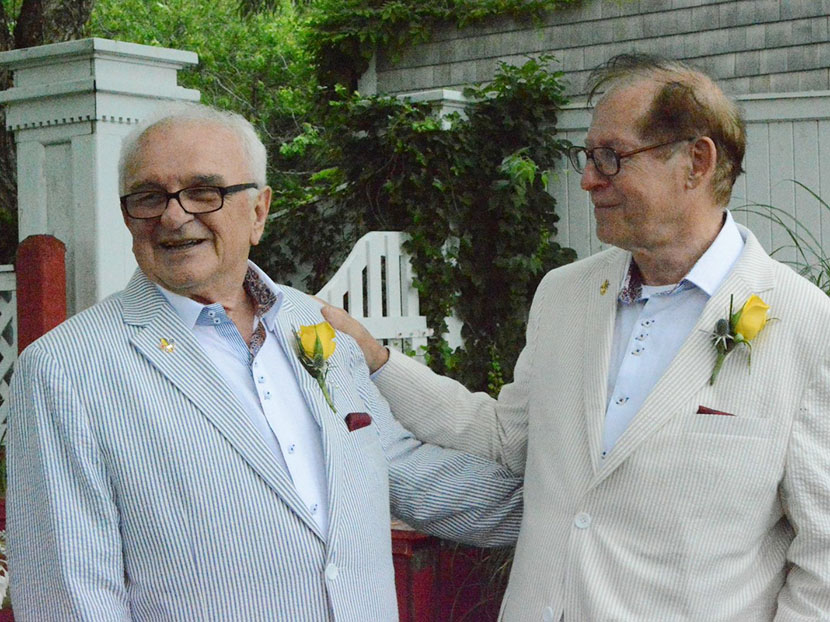
Although it’s been five decades, Claude Summers and Ted-Larry Pebworth still remember perfectly the night they met.
The two were in the Boulevard Lounge, a gay bar in Baton Rouge, Louisiana, in the summer of 1963—six years before riots at the Stonewall Inn in New York City effectively launched the modern gay rights movement. Ted was a 27-year-old Ph.D. candidate at Louisiana State University. Claude was 18, home for the summer after finishing his freshman year at UCLA.
“He accuses me of robbing the cradle,” said Ted, now 77, in his Southern drawl. “It was pretty much love at first sight.”
As Claude tells it, the most important decision he anticipated having to make that summer was whether to major in English or pre-law. He never could have imagined the man who bought him a beer that night and talked to him about Tennessee Williams would eventually become his spouse.
On Thursday, nearly 50 years to the day after they first met, Claude and Ted are tying the knot. Not only will the wedding commemorate their golden anniversary—a time when most couples would be renewing their vows, not saying them for the first time—but it will also mark the Supreme Court rulings on two historic marriage equality cases.
For the couple whose relationship has spanned the entire gay rights movement, the decision to marry bridges the political with the deeply personal.
“We just decided that marriage was something both public and private,” said Claude, now 68, whose Louisiana accent rivals that of his soon-to-be spouse. “We don’t need the government for our private relationship, but we wanted to stand with our community and have our relationship honored the same way heterosexual relationships are.”
Claude and Ted are now back in Louisiana, retired after 30-year careers as English professors at the University of Michigan-Dearborn. But their wedding will be held in Provincetown, Massachusetts—the first state to legalize marriage equality through a state Supreme Court ruling nearly a decade ago. Though Louisiana does not recognize same-sex marriages, even those which took place in states that do, the decision to marry in Massachusetts seemed “very natural,” said the couple.
“I was struck by the Goodridge decision, in which the Massachusetts Supreme Court said there can be no second-class citizens, and therefore only marriage would suffice,” said Claude. “So we see it as not only public affirmation for our love to one another, but as a way of asserting our right to first-class citizenship.”
“There is value in having your relationship authorized, in a way,” said Ted. “Especially for gays, who have been denied that right. So that’s the thing I’m most happy about.”
Thursday’s wedding will gather about 40 friends from the couple’s happy life together.
Ted grew up in Homer, Louisiana, “one of the buckles on the Bible belt,” as he describes it. His mother found it hard to accept her son’s sexuality. She used to send Ted newspaper clippings of raids on gay bars. But Ted’s father was surprisingly supportive, even insisting that his son and Claude share a room the first time they came home together for the weekend.
“I never regretted being gay,” said Ted. “I thought everybody should just let me alone, and I’d let them alone.”
Claude, who grew up in Gonzales, Louisiana, said his mother was welcoming, too.
It wasn’t until after 1970 that the couple faced real homophobia that threatened the relationship. The pair was living in Chicago when Claude received a teaching job offer in California. Ted accepted a position there as well. But shortly after, Claude’s offer was rescinded when his employer found out about his sexuality, and the couple was forced to spend a year away from each other.
“I think that was the most difficult time,” said Ted. “Just being alone.” Claude took a job at the University of Michigan-Dearborn, and a year later, so did Ted. The two flourished there, even receiving a distinguished professorship as a couple after both were nominated. “It worked out well for us, because we wound up being very happy at the University of Michigan-Dearborn,” said Claude. “We lived normally with a great deal of support. Beyond some isolated incidents, we thought we were very well accepted as a couple.” In 2001, the pair retired to New Orleans, where they now live with two rescue beagles, who they reluctantly placed in a kennel for their wedding. Both are editors of glbtq.com, a website devoted to gay, lesbian, bisexual, transgender, and queer culture. “We’ve been through it all,” said Ted. They’ve marched in gay pride parades from New York City to San Francisco and are pleased with the progress the gay rights movement has made. “I’m not happy with how long it’s taken, but it’s certainly a lot better now than it was then,” said Ted. “I wish it would move faster.” Wednesday morning, the Supreme Court overturned the Defense of Marriage Act, a 1996 law which did not recognize same-sex marriages on a federal level. Writing the decision, Justice Anthony Kennedy said DOMA violated gay Americans’ equal protection under the law and is thus unconstitutional. The Court ruling struck down the part of DOMA that prevented the federal government from giving same-sex couples access to thousands of federal benefits. Under this decision, Claude and Ted will now be entitled to receive some of those benefits, because they legally married in Massachusetts. But other benefits—such as tax breaks for married couples, and Social Security survivors’ benefits—depend on where the couple currently lives, which in Claude and Ted’s case is Louisiana. Since the Supreme Court did not issue a broad ruling in the Proposition 8 case, Louisiana will continue to not recognize Claude and Ted’s marriage, and they will lose out on some of those valuable federal benefits. Nevertheless, the couple still believes their wedding will carry significant meaning and hope for the future. “I don’t want to weep,” said Claude, trying to articulate how he will feel when finally marrying his partner of 50 years. “We know we’ve loved each other and have been able to do so without ever being married, but also having the community blessing that is involved in marriage adds something. It may be intangible but it’s real.”
Emma Margolin
Emma Margolin is a reporter at MSNBC.com. Recommended


