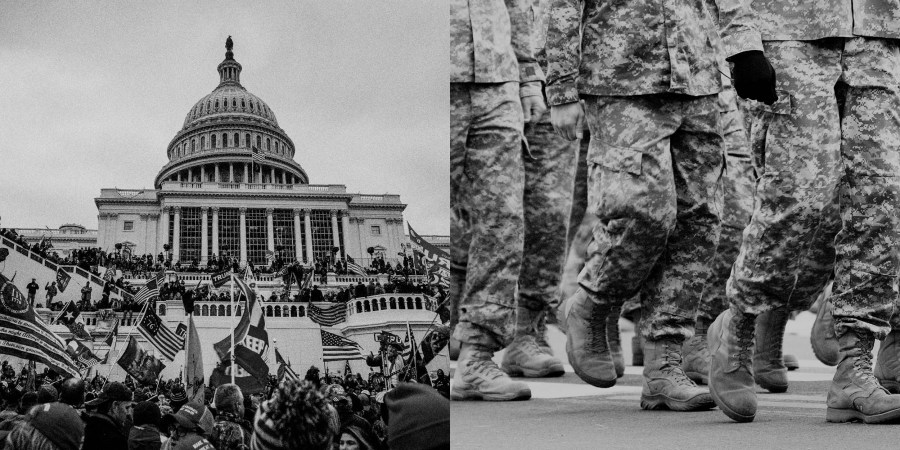
In the immediate aftermath of the Jan. 6 attack on the U.S. Capitol, reports made it clear that many of those involved had served in law enforcement or the military.
Dozens of active or former service members have been charged in connection to the Capitol riot, NBC News has reported. Some members of the violent extremist groups that participated in the attack, including the Proud Boys, the Oath Keepers and the Three Percenters, had military experience. That grim reality has prompted concern in Congress, displayed most recently in a House Committee on Veterans’ Affairs hearing Thursday focused on curbing violent extremism.
Committee Chair Mark Takano, D-Calif., opened the hearing by explaining why extremist groups seek out service members:
These groups value the leadership skills, combat experience, and the weapons training that veterans possess. Having veterans among their ranks also gives these groups an air of credibility. It allows them to project a false appearance of patriotism and duty that belies their true anti-government views, and racial, ethnic, and religious hatred.
He cited data showing veterans and active duty service members killed more than 300 people and injured nearly 2,000 more in attacks spanning from 1990 to 2021. Those attacks include the 1995 Oklahoma City bombings, the 2012 shooting at a Sikh temple in Wisconsin, the 2014 shooting at a Jewish community center in Kansas, and the 2018 shooting at a yoga studio in Florida.
Takano repeatedly emphasized that only a small percentage of veterans become extremists, and that violent extremism has been practiced by both liberals and conservatives. But he was clear that far-right extremism is the most dominant form in the U.S. today.
The hearing focused heavily on reasons why veterans become extremists.
One witness cautioned against narratives that paint veteran extremists as “misguided, troubled, broken people that are manipulated.”
“The sweeping use of this characterization is surely offensive to the countless veterans out there who live each day with trauma but choose not to abandon their oath or subvert our democracy,” said William Braniff, director of the National Consortium for the Study of Terrorism and Responses to Terrorism and a founding board member of We the Veterans, a veteran advocacy nonprofit.
Pete Simi, a sociology professor at Chapman University with expertise in white supremacist groups, testified that these groups can, in fact, take advantage of service members’ shortcomings and disillusionment. “Individuals who experience involuntary exit, such as dishonorable discharge, or even cases where a person fails to gain entry to specialized training can produce an identity crisis of sorts,” Simi said. “Extremist recruitment often targets people experiencing these types of crises because they understand how to manipulate and take advantage of individual vulnerabilities,” he added. Democrats led the meeting, with Republicans repeatedly denouncing it as politicized and unnecessary. But the threat of violent extremism by veterans is clearly real. The fact that much of this extremism is fomented in the conservative movement is inconvenient for Republicans — but that obviously doesn’t mean it shouldn’t be investigated.
Ja’han Jones is an MS NOW opinion blogger. He previously wrote The ReidOut Blog. Recommended