








The House Committee on Homeland Security hosted a hearing Monday that focused on violent extremism, with an emphasis on a raft of antisemitic threats made recently in New Jersey.
The hearing was held in Teaneck, New Jersey, and highlighted a troubling trend in the state. An Anti-Defamation League study released in April found that “reported antisemitic incidents in 2021 rose by 25% in New Jersey, reaching 370 total incidents — the highest number ever recorded by ADL in the state and the second-highest number recorded in any state across the country last year.”
According to the Jewish advocacy group, the 370 incidents in New Jersey “constitute 14% of the total number of antisemitic incidents recorded across the United States last year.”
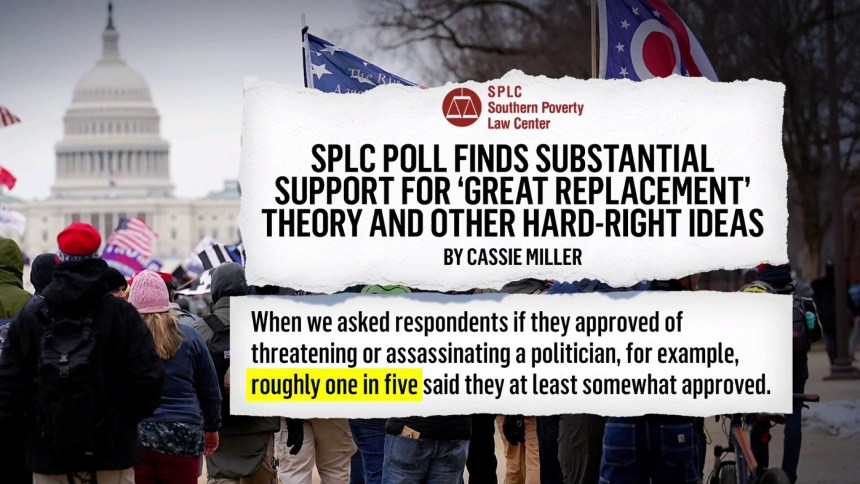
In his opening remarks, U.S. Rep. Ritchie Torres, a New York Democrat who is vice chair of the homeland security committee, said about 30% of all antisemitic incidents last year in the U.S. occurred in New York and New Jersey, but he highlighted multiple violent incidents elsewhere to note that the problem is widespread. And he highlighted the role that “replacement theory” — a right-wing conspiracy theory alleging that Jews and nonwhite Americans are plotting to replace white Christians — has played in antisemitic attacks. A poll conducted in May found that a large majority of people who voted to re-elect Donald Trump as president in 2020 believe in this racist theory.
Specifically, Torres referred to white supremacists chanting “Jews will not replace us!” in 2017 before the deadly Unite the Right rally in Charlottesville, Virginia, which Torres rightly called an “odious reference to the ‘great replacement theory.’” He also noted the 2018 massacre at a Pittsburgh synagogue, in which a gunman said to be motivated by the replacement theory killed 11 people and injured six others in the deadliest act of antisemitism in U.S. history. The suspect, Robert Bowers, has pleaded not guilty and is awaiting trial.
Torres also denounced offensive trending topics — like “Hitler was right” — being allowed to spread online “with no content moderation in sight.” Several participants in Monday’s discussion, including Rep. Josh Gottheimer, D-N.J., a member of the homeland security committee, noted that social media sites have played a key role in helping radicalize extremists. As an example, Gottheimer pointed to groups involved in the deadly Jan. 6 siege on the U.S. Capitol, such as the Oath Keepers, that include admitted Holocaust deniers who had met one another online.
Lorie Doran, a Department of Homeland Security official based in New Jersey, said that her agency had identified “homegrown violent extremists” and “white, racially motivated extremists” as high-level threats. But she emphasized that antisemitism is espoused across racial lines and added that her office is concerned with “managing potential threats of targeted violence regardless of motive.”
Still, she and other witnesses testified that antisemitism as a central political motivation was most likely to be found in white nationalist groups, which frequently target Jews and other ethnic or racial minorities. Scott Richman, the ADL’s regional director for New York and New Jersey, drew attention to overtly antisemitic groups with links to New Jersey, such as the hate group Goyim Defense League. But he also referred to white supremacist groups that “cloak themselves in feigned legitimacy with innocuous-sounding names like the New Jersey European Heritage Association.” Richman referred to the May massacre of 10 people at a supermarket in Buffalo, New York, in which authorities say a white shooter targeted a Black community, as having united activists against the violently racist sentiment taking hold in the conservative movement. The teenage suspect, Payton Gendron, allegedly espoused replacement theory in writings online; he has pleaded not guilty. “Hate and extremism are metastasizing, threatening our communities and democratic institutions,” Richman said.
Ja’han Jones is an MS NOW opinion blogger. He previously wrote The ReidOut Blog. Recommended


