Madam C.J. Walker was born to former slaves, orphaned, abused, widowed, raised a child alone — and still found a way to secure her place in the Guinness World Records as the first American woman to become a self-made millionaire. Her millionaire status would later be disputed, but in her lifetime, her success was still largely unparalleled.
Walker, a hair care mogul, is one to talk about. But her great-great-granddaughter A’Lelia Bundles, who has written five books on her ancestor, doesn’t want everyone getting in on the discourse.
Nonetheless, a few Republicans and showrunners have taken it upon themselves to play fast and loose with Walker’s legacy anyway.
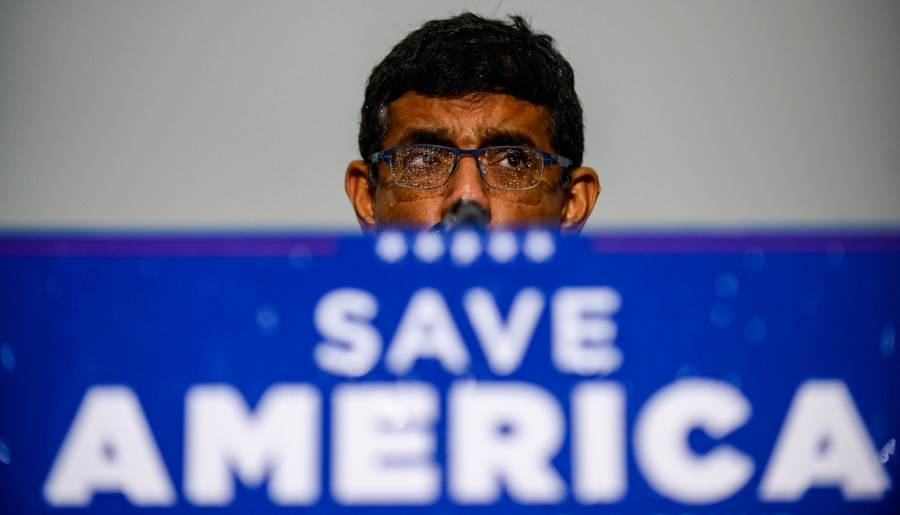
Among these is Dinesh D’Souza and his 2014 political commentary film “America: Imagine the World Without Her,” in which he introduces a character billed as Madam C.J. Walker. The character is seen giving a motivational speech to a group of women, using herself as an example that success can be had no matter the hardships.
A few Republicans and showrunners have taken it upon themselves to play fast and loose with Walker’s legacy anyway.
“I got my start by giving myself a start,” the woman says. “Ladies, there is no flower-strewn path to success. And if there is, I haven’t found it. If I’ve accomplished anything in my life, it’s because I was willing to work hard.”
Walker did give an inspirational speech at the 13th Annual Convention of the Negro Business League in 1912 in which she alluded to having overcome adversity. But she didn’t co-sign any delusions in her speech about bootstrapping one’s self to success in America.
Walker, having been excluded from the convention’s speaker lineup, instead demanded recognition for her business from conference curators and attendees. While there, she announced that her goal for her wealth was to give back, including her aspiration to build a Tuskegee Institute (America’s first historically Black college) in Africa.
D’Souza’s work left that bit out.
Instead, the Walker character in his film seems to suggest that America is the sweet land of meritocracy — slavery and its consequences be damned. Speaking as narrator, D’Souza then goes on to assert that Walker has been left out of history books because her trajectory doesn’t align with what he refers to as the “shame narrative.”
As if D’Souza’s cockamamie thesis wasn’t bad enough, Bundles recalls that the Trump White House name-checked Walker in its 2017 Black History Month statement. Nearly a year later, the then-president would refer to Haiti and nations in Africa, where Walker sought to build a school, as “s—hole countries.”
The paradox is overwhelming, and Bundles would prefer that the aforementioned politicos keep some distance from Walker’s legacy.
“Keep her [name] out of your mouth,” Bundles said of Republicans like D’Souza and Trump officials.
“Because you don’t really understand what she’s about. She was a radical,” Bundles said of her ancestor’s advocacy.
In 1917, in the wake of the riots in East Saint Louis, the National Convention of the Madam C.J. Walker Agents wrote a letter to President Woodrow Wilson urging him to take action against lynchings and to ensure Black soldiers fighting for America in World War I would be afforded civil rights upon their return.
One year later, she and journalist Ida B. Wells were referred to as “Negro subversives” in a military intelligence report. Bundles found that her ancestor had been surveilled by a Black spy, Walter H. Loving, from the war department. Walker and Wells were named in the report alongside six men whom Loving described as being “more or less agitators.” He suggested Walker, Wells and the six men be prevented from obtaining passports, Bundles writes in her biography of Walker, “On Her Ground.” By denying them passports, William E. Allen, acting director of the Bureau of Investigation, sought to stop them from raising the “Negro question” at the Paris Peace Conference in 1919. Perhaps D’Souza should have found another poster woman (people like Candace Owens exist for a reason). But D’Souza isn’t the only one to attempt to flip Walker’s legacy. Netflix’s “Self-Made” biopic was supposed to be based on Bundles’ 2002 biography, referenced above. Despite her work being the basis for the series, Bundles says it misrepresented several areas of Walker’s life, and the showrunners veered off course. Bundles wrote multiple searing op-eds in response and did interviews speaking out against the four-part series. “They really misled people about the real pieces of Madam Walker’s life — her philanthropy, her commitment to African American activism and her inspiration for other women,” Bundles said. Walker’s philanthropy was so wide-reaching that it became the cornerstone for a book on the charitable works of Black women. She made financial contributions to the National Association of Colored Women, to the NAACP and to several Tuskegee Institute students. As Bundles puts it, “she was Black Lives Matter 1.0.”
Zahara Hill is a platforms editor for MS NOW. She previously worked as a front page editor for HuffPost. Recommended