








Lately, there has been justifiable alarm over conservatives’ efforts to ban school lessons about social inequality. These attacks strike at the heart of Black history, threatening to bury it under a heap of white, revisionist excrement.
But lest we forget: The Black present and Black future are under vicious assault, as well.
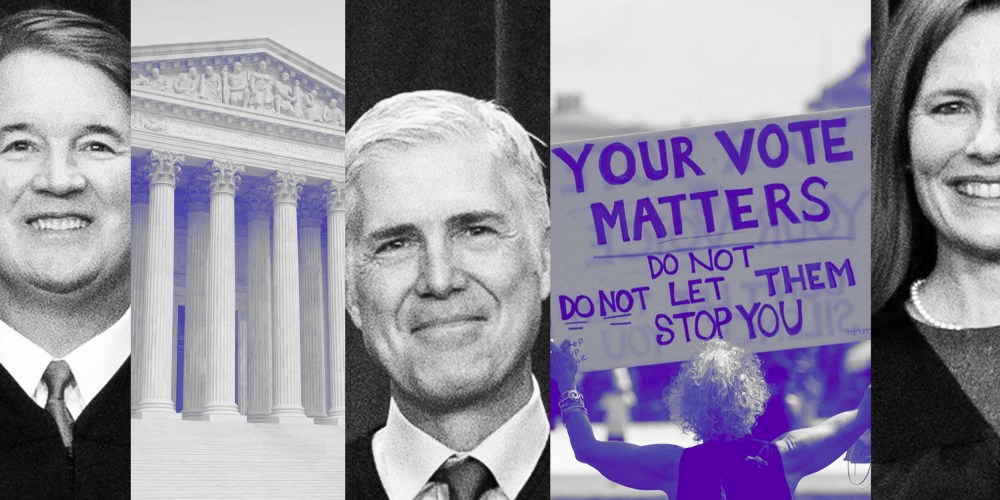
The Supreme Court ruling on Monday allowing the Alabama Legislature to move forward with its racist district maps is a prime example. The five archconservatives in the court’s majority said it would hear an appeal to a district court ruling that found the new, Republican-drawn maps illegally diminished the power of Black Alabamians.
Alabama’s Black leaders have responded accordingly.
Here’s Democratic Rep. Terri Sewell, Alabama’s only Black member of Congress:
Today’s SCOTUS order is yet another blow to the fight for fair Black political representation that is at the heart of the Voting Rights Act. The ruling allows the votes of Black Alabamians to be diluted & further undermines Section 2 of the VRA. (1/2) https://t.co/5cb5y946YD
— Rep. Terri A. Sewell (@RepTerriSewell) February 7, 2022
Here’s Alabama state Rep. Chris England, chair of the Alabama Democratic Party:
For folks that are concerned about the Voting Rights Act, today’s SCOTUS decision means that the canary in the coal mine just died. If there were ever a time for Congress to act on voting rights legislation, now would be it. Make no mistake, this is not a good outcome.
— Chris England (@RepEngland70) February 7, 2022
This erasure of Black power — now and in the future — is an implicit goal of the court’s conservatives, who have upheld racist voter restrictions, helped uphold policing policies that disproportionately harm Black people and look primed to gut race-conscious school admissions policies that counteract institutional racism.
This latest ruling is an attempt to erase Black power and Black people.
You don’t have to be a math whiz to see the oppression at work.
The percentage of white Alabamians declined over the past decade, while the percentage of Black Alabamians increased, according to census data. White people now make up around 64 percent of the state, while Black people account for about 26 percent.
Those numbers are important because Alabama Republicans drew maps that created one majority-Black district out of seven possible, seemingly defying Section 2 of the Voting Rights Act, which forbids practices that give racial minorities “less opportunity than other members of the electorate to participate in the political process and to elect representatives of their choice.”
You don’t have to be a math whiz to see the oppression at work. One out of seven is 14 percent. Black Alabamians deserve an opportunity to elect two lawmakers because their population is about double that. The Alabama district court that struck down the maps, which includes one judge appointed by then-President Bill Clinton and two appointed by then-President Donald Trump, was right to call these maps illegal. Justice Brett Kavanaugh was revealing when he wrote in his concurring opinion that the district court ruling would lead to “unfair consequences for candidates, political parties, and voters.” Kavanaugh and his fellow archconservatives see obstacles to unearned, white, totalitarian rule as unfair. As for those who suffer under it? They’re just voices in the wind. Related posts: Gosar whines over Jan. 6 committee subpoenaing his white nationalist buddy Kyrsten Sinema raked in hefty GOP donations while opposing Biden’s agenda Sarah Palin is out for blood with long shot NYT defamation lawsuit Head over to The ReidOut Blog for more.
Ja’han Jones is an MS NOW opinion blogger. He previously wrote The ReidOut Blog. Recommended


