








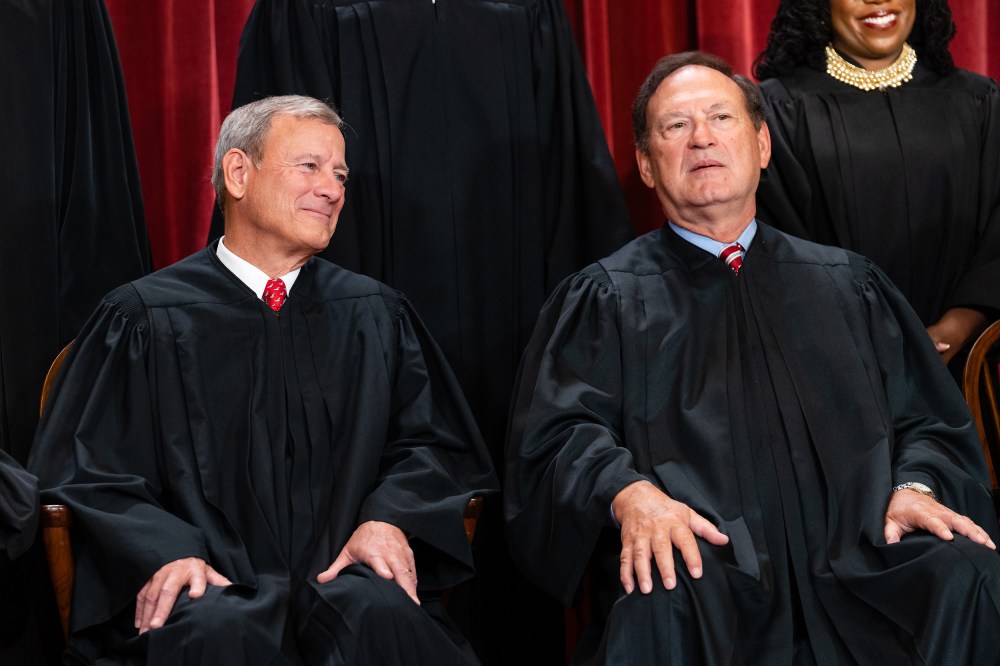
June 24 marked one year since the Supreme Court, in the landmark Dobbs case, overturned Roe v. Wade, shockingly reversing almost 50 years of precedent to strip away what had been a constitutional right to an abortion.
You see, the conservative justices in the majority of that 5-4 decision argued the Roe decision was “egregiously wrong” because the Constitution never mentioned abortion. That meant, the justices said, abortion couldn’t possibly be a constitutional right and must be left to the states.
It’s one of Republicans’ longest-running talking points: “Don’t legislate from the bench.”
Doing anything else would amount to activist judges “making things up,” or as the phrase goes, “legislating from the bench.” To hear Republicans talk, that’s pretty much the worst thing a federal judge could do.
It’s one of Republicans’ longest-running talking points: “Don’t legislate from the bench.”
Now that Republican appointees are a supermajority on the Supreme Court, you would think that this majority would steer clear of anything that might look like it was writing laws and thereby undermining the people’s representatives in Congress.
But you’d be wrong.
Today’s conservative justices are happily imposing their reactionary legislative vision on America, not just by interpreting laws, but by effectively rewriting them, in order to implement unpopular policies that could never get passed through Congress. Separation of powers be damned.
Take some of the biggest, most divisive, most consequential issues in American life right now: student loan relief, climate change, voting rights, labor laws and gun control. Now the Supreme Court decides what happens on those issues. Not you. Not me. Not our elected representatives.
Like on Friday when the Supreme Court decided 6-3 that 43 million Americans would not receive student loan relief under President Joe Biden’s plan.

The conservatives ruled the program had not been explicitly approved by Congress in the Higher Education Relief Opportunities for Students Act, or HEROES Act.
But that law allows the Education Department to “waive or modify” financial assistance programs “as the Secretary deems necessary” in a national emergency.
Like the Covid pandemic we were still in when Biden announced his plan last year.
In her dissent, liberal Justice Elena Kagan slammed her conservative colleagues, writing: “The result here is that the Court substitutes itself for Congress and the Executive Branch in making national policy about student-loan forgiveness.”
Got crippling student debt from predatory loans? Tough. The Supreme Court says you can’t get relief.
Got crippling student debt from predatory loans? Tough. The Supreme Court says you can’t get relief.
On climate change, the Supreme Court has undermined Congress and the Environmental Protection Agency twice in the last year alone.
In West Virginia v. EPA, a 6-3 majority ruled the EPA exceeded its authority by regulating carbon emissions from power plants. Chief Justice John Roberts wrote for the majority: “It is not plausible that Congress gave EPA the authority to adopt on its own such a regulatory scheme. … A decision of such magnitude and consequence rests with Congress itself.”
Except that Congress did explicitly give the EPA the authority to use the “best system of emission reduction” when it passed the Clean Air Act in the ’60s.
As Kagan put it in her dissent, “The Court will not allow the Clean Air Act to work as Congress instructed. The Court, rather than Congress, will decide how much regulation is too much.”

Then in May in Sackett v. EPA, Justice Samuel Alito wrote for the majority in a precedent-setting opinion that the Clean Water Act only allows the EPA to regulate wetlands that have “a continuous surface connection” to “waters of the United States.”
Except that’s not what the law says. The law applies to “all waters of the United States” and explicitly wetlands “adjacent” to those waters. But instead of applying the law as written, Alito just changed the meaning of the word “adjacent” to mean “adjoining.”
You want Congress to decide how to protect our air and water? Tough. The Supreme Court decides that now.
Next, look at voting rights, where in the last 10 years, the Supreme Court effectively rewrote the core protections of the historic Voting Rights Act, first passed by Congress in 1965.
In the last 10 years, the Supreme Court effectively rewrote the core protections of the historic Voting Rights Act, first passed by Congress in 1965.
Congress passed the VRA explicitly to force southern states with a history of disenfranchising Black voters through seemingly neutral voting requirements to get approval from the federal government before they could implement any new voting laws.
This “preclearance” was such a crucial part of the VRA that Congress voted overwhelmingly to extend the preclearance provision in 1982 and again in 2006.
But in 2013, a 5-4 majority led by Roberts decided that voter suppression laws were no longer a problem in those states. That ruling in Shelby County v. Holder effectively voided the preclearance provisions that Congress had voted overwhelmingly to extend just seven years earlier.
In Brnovich v. Democratic National Committee in 2021, the 6-3 majority upheld an Arizona election law that imposed burdens upon Native Americans living on reservations because the majority felt the burdens alleged were “modest when considering Arizona’s ‘political processes’ as a whole.”

As Kagan noted in her dissent, “The Court has (yet again) rewritten—in order to weaken—a statute that stands as a monument to America’s greatness, and protects against its basest impulses.”
Do you want Congress to protect voting rights and stop racist rules from suppressing minority votes? Tough. The Supreme Court is writing the laws now. Now look at labor rights, where this anti-worker, anti-union court has legislated from the bench to create new rights for corporations, and against their employees, in two major cases. In 1935, Congress passed the National Labor Relations Act, which enshrined the right of workers to join unions and to organize orderly strikes. To resolve disputes between workers and employers, the law also established the National Labor Relations Board. This court has hacked away at that system. You want Congress to protect labor rights? Tough. The Supreme Court has other policy ideas. This happened most crucially in 2018 with Janus v. AFSCME, when the Roberts court struck down the long-standing practice of mandatory union “agency fees” being deducted from employees’ paychecks. “There is no sugarcoating today’s opinion,” Kagan wrote in her dissent. “The majority overthrows a decision entrenched in this Nation’s law—and in its economic life—for over 40 years.” You want Congress to protect labor rights? Tough. The Supreme Court has other policy ideas. In the absence of much meaningful action by Congress, this Supreme Court has done more than any legislature to radically alter gun policy. In Washington, Chicago and New York state, over more than a century, lawmakers passed tailored gun regulations, but in recent years, the Supreme Court has gutted them. In 2008, in District of Columbia v. Heller, five justices struck down a Washington, D.C., handgun ban, deciding that the Second Amendment wasn’t about colonial militias but about the right of the average Joe to brandish a Glock. In 2010, that ruling was extended to the rest of the country with McDonald v. Chicago. Then in 2022, in New York State Rifle & Pistol Association Inc. v. Bruen, the court went a step further and decided that the Second Amendment also says Americans are guaranteed a right to carry guns in public, contradicting New York’s century-old law requiring gun owners to show proper cause for doing so and obtain a license. As Justice Sonia Sotomayor put it during oral arguments, “You’re asking us to make the choice for the legislature.” As liberal Justice Sonia Sotomayor put it during oral arguments, describing the implications of a court stepping in on a state’s legal turf, “You’re asking us to make the choice for the legislature.” The six conservative Supreme Court justices were more than happy to make that choice for the state Legislature. States only get to put limits on really dangerous things, like voting rights and abortion. You want Congress to stop mass shootings? Tough. This Supreme Court is calling the shots. Making the choice for the legislature — that’s exactly what this Supreme Court now does, on a regular basis, and on a range of key issues. It takes issues decided by the people’s representatives and then re-decides them in a manner that pleases the conservative supermajority on the bench. So an elected, and Democratic-controlled, Congress can write and pass a progressive law, but an unelected and very conservative Supreme Court can just rewrite it. Confidently. Brazenly. Shamelessly. These are not neutral judges. These are politicians in robes. This op-ed is an adaptation of a segment of “The Mehdi Hasan Show” on Peacock on June 22.
Mehdi Hasan
Mehdi Hasan is host of "The Mehdi Hasan Show" on Peacock and an MSNBC political analyst. He is a former senior columnist for The Intercept, for which he launched the "Deconstructed" podcast. He was also the presenter of "UpFront" and "Head to Head" on Al Jazeera English. He is the author of two books and the winner of the Society of Professional Journalists' 2018 Sigma Delta Chi Award for Online Column Writing. Recommended


