








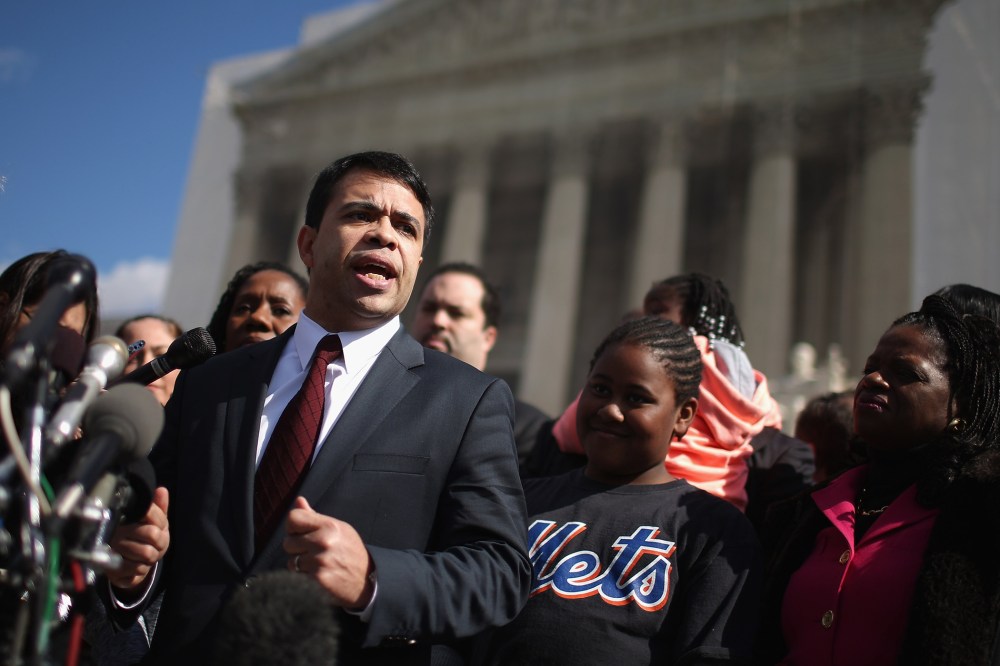
This week, the Senate blocked President Barack Obama’s Justice Department pick after Republicans took issue with the nominee’s previous work in representing a client convicted of murdering a police officer in the early ’80s.
Debo Adegbile spent more than a decade working for the NAACP’s Legal Defense Fund where he was the in-house voting rights expert, but on Wednesday his confirmation to lead the DOJ’s civil rights division failed by a 52-47 margin; seven Democrats broke from their party leadership to vote against the confirmation.
Sen. Tom Harkin, an Iowa Democrat, took to the Senate floor to lambaste his colleagues for blocking Adegbile. “Maybe we all ought to go back and watch that movie, To Kill a Mockingbird, read the book, watch the movie, and know what it is to stand up against the powers of the government and defend someone who’s unpopular,” said Harkin. “And Mr. Adegbile didn’t even do that. He was not the defense attorney. He was only on an appeal.”
The controversy over Adegbile’s nomination stems from the case of Mumia Abu-Jamal, who was convicted of murdering a Philadelphia police officer in 1981. Decades after Abu-Jamal’s conviction, Adegbile was part of the NAACP LDF team that successfully persuaded a federal court to commute his death sentence.
Harkin pointed to the “terrible double-standard” in Adegbile’s blocked confirmation as lawmakers noted the times other nominees managed to sail through the Senate without seeing their client-history be used against them.
“The truth is many lawyers–not all of them–represent unpopular clients at some point in their causes and in their careers,” Senate Majority Leader Harry Reid said, pointing to Supreme Court Justice John Roberts. The chief justice provided pro bono assistance to defend a Florida man convicted of murdering eight people. But unlike Adegbile, Roberts was confirmed by the Senate in 2002 by a margin of 78-22. No Republican voted against his nomination and Democrats were split, 22-22.
“That was not brought up during his confirmation hearing by us, because he had a job to do,” Reid said of Roberts’ work on the case. “And as he said, advocacy on behalf of a client is not about overturning the rule of law, but about vindicating the rule of law.”
Harkin warned Wednesday’s vote was going to have a chilling effect on young attorneys who might want to avoid taking on controversial cases.
“If you are a young black person and you go to work for the NAACP Legal Defense Fund and they assign you under your obligations as an attorney–in keeping with your oath of office–they assign you to appeal a case of someone who committed a heinous murder, and you do that and you sign your name on the appeal… What the message said today is don’t do it,” he said. President Obama said that the failed vote was a “travesty based on wildly unfair character attacks against a good and qualified public servant.” But Adegbile is not the first to see his career affected by the backlash to Abu-Jamal’s case. Civil rights activist and attorney Van Jones lost his job at the White House, in part, due to his support for a new trial for Abu-Jamal. Kathy Boockvar was a Democratic congressional candidate in Pennsylvania who lost her 2012 campaign after a series of robocalls linking her husband to Abu-Jamal’s literary agent. The question that lingers now is if Adegbile and President Obama can garner the political support needed to launch a second effort for the nomination at the Justice Department.
Ariana Pekary Recommended


