








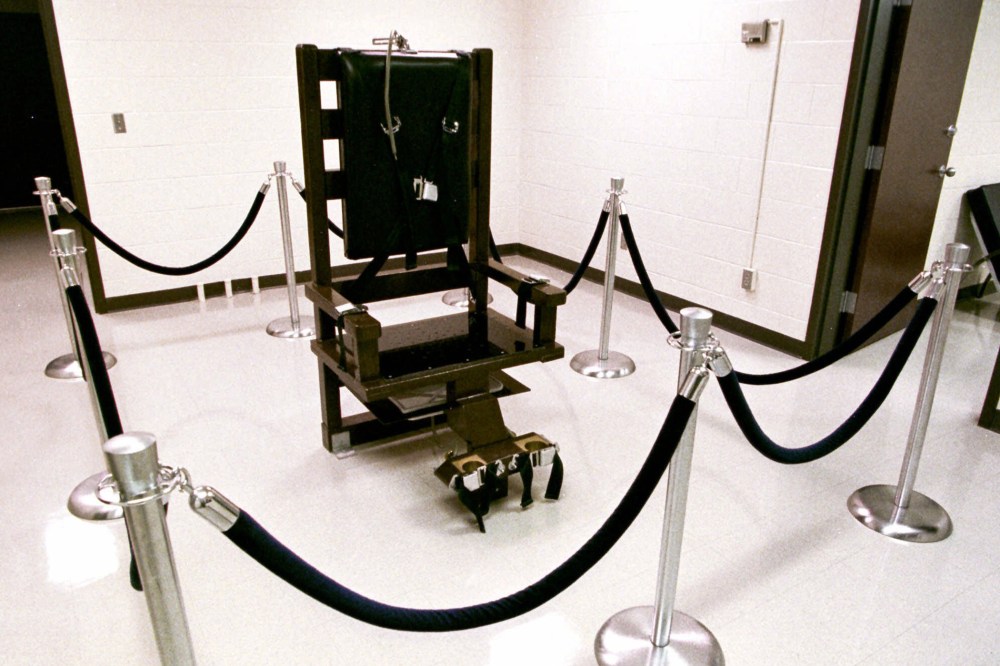
“It’s unfortunate that Tennessee has decided to take a step back,” said Kelley Henry, who supervises capital punishment cases for the Federal Public Defender’s office in Nashville, Tenn.
Henry was responding to the news that on Thursday evening, Tennessee’s Republican Governor Bill Haslam signed a bill authorizing the state to use the electric chair if the drugs needed for lethal injection are unavailable for executions — a problem that, after Oklahoma’s botched execution on April 30, is receiving national attention. Henry continued, “But I believe the electric chair, in and of itself, is unconstitutional.”
Henry represents several of the state’s death row inmates, including Edmund Zagorski, who is second-in-line to be executed by the state of Tennessee. Zagorski’s sentence is due to be carried out on Dec. 9 according to the Tennessee Department of Corrections. He was convicted in 1984 of two counts of felony murder.
Ahead of Zagorski on Tennessee’s death row is Billy Ray Irick who is scheduled to be executed on Oct. 7. Irick was convicted for the 1985 rape and murder of a seven-year-old girl in Knoxville, Tenn. Irick’s attorney, Gene Shiles, said whether the state will use lethal injection or the electric chair on his client remains in limbo because of ongoing litigation. Shiles charged that Tennessee officials are refusing to disclose the materials the state would use to execute his client, their source, the planned procedure, and the personnel who would be involved.
Shiles told msnbc that the use of electrocution in the state will need to be litigated calling the method “cruel and unusual,” adding that “its consideration is an indictment of our culture.”
Shiles’s concerns were echoed by the Executive Director of Tennesseans for Alternatives to the Death Penalty, Rev. Stacy Rector, who is also an ordained Presbyterian minister. Rector told msnbc, “We have evidence of it being ghastly and horrible, and we’ve heard stories of people who have witnessed an inmate catching on fire.”
Rector was referring to a 1997 Florida execution in which “a mask worn by an inmate who was being executed caught fire, sending foot-long flames into the air and filling the execution chamber with smoke,” according to The New York Times.
“That’s a part of this that the public doesn’t think as much about; who are the correctional officers who have to carry these sentences out?” Rector said. “The toll that, mentally and morally, this takes on those people.”
Rector also said that the courts will have to deal with this issue, adding, “We do have standards in this country about what is cruel and unusual punishment.”
Rector signaled that her group is seeing more and more legislators in the state question the use of the death penalty as a whole, but said there is still a long way to go. “What we hope is that the governor will not simply sign this bill and move on,” she said. “We encourage him to look at what’s happening around the country and hopefully start asking some hard questions.”
Rector does not believe it is possible to ever execute anyone fairly. “I do not believe the system can ever be appropriately run,” she said. “For me it makes no sense, on any level, to execute citizens.” David Smith, spokesman for Governor Haslam, pointed out that the bill authorizing the state to use the electric chair passed easily in the state legislature — the vote was 23-3 in the Tennessee Senate and 68-13 in the House. He also made a point to mention the fact that “this was not a bill brought by the (Governor’s) administration.” Smith also told msnbc that the state’s Attorney General Robert E. Cooper deemed the legislation constitutional. That opinion, released back in March, speaks directly to the argument that use of the electric chair constitutes cruel and unusual punishment in violation of the Eighth Amendment. Attorney General Cooper cites that its use has been upheld both by the Supreme Court and the Sixth Circuit Federal Court of Appeals. What the state Attorney General’s opinion fails to note is that, according to the Associated Press, it was 1890 when the Supreme Court upheld the use of the electric chair. As for the Sixth Circuit decision mentioned, that occurred in 1997, and while it may have been true in 1997 that no American court had ruled the use of the electric chair unconstitutional, it isn’t true now. In a six-to-one decision from February 2008, Nebraska’s Supreme Court ruled that use of the electric chair constituted cruel and unusual punishment. In that majority opinion, Justice William M. Connolly wrote, “The evidence here shows that electrocution inflicts intense pain and agonizing suffering.” Attorney General Cooper notes that 2008 Nebraska decision at the end of his opinion adding that the cruel and unusual punishment language of Nebraska’s state constitution “mirrors that of the federal and Tennessee Constitutions.”
Nick Ramsey
Nick Ramsey is a senior producer with MSNBC’s “The Last Word with Lawrence O’Donnell.” Recommended


