








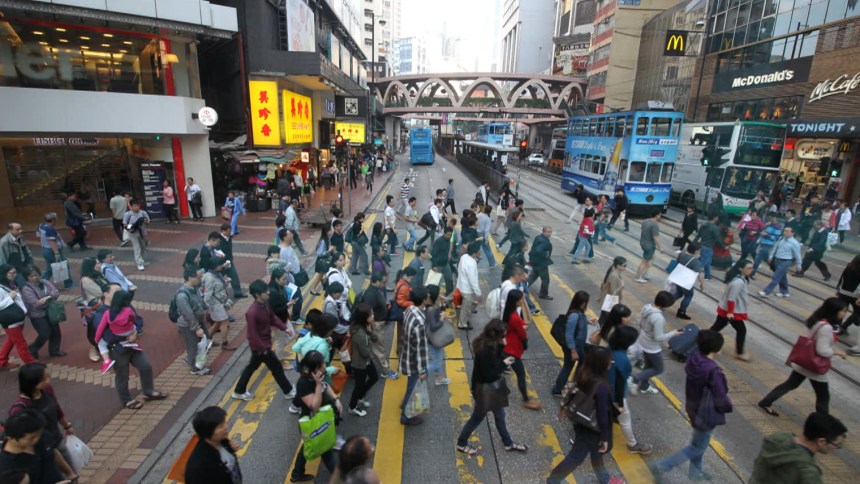
Hong Kong’s chief executive—appointed by Beijing—called on organizers to stop the protests “immediately” as the protesters up their demands ahead of a two-day national holiday.
“Occupy Central founders had said repeatedly that if the movement is getting out of control, they would call for it to stop,” executive Chun-ying Leung said in his first remarks since police used tear gas against the growing protest movement on Sunday night, The New York Times reported. “I’m now asking them to fulfill the promise they made to society and stop this campaign immediately.”
Leung didn’t say whether he’d compromise on any of the protesters’ calls and the protesters, who have blocked major streets in three parts of the cities since Friday, upped their demands. In addition to their calls for more open elections, they’re also calling for Leung’s resignation.
If their demands are not met by Wednesday, the protesters said the movement would grow and spread. Hong Kong will celebrate a two-day national holiday starting Wednesday, which may fuel protests, Bloomberg reported.
PHOTO ESSAY: Pro-democracy demonstrations in Hong Kong
The calls to shut down the protests comes the day after police opted to let protesters gather peacefully on Monday night, a radical shift in tactics from Sunday’s demonstrations when police used tear gas, batons, and pepper spray against the protesters. Many attempted to block the gas using umbrellas; hence the demonstrations’ nickname, the “Umbrella Revolution.”
The protests have shut down parts of the city; some schools and banks closed on Monday, while some businesses told employees to stay home from work. Government officials announced through China’s state-run media that a large fireworks display in Hong Kong planned for a major Chinese holiday Wednesday would be canceled.
An official with the Hong Kong police defended officers’ use of aggressive tactics over the weekend. But protesters told reporters they were rallying peacefully when the violence broke out. From Sunday to Monday, the number of protesters increased from thousands to tens of thousands in what’s being called an unprecedented show of civil disobedience for the city.
“One country, two systems”
The protesters, predominantly a mix of students and activists, including a group that calls itself Occupy Central, are demanding democratic reforms from Beijing. The Chinese government took over sovereignty of the former British colony in 1997. Since then, Hong Kong has remained a semi-autonomous territory with much greater civic and financial freedom than mainland China.
The relationship is known as “one country, two systems,” and has created two very different realities in Hong Kong and mainland China. As government officials have exercised tighter and tighter control on the mainland, Hong Kong has enjoyed a relatively free press, a westernized legal system, and a robust capitalist economy. As a result, Hong Kong has “thrived … drawing international business in a way that Shanghai, for all its success, still cannot,” according to The Washington Post.
In effect, the “one country, two systems” relationship has allowed Hong Kong to both be, simultaneously, a part of China and nothing like the rest of the country for nearly three decades.
Protesters say these demonstrations are a direct reaction to Beijing asserting greater control in Hong Kong’s affairs, especially in recent months:
And while that same white paper reaffirmed the Chinese government’s promise of free and fair elections in Hong Kong by 2017, it also said that “[l]oving the country is the basic political requirement for Hong Kong’s administrators.” That includes the top leader of Hong Kong known as the chief executive. The paper also indicates that the chief executive will “be accountable to the central government” and be “subject to oversight by the central government.” That is in stark contrast to how those behind Occupy Central view the “one country, two systems” relationship. In a post on its English-language blog, the group stated that when “one country, two systems” was proposed thirty years ago the Chinese government promised Hong Kong a “high degree of autonomy.” The post continues, “Those promises have never been fulfilled and democracy in Hong Kong is stifled.” The final straw After the white paper’s release, the Chinese government declared in August that all candidates for chief executive must receive the approval of a committee of Chinese government loyalists. For the protesters now collected in Hong Kong’s streets, that was the final straw. First came students boycotting classes, then demonstrators spilled into the streets, and then their numbers multiplied. As one student protester told the Associated Press, “We have a simple message, it’s that we want democracy and a fair voting of choosing our Chief Executive of Hong Kong.” U.S. officials have voiced their support for the demonstrations. White House Press Secretary Josh Earnest told reporters that voters in Hong Kong deserve a “genuine choice of candidates” and urged the city’s officials to “exercise restraint” in reacting to the protests. State Department spokesperson Jen Psaki echoed those remarks, saying the United States “support[s] universal suffrage in Hong Kong … and we support the aspirations of the Hong Kong people.” Chinese officials in Beijing are likely concerned the calls for more democracy could spread to the mainland, therefore news of the protests has reportedly been censored by the Beijing on television and online, including social media. Demonstrators are calling for the resignation of the city’s current Chief Executive Leung Chun-ying, and as they remain in the streets it is creating a stalemate with government officials. “We are not scared,” 55-year-old civil service worker Carol Chan told the Associated Press. “We are not frightened, we just fight for it.”
Jane Timm
Nick Ramsey
Nick Ramsey is a senior producer with MSNBC’s “The Last Word with Lawrence O’Donnell.” Recommended


