








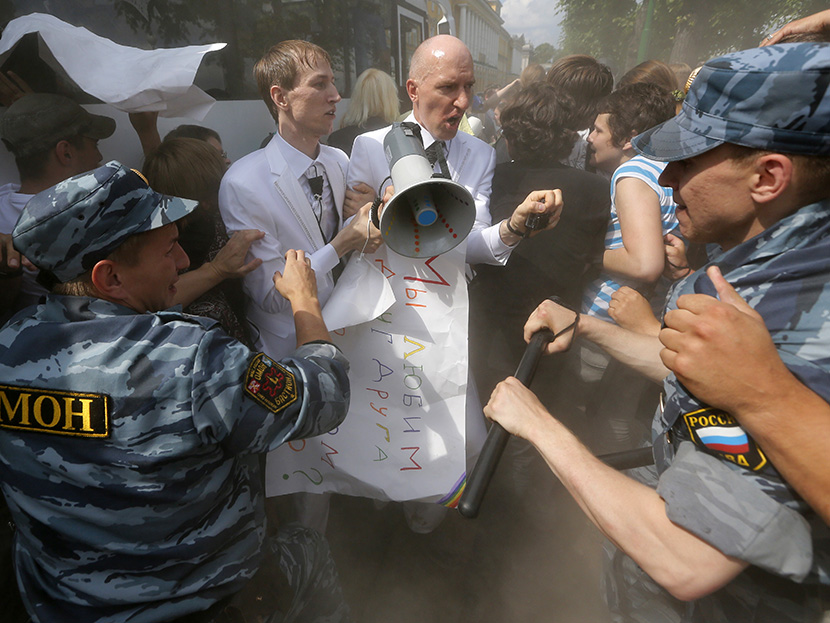
The LGBT community is stepping up its efforts to call attention to Russia’s draconian new anti-gay laws, calling for a boycott of the country’s most prized commodity–vodka–and in some instances, a full-fledged boycott of the upcoming Olympic Games.
Gay bars across the country are declining to serve Russian vodka brands, like Stolichnaya. Sex columnist (and Rick Santorum nemesis) Dan Savage first called for a boycott of Russian vodka, and a growing number of LGBT advocates like the group Queer Nation are saying they support this tactic.
“To show our solidarity with Russian queers and their allies and to help to draw international attention to the persecution of gay men, lesbians, bisexuals, trans people, and straight allies in Putin’s increasingly fascistic Russia: Dump Russian vodka,” Savage wrote in a blog post last week. He specifically called out Stolichnaya using the hashtag “#Dumpstoli” and “DumpRussianVodka” on social media.
In response to the campaign, SPI Group CEO Val Mendeleev wrote an open letter to the LGBT community, reiterating the company’s ongoing support of gay rights and slammed the “recent dreadful actions” of the Russian government.
“We fully support and endorse your objectives to fight against prejudice in Russia. In the past decade, SPI has been actively advocating in favor of freedom, tolerance and openness in society, standing very passionately on the side of the LGBT community and will continue to support any effective initiative in that direction,” said Mendeleev. He also noted the company has sponsored gay pride rallies in cities like Miami, Durban and Vienna, among other efforts to further gay rights.
A new bill signed into law last month by Russian President Vladimir Putin bans the “propaganda of nontraditional sexual relations.” Public displays of affection, events promoting gay rights like pride rallies, being gay or being suspected gay could land citizens and tourists in jail. The recent arrests of four Dutch tourists–-and increased violence against gay supporters–further fueled concern over what could happen when hundreds of thousands of athletes and tourists make the pilgrimage to Sochi for the 2014 Winter Olympics.
In a recent op-ed for The New York Times, actor and playwright Harvey Fierstein said, “so far, the world has mostly been silent” on Putin’s “war on homosexuals.” He accused the Russian government of employing “a strategy of demonizing a minority for political gain taken straight from the Nazi playbook.”
Fierstein called upon the U.S. and the rest of the world to fight back against Putin’s efforts to “criminalize homosexuality” by threatening to boycott the Games and demanding the retraction of these laws. “American and world leaders must speak out against Mr. Putin’s attacks and the violence they foster. The Olympic Committee must demand the retraction of these laws under threat of boycott,” he wrote.
RUSA LGBT, a Russian-American gay rights group, also announced their support for a boycott of the Games in Sochi.
The International Olympic Committee tried to address complaints, stressing they’ve “received assurances from the highest level of government in Russia that the legislation will not affect those attending or taking part in the Games.” IOC media relations manager Sandrine Tongue told msnbc, “The Games themselves should be open to all, free of discrimination, and that applies to spectators, officials, media and of course athletes. We would oppose in the strongest terms any move that would jeopardize this principle.”
Human Rights Campaign President Chad Griffin said these verbal assurances from Putin’s government are simply “not enough.”
“The IOC must obtain ironclad written assurance from President Putin,” Griffin said in statement issued on Friday. “More importantly, they should be advocating for the safety of all LGBT people in Russia, not simply those visiting for the Olympics. Rescinding this heinous law must be our collective goal.”
HRC did not go as far to call for a formal boycott of the Olympic Games or Russian exports. In a letter, the gay rights group put the pressure on NBC, who owns the exclusive rights to broadcast the Olympics in the United States, to “expose” Russia’s “inhumane and unjust” laws to its American viewers. While remaining vague on specific coverage plans, NBC Sports chairman Mark Lazarus told reporters on Saturday, “We’ll address it at the time because it’s still unfolding.” He added, “If it is still their law and it is impacting any part of the Olympics Games, we will make sure that we acknowledge it and recognize it.” (Editors note: msnbc and NBC Sports are both owned by the parent company NBC Universal.) Some openly gay athletes have no intention of giving up their Olympic ambitions just yet. In an op-ed published in the Falls Church News-Press, U.S. figure skating star and Olympian Johnny Weir urged the international community not to boycott Sochi over Russia’s “heartbreaking” anti-gay laws and “support the athletes.” “I beg the gay athletes not to forget their missions and fight for a chance to dazzle the world,” he wrote. “I pray that people will believe in the Olympic movement no matter where the event is being held, because the Olympics are history, and they do not represent their host, they represent the world entire. People make their own futures, and should a government or sponsor steal that future, whether it be the Russian government or American government, it is, as an athlete, the death and total demolition of a lifetime of work.” If he gets to compete at the 2014 Games, New Zealand speed skating hopeful Blake Skjellerup said he already plans to wear his rainbow flag pin as a symbol of gay pride. “If it gets me in trouble, then I guess so be it.” In 1980, President Jimmy Carter famously led the charge for a boycott of the Summer Games in Moscow in protest of the former Soviet Union’s invasion of Afghanistan. About 50 countries opted out of competition that year. Perhaps to return the favor, the U.S.S.R. boycotted the 1984 Summer Olympics in Los Angeles, citing security concerns.
Sarah Muller Recommended


