








Responsible for initiating The New Deal, President Franklin D. Roosevelt is often touted as the great realizer of Keynesian economics. But FDR didn’t always believe in the theory that government spending could help pull the country out of hard economic times.
Mike Konzcal of The Next New Deal, with the help of folks over at the FDR Presidential Library, have uncovered a fascinating piece of historical skepticism in Roosevelt’s old copy of William Foster and Waddill Catchings’ The Road to Plenty (1928), a book that put forward a prototype of Keynes’ “General Theory” eight years before the famous economist formalized it himself. Inside the front cover, under his name and the date, Roosevelt scrawled: “Too good to be true–you can’t get something from nothing.”
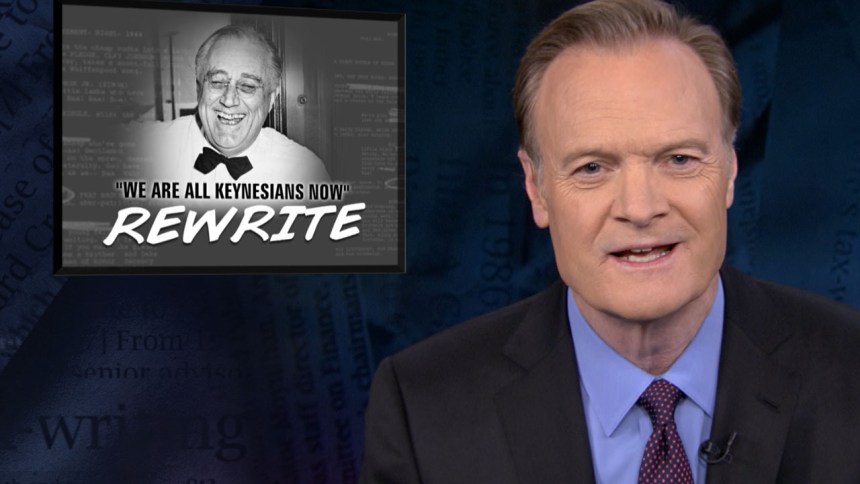
Eventually Roosevelt’s skepticism faded. As msnbc’s Lawrence O’Donnell noted in the Rewrite Tuesday, “by the time Roosevelt took the oath of office as president in 1933, he had in effect become a Keynesian, a follower of the most prominent advocate of government spending during a recession.”
Roosevelt’s change in opinion was evident in his first inaugural address in 1933: “Our greatest primary task is to put people to work. This is no unsolvable problem if we face it wisely and courageously. It can be accomplished in part by direct recruiting by the government itself, treating the task as we would treat the emergency of a war, but at the same time, through this employment, accomplishing greatly needed projects to stimulate and reorganize the use of our natural resources.”
The success of The New Deal, a program based philosophically on Keynes’ theory, was an important lesson for those who lived through that era. It prompted Republican Richard Nixon to say in 1971, “I am now a Keynesian in economics.” Even Milton Friedman, the conservative economist, admitted famously in 1965, “We are all Keynesians now” (though later he said he was quoted out of context).
“It was just a matter of fact,” said O’Donnell, “like that moment when we all realized our planet was round. It seemed there was no going back.” So why was there such a Republican backlash when President Obama put forward the Recovery Act, also known as the stimulus package, in 2009? O’Donnell argues that Republicans were reacting to the man in office more than the tried-and-true method of stimulus spending. “Once Barack Obama proposed the tried-and-true use of Keynesian economics to confront our recession, Republicans were unanimously opposed,” he said. “At no point during his presidency has Barack Obama gone on record on the matter of planet earth being round and so Republicans have not yet been forced to change their minds about that.” Check out Roosevelt’s copy of The Road to Plenty with his two line review below, courtesy of TheNextNewDeal.net via the FDR Presidential Library:
Evan Puschak Recommended


